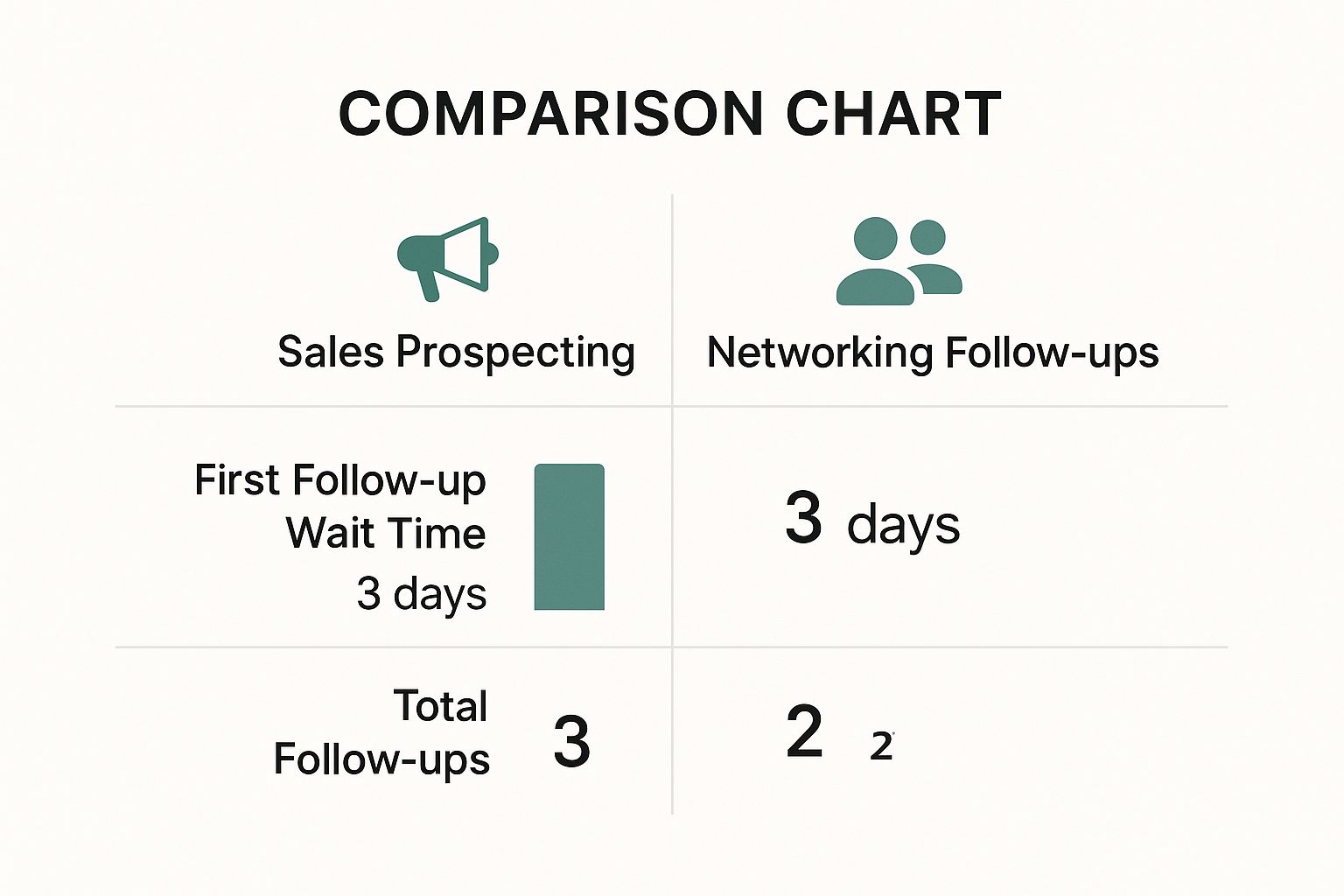
Tag: follow up email

  • No Response Follow Up Email Strategies That Work

    No Response Follow Up Email Strategies That Work

    A no response follow up email is your secret weapon for turning radio silence into a real conversation. Think of it as a brief, strategic nudge sent after your first email goes unanswered, designed to gently resurface in your recipient's inbox and dramatically boost your chances of getting a reply.

    Why Your Follow-Up Email Is Your Strongest Tool

    Let's get real for a moment: most first emails are just the opening act. An ignored email isn’t a dead end—it's an opportunity. The modern inbox is an absolute battlefield for attention. With the average professional getting hit with over 120 emails a day, it’s just plain easy for a good message to get buried.

    A smart follow-up acknowledges this reality. Thoughtful persistence isn't annoying; it's genuinely helpful. Decision-makers are busy, and they often welcome a gentle reminder because your first email might have just shown up at the wrong time or slipped through the cracks.

    The Power of Professional Persistence

    Sending a follow-up isn't about being pushy. It’s about being professional. It shows you value the potential connection and are confident in what you’re offering. I like to think of it less as a "reminder" and more as a simple continuation of the conversation.

    The single biggest mistake in outreach is giving up too soon. Silence is rarely a definitive 'no.' More often, it's just a 'not right now.' A well-crafted follow-up is what bridges that gap.

    This simple act of circling back can completely change your engagement rates. The data doesn't lie. Most replies don't come from the first message. In fact, one study I often refer back to found that over 50% of all replies to cold email campaigns were triggered by follow-up emails, not the initial outreach. If you want to dive deeper, learning more about these compelling cold email statistics really drives home the impact of persistence.

    Before we get into the templates, let's look at the numbers and what they mean for your strategy.

    The Impact of Following Up At a Glance

    This table breaks down why a solid follow-up strategy is non-negotiable for anyone serious about outreach. The stats make a clear case for not giving up after one try.

    Metric Key Statistic What This Means For You
    Replies from Follow-Ups 50%+ Over half of your potential conversations are waiting in your follow-ups. Skipping them means leaving the majority of your results on the table.
    Campaign Success Up to 27% reply rate Campaigns with 4-7 follow-ups significantly outperform those with only 1-3. Persistence pays off directly in your reply rates.
    Inbox Overload 120+ emails/day Your first email is easily missed. A follow-up gives you a second (or third) chance to be seen by a busy prospect.
    Giving Up Too Soon 44% of salespeople Nearly half of salespeople give up after just one follow-up, creating a massive opportunity for those who are willing to be more persistent.

    The takeaway here is simple: if you're not following up, you're competing with less than half of your potential.

    This isn’t about just blasting more emails into the void. It’s about building a thoughtful sequence that adds a little more value with each touchpoint. Every follow-up is a fresh chance to:

    • Provide Context: Briefly and politely remind them why you reached out.
    • Offer New Value: Share a relevant article, a quick tip, or a powerful case study.
    • Simplify the Ask: Make your call to action even clearer and easier to act on.

    When you adopt this mindset, you can turn that initial silence into a genuine conversation and massively improve your odds of getting that all-important reply.

    Mastering the Timing and Cadence of Your Follow Ups

    When you send a follow-up is just as crucial as what you write. I’ve seen incredible messages fall flat simply because the timing was off. The real art is finding that sweet spot between being helpfully persistent and just becoming an inbox pest.

    Silence doesn't always mean "no." Sometimes, your email just got buried. Other times, the person saw it but got pulled into a meeting. A well-timed no response follow up email respects their busy schedule while gently popping your message back to the top of their list.

    The Critical First Follow Up Window

    The timing of your very first follow-up is the most important one. Jump the gun, and you look desperate. Wait too long, and they've already forgotten your original email. Through years of trial and error, I've found the ideal window is 2-3 business days after your initial outreach.

    This short pause gives them enough time to read and process your message without letting it get lost in the digital abyss. It establishes a professional rhythm that says you're on top of things, but not pushy.

    Silence is rarely a hard 'no.' More often, it's a 'not right now.' Your follow-up timing is what helps you determine the difference and stay top-of-mind for when 'right now' happens.

    The data backs this up, too. That little window between emails can make a huge difference. For instance, waiting three days before that first nudge can boost reply rates by a whopping 31%. But if you delay for more than five days, you're looking at a 24% drop in responses. You can dig into more of these fascinating cold email statistics and their impact to see for yourself.

    Building a Professional Follow Up Cadence

    One follow-up is good, but a planned-out sequence is what separates the pros from the amateurs. You need a cadence—a schedule for your follow-up attempts. This keeps you from sending random, one-off messages and makes every touchpoint feel deliberate.

    A rookie mistake is firing off follow-ups too close together. A much better strategy is to gradually increase the time between each email. This approach keeps you on their radar without completely overwhelming them.

    This simple visual breaks down the core rhythm: send, wait, then follow up.
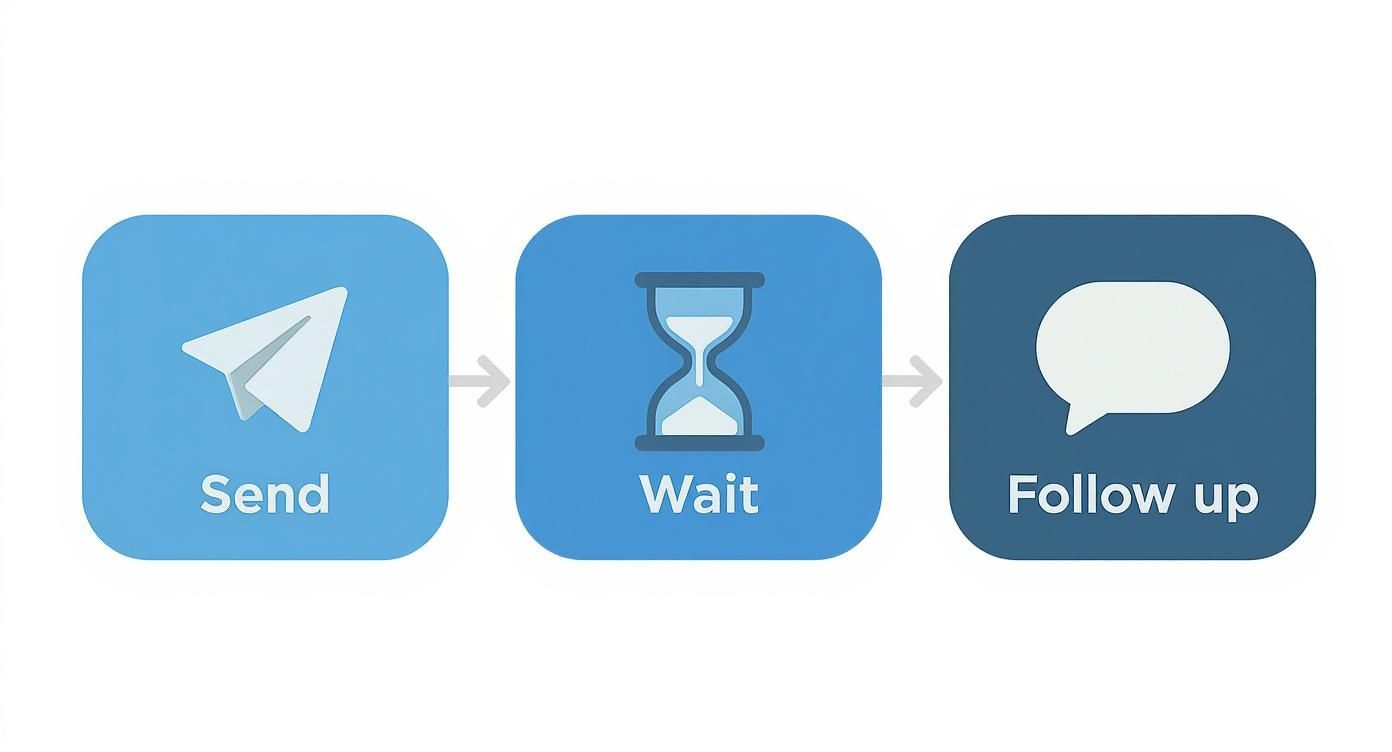
    An infographic showing a three-step process: Send (paper airplane), Wait (hourglass), and Follow up (speech bubble).

    The key thing to remember is that the 'wait' period isn't just a passive delay; it's an active part of your strategy.

    Here’s a practical, multi-touch cadence that I've seen work wonders for B2B sales and general outreach:

    • Follow-Up 1: Send 3 days after the initial email.
    • Follow-Up 2: Send 5 days after the first follow-up.
    • Follow-Up 3: Send 7 days after the second follow-up.

    If you get radio silence after three attempts, it's usually best to press pause on that sequence. This schedule gives your contact plenty of breathing room while still giving you multiple, well-spaced chances to connect. It strikes that perfect balance, making sure your no response follow up email lands with professional grace every time.

    Field-Tested Follow Up Email Templates That Get Replies

    We’ve all been there. Staring at a sent email, waiting for a reply that never comes. The temptation to just send a generic "just checking in" is strong, but it's also a fast track to the trash folder. Let's ditch that approach.

    To help you get unstuck, I’ve pulled together a few of the exact, field-tested templates I use every day. Think of them less as copy-paste formulas and more as battle-tested frameworks. They’re built on real human psychology to re-engage your prospect without being annoying.

    Of course, the golden rule is to never be generic. A little personalization goes a long way in showing you’ve actually done your homework. Use these templates as your starting point, but always add your own voice.

    A flat lay of a workspace with a laptop, notebook, pen, and a 'FOLLOW UP TEMPLATES' speech bubble.

    Template 1: The Quick Bump

    This is your first move, usually 2-3 days after your initial email goes unanswered. It's designed to be light, polite, and respectful. The whole point is to assume they’re just swamped—because most people are.

    It works because it isn’t demanding. It’s a simple nudge that brings your original message right back to the top of their inbox.

    Subject: Re: [Original Subject Line]

    Hi [First Name],

    Just wanted to quickly follow up on my email about [briefly mention original topic].

    I know how easy it is for things to get buried in a busy inbox. Just wanted to gently bump this to the top for you.

    Best,
    [Your Name]

    This template is all about being low-pressure. It gives them context without making them dig through their inbox, making it super easy to fire back a quick reply. If you need some inspiration for that first email, these https://emailscout.io/cold-email-example/ offer a great look at what actually gets opened.

    Template 2: The Value-Add

    Okay, so the quick bump didn't work. Time for a new tactic. Instead of asking for their time again, you’re going to give them something useful. This move instantly repositions you from a salesperson to a helpful resource. It's a perfect play for your second or third follow-up.

    Subject: A resource for [Their Company Name]

    Hi [First Name],

    Following up on my last note about [original topic].

    I actually came across this [article/case study/report] today and immediately thought it might be relevant to your work on [mention a specific project or goal of theirs]. It has some great insights on how to [achieve a specific positive outcome].

    No reply needed, just thought it might be helpful.

    Cheers,
    [Your Name]

    The real magic here is in its selflessness. By saying "no reply needed," you remove all the pressure, which—paradoxically—often makes people want to reply out of genuine appreciation.

    Template 3: The Breakup Email

    You've sent a few polite, value-driven follow-ups, but you're still hearing crickets. It's time to close the loop with the "breakup" email. This one works surprisingly well because it taps into a powerful psychological trigger called loss aversion.

    By politely signaling you're going to stop contacting them, you create one last chance for them to act if they ever had even a flicker of interest.

    Subject: Closing the loop

    Hi [First Name],

    I've reached out a few times about [original topic] but haven't heard back, so I'll assume this isn't a priority for you at the moment.

    I won't follow up on this again, but please don't hesitate to reach out if things change down the road.

    All the best,
    [Your Name]

    This approach is pure professionalism. It shows you respect their time and inbox, leaving the door open on a positive and memorable note. For more ideas on handling different follow-up situations, check out these 7 Sample Follow-Up Email After No Response Templates.

    Choosing Your No Response Follow Up Email Template

    To make it even clearer, here’s a quick breakdown of when to pull each template out of your toolkit.

    Template Name Best For Key Goal Tone
    The Quick Bump First follow-up (2-3 days after) Gentle reminder & easy reply Polite & brief
    The Value-Add Second or third follow-up Build credibility & offer help Resourceful & generous
    The Breakup Email Final follow-up (after 3-4 attempts) Prompt a final decision Professional & respectful

    Having a few distinct plays like this for your no response follow up email strategy is a game-changer. It lets you create a thoughtful sequence that adapts to the silence, rather than just hitting "send" on the same boring message again and again.

    Common Follow-Up Mistakes That Land You in Spam

    Even a perfectly crafted no response follow up email can misfire and tank your sender reputation if you’re not careful. Let’s be honest, many follow-ups are doomed from the start, loaded with rookie mistakes that get them instantly deleted—or worse, flagged as spam. Avoiding these common traps is just as crucial as knowing what to write in the first place.

    When your email lands in the spam folder, it's not just a wasted effort. It actively hurts your chances of reaching anyone's inbox down the road. The goal is to be persistent without being a pest, and that's a fine line to walk.
    Computer screen displaying 'AVOID SPAM' and an email icon, with crumpled paper on a wooden desk, symbolizing email management.

    Vague Subject Lines and Lazy Language

    Want a one-way ticket to the trash folder? Use a lazy, generic subject line. Phrases like "Just checking in" or "Following up" scream low effort and offer zero value to the person reading it. They give no context and force the recipient to do the mental gymnastics of remembering who you are and what you wanted.

    Just as bad is using passive-aggressive or guilt-tripping language.

    Avoid phrases like, "Just bumping this to the top of your inbox." It can come across as entitled and impatient, which is rarely a good look.

    The solution is simple: always reply in the same thread to keep the conversation history intact. And for your subject line? Add a new piece of information or a clear question to make it worth their while to open.

    The Failure to Personalize and Add Context

    Blasting out a generic, impersonal follow-up is another huge mistake. An email that just repeats the same request without adding anything new feels automated and spammy. You have to remind them of the original context and then give them a fresh angle or a new piece of value.

    It's shocking how few sales pros actually follow up, especially when the data proves it works. Industry benchmarks show that a staggering 48% of reps never even send a second message, and 44% give up after just one attempt. This massive drop-off is a huge opportunity for anyone willing to follow up thoughtfully. You can dig into more of these B2B cold email statistics on martal.ca.

    Here are a few common slip-ups that will absolutely destroy your deliverability:

    • Forgetting Context: You don't reference the original email or your last conversation.
    • No New Value: You're just nagging them with the same ask over and over.
    • Incorrect Contact Info: You're sending messages to outdated or wrong email addresses, causing high bounce rates.

    Ultimately, a massive number of follow-up failures happen before you even hit "send." Blasting emails to unverified addresses is one of the fastest ways to destroy your domain's reputation. We put together a guide on how to verify emails before you start your outreach—it’s a crucial step to protect your deliverability.

    Using EmailScout to Supercharge Your Outreach

    Let's be honest. All the clever templates and perfect timing in the world are completely worthless if your emails just land in a dead inbox. A truly great no response follow up email strategy starts long before you ever write a single word—it begins with a clean, verified list of contacts.

    This is exactly where having the right tool becomes your biggest advantage.

    Plugging a platform like EmailScout into your workflow isn't just a nice-to-have; it's a foundational move to protect your sender reputation and actually get a return on your outreach. Every email sent to an invalid address spikes your bounce rate, which email providers see as a huge red flag.

    Too many bounces will absolutely tank your domain's credibility. Before you know it, even your valid emails struggle to get through. It's the silent killer of so many outreach campaigns.

    Verify Before You Send

    The single most effective way to boost your follow-up success is to guarantee deliverability from the jump. That means verifying every single email address before it ever touches your sequence.

    Using an email verification tool is like basic digital hygiene. It scrubs your list of typos, old contacts, and those tricky catch-all addresses that almost always bounce. This one simple step has a massive impact on your campaign's health and ensures your carefully written messages actually have a chance of being seen by a real decision-maker.

    The EmailScout dashboard gives you a clean, at-a-glance view of this whole process.

    This interface lets you quickly upload lists, check verification results, and manage your contacts without any fuss, making that pre-campaign cleanup dead simple.

    Find Accurate Contact Information

    Beyond just verifying addresses, real success comes from contacting the right person. A follow-up sent to a generic info@company.com inbox is a shot in the dark. One sent directly to the department head? That’s how you start a conversation.

    Your outreach is only as good as your contact data. Spending a few extra minutes to find the direct email of a key decision-maker can be the difference between a closed deal and a deleted email.

    Tools like EmailScout were built to solve this exact problem. They help you pinpoint the correct contacts inside a target company and give you their direct email addresses. If you're looking to build hyper-targeted lists, you can learn more about how to find business emails with precision on our blog.

    When you combine accurate contact discovery with pre-send verification, you create a powerful one-two punch. This ensures your no response follow up email sequence not only dodges the spam folder but lands right in the inbox of the person who can actually say "yes." It's a proactive approach that saves you time, protects your sender score, and dramatically boosts the effectiveness of your entire outreach effort.

    Your Follow-Up Email Questions, Answered

    Even with the best templates, you'll run into situations that feel a bit tricky. When it comes to the no response follow up email, there isn't always a single right answer. This is where experience comes in handy.

    I've rounded up some of the most common questions we get, with practical advice to help you navigate those gray areas and send every follow-up with confidence.

    How Many Follow-Ups Is Too Many?

    Ah, the million-dollar question. While there's no magic number, a good rule of thumb for most cold outreach is 3-5 follow-ups spread out over a few weeks. If you send fewer, you’re probably giving up too soon. Any more than that, and you're venturing into annoyance territory, which is a quick way to get marked as spam.

    The real key, though, is to add value every single time. If all you're doing is sending "just checking in" pings, even two follow-ups will feel like too many. But if each message offers a new resource, a relevant case study, or a fresh insight, a longer sequence can feel helpful and natural.

    A good follow-up sequence shouldn't feel like a countdown. It should feel like a series of helpful nudges. When you run out of genuine value to add, it's time to send the breakup email and close the loop.

    What’s the Best Day and Time to Send a Follow-Up?

    The technically correct answer is "it depends," but we've seen enough data to spot some pretty clear trends. For most B2B communication, the sweet spots are during standard work hours.

    • Best Days: Tuesday, Wednesday, and Thursday consistently win. Mondays are a mad dash of catching up from the weekend, and people are often checked out by Friday afternoon.
    • Best Times: Mid-morning (around 10 AM) and early afternoon (around 2 PM) tend to perform best. This timing helps you avoid the morning inbox tsunami and the end-of-day scramble to wrap things up.

    Of course, use your judgment. Think about your prospect's world. An email to a restaurant owner might land better outside of the lunch and dinner rush, while a contact at a global tech company might be online at all hours.

    Should I Send a New Email or Reply in the Same Thread?

    Always, always, always reply in the same thread. I can't stress this one enough. It's a non-negotiable for sending a no response follow up email.

    Keeping the conversation in one place provides instant context. Your prospect doesn't have to go digging through their inbox to remember who you are or what you were talking about. You're making their life easier, which dramatically boosts your chances of getting a reply.

    Starting a new email for every follow-up shatters the conversational flow. It feels disjointed and, frankly, can come across like a brand new, unsolicited email each time—a surefire way to get ignored or flagged.


    Ready to make sure every follow-up has the best chance of landing in the right inbox? EmailScout helps you find and verify accurate contact information for key decision-makers, so your perfectly crafted messages never go to waste. Start building cleaner, more effective outreach lists today.
  • How to Follow Up Email No Response for Better Replies

    How to Follow Up Email No Response for Better Replies

    Figuring out how to follow up when you get radio silence can feel like walking on eggshells. The trick is to send a short, polite message that adds a little extra value, gives a gentle nudge about your first email, and ends with a crystal-clear, easy-to-do call-to-action.

    This simple shift turns a needy "just checking in" email into a smart, strategic conversation starter.

    Why Your First Email Went Unanswered

    A person looking thoughtfully at their laptop screen, considering why their email hasn't received a response.

    It’s easy to jump to conclusions and think, "They're just too busy." But honestly, the silence is often a sign that something in your original email missed the mark.

    Before you can fix it, you have to figure out why it didn't connect. Was your offer confusing? Was your ask too big? Nailing down these potential problems is the first real step to writing a follow-up that actually gets a reply.

    Plenty of outreach campaigns fizzle out because they just don't stand out in a sea of other emails. The data is pretty clear: mastering the follow-up is what separates the pros from the amateurs. Response rates for cold emails can be as low as 1% to 8.5%. But campaigns that use smart, targeted follow-ups? They can see incredible response rates of 40% to 50%.

    Quick Diagnosis for Unanswered Emails

    Sometimes, the problem isn't a lack of interest—it's that your email didn't make a strong enough case for their time and attention. Before you hit send on another message, a quick diagnosis can help you pinpoint what went wrong.

    This table breaks down some of the most common reasons for a no-reply and gives you a clear strategy for your next attempt.

    Potential Problem Strategic Fix for Your Follow-Up
    Weak or Vague Value Prop Re-explain the benefit from a new angle or highlight a different specific outcome.
    Unclear or High-Effort CTA Simplify your ask. Instead of a 30-min call, ask a simple yes/no question.
    Bad Timing or Irrelevance Offer a relevant resource (like a case study or blog post) to show you understand their world.
    Confusing or Long Message Get straight to the point. Trim your message down to the absolute essentials.

    By thinking through these points, you can turn your follow-up into a much more compelling message that’s easier for them to say "yes" to.

    Instead of just bumping your first email back to the top of their inbox, your real goal is to give them a new reason to engage. For a closer look at what makes an initial email work, you can check out some data on average cold email response rates.

    Key Takeaway: The silence on the other end isn't personal—it's feedback. Use it to refine your approach, add more value, and make responding feel effortless for the recipient.

    Think of your follow-up as a chance to re-pitch your idea from a slightly different angle. Maybe you can share a helpful resource, shine a light on a different benefit, or just make your request a whole lot simpler. This kind of thoughtful persistence shows you’re a professional who genuinely believes in the value you’re bringing to the table.

    Writing a Follow-Up That Actually Gets Read

    So, your carefully crafted email vanished into the void. No reply. The natural impulse is to fire off a quick "just checking in" message, but that's a huge missed opportunity.

    Think of your follow-up as more than just a nudge; it's your second chance to make a real impression and prove your email is worth their time.

    A great follow-up really only does three things: it jogs their memory about the original email, offers something new and valuable, and makes hitting "reply" almost effortless. Get that balance right, and you’ll start turning silence into actual conversations.

    Crafting a Subject Line That Re-Engages

    First things first: the subject line. Your goal here is to be familiar without being boring. Just hitting "forward" and typing "Following up" is lazy, and honestly, it can come across as a little passive-aggressive. You need to aim for clarity and context.

    • For Sales Outreach: Try something like, "Re: [Original Subject] – Quick Question" or "A thought on [Their Company Goal]." This links back to your first email but hints that you have something new to add.
    • For Job Applications: Be direct. "Following up on my application for the [Job Title] role" is perfect. It’s professional and makes it dead simple for a busy recruiter to find your file.
    • For Networking: A friendly touch works best. "Enjoyed our chat at [Event Name]" is personal and instantly reminds them who you are.

    The best subject lines are short, specific, and create just enough curiosity to get that open. Keeping it between 30-50 characters is a good rule of thumb, especially since most people will see it on their phone first.

    Adding New Value Is Non-Negotiable

    This is the part where most follow-ups completely fall flat. Just repeating your original request gives them zero new reasons to respond. People are busy. Their priorities have changed since yesterday. The single best way to master how to follow up on an email with no response is to bring something new to the table.

    So, what does "new value" actually look like?

    • Share a Relevant Resource: Did you stumble upon an article, a case study, or a tool that solves a problem they mentioned? Send it over. A simple "Came across this and thought of our conversation about scaling your team" works wonders.
    • Offer a New Insight: Maybe you had a fresh idea after you sent the first email. A quick note like, "I was thinking more about your challenge with [X], and it occurred to me that [Y] could be a solution" shows you’re genuinely thinking about their problems.
    • Provide a Quick Win: Instead of immediately asking for a 30-minute call, offer a small piece of advice they can use right away. For example, "I noticed a small tweak you could make on your website that might boost conversions."

    This simple shift changes the entire dynamic. You’re no longer someone asking for something; you're someone offering something. It’s a subtle change, but it shows you respect their time and have real expertise to share. Your first email sets the stage, but the follow-up is where you prove you’re a connection worth having. If you're still dialing in that first message, our guide on how to write cold emails can help.

    Design a Low-Friction Call-to-Action

    Okay, you’ve reminded them of the context and offered new value. The last step is to make it incredibly easy for them to reply. Vague CTAs like "Let me know your thoughts" feel like work. You need to be specific and make the ask as small as humanly possible.

    Just look at the difference between these two:

    High-Friction CTA: "Are you free for a 30-minute call next week to discuss this further?"
    Low-Friction CTA: "Would learning more about this be a priority for you right now?"

    The second one is a simple yes/no question. It takes almost no mental energy to answer. If they say "yes," then you can figure out the scheduling. This micro-commitment approach is way more effective at getting that initial reply, which is the only goal that matters for a follow-up email.

    Mastering Your Follow-Up Timing and Cadence

    Sending a brilliant follow-up at the wrong moment is like telling a great joke to an empty room—it just doesn't land. The art of the follow-up isn't just about what you say; it's about when you say it. Getting this rhythm right is the key to staying persistent without becoming a pest.

    The timing of your messages can dramatically change your outcomes. In fact, data shows the first follow-up email can get a reply rate that's 40% higher than later attempts. Speed is also a massive factor in some situations; companies that respond to new leads within just five minutes are 100 times more likely to actually connect and convert them. Delaying even a day can have a huge impact. You can read more about these powerful follow-up statistics to see just how much timing matters.

    This infographic gives you a great visual guide on structuring a follow-up to grab your recipient's attention.

    Infographic about how to follow up email no response

    As the image highlights, a successful email has to immediately capture attention, which reinforces why a well-timed and well-crafted message is so important.

    Finding the Right Cadence

    Look, there's no single magic number for how long you should wait, but there are some smart guidelines that work for most situations. Your goal is to build a cadence that respects their inbox while keeping your request top-of-mind.

    A solid starting point is what I call the "3-5-7 rule," which you can easily adapt based on your specific needs. It’s a balanced approach that gives you a clear follow-up sequence.

    • First Follow-Up: Wait 2-3 business days after your initial email. This is the sweet spot—enough time for them to have seen your message, but not so long that they've completely forgotten it.
    • Second Follow-Up: Give it another 4-5 business days. At this point, you're giving them more space and acknowledging they're likely busy.
    • Third Follow-Up (and beyond): Extend the gap to 7+ business days. Each message from here on out should be more spaced out to avoid overwhelming their inbox.

    Your cadence isn't set in stone. If your request is time-sensitive, like following up after a job interview where they mentioned a decision timeline, you can absolutely shorten these windows. For less urgent networking, feel free to stretch them out.

    When to Adjust Your Timing

    Context is everything when you're deciding how to follow up on an email with no response. The perfect timing can shift based on who you're talking to and why.

    For instance, reaching out to a C-suite executive requires more patience than connecting with a junior team member. Their schedules are slammed, so longer intervals between emails feel more respectful and are often more effective.

    Think about these common scenarios:

    1. After a Sales Demo: Following up within 24 hours is pretty standard. You want to capitalize on their interest while the details are still fresh in their mind.
    2. Post-Networking Event: A quick "great to meet you" email or a connection request within 1-2 days is perfect. It solidifies the connection before the memory of your chat fades.
    3. Following Up on a Proposal: Give them a few business days (3-5 days) to review the document with their team before you check in. Rushing them can come across as pushy and might undermine your position.

    Ultimately, the best cadence is one that feels natural for the relationship and the context. Listen to the signals. If you've sent three or four well-spaced, value-driven emails with zero response, it’s a strong sign to pause your outreach and try a different approach down the road.

    Follow-Up Email Examples for Any Scenario

    Knowing the theory behind a good follow-up is one thing, but having battle-tested examples you can adapt makes all the difference. This is your practical toolkit for turning silence into a conversation.

    Whether you’re nudging a cold lead, checking in after an interview, or waiting on a proposal, the right words matter. The goal isn't just to remind them you exist; it's to re-engage them with a message that feels helpful, respectful, and easy to act on.

    The Gentle Nudge for Cold Outreach

    When an initial cold email goes unanswered, your first follow-up is often your best shot at getting a reply. Don't just "bump" the old message. Instead, come at it from a slightly different angle and reframe your value.

    Example: The Quick Value-Add Follow-Up

    Subject: Re: [Original Subject] – a quick thought

    Hi [First Name],

    Just wanted to circle back on the email I sent last week about [original topic].

    I was thinking about your goal of [mention their company goal] and came across this case study on how [Similar Company] tackled the same challenge. Thought you might find it interesting: [Link]

    Is solving [pain point] a priority for your team right now?

    Best,
    [Your Name]

    Why It Works: This approach instantly provides fresh value—the case study—and connects it directly to a goal they likely care about. The final question is a simple yes/no, making it far easier to answer than a request for a call. For more ideas on nailing that first message, check out these examples of cold emails from our guide.

    Following Up After a Job Interview

    The post-interview follow-up is all about showing continued enthusiasm without being pushy. It’s a delicate balance, but a polite check-in can absolutely keep you top of mind.

    Example: The Professional Check-In

    Subject: Following up on the [Job Title] role

    Hi [Hiring Manager Name],

    Hope you’re having a great week.

    I really enjoyed our conversation on [day of interview] about the [Job Title] position and learning more about the team at [Company Name].

    You mentioned a decision might be made around this time, so I just wanted to politely check in on the status of the role. I'm still very interested and confident that my skills in [mention 1-2 key skills] would be a great asset.

    Please let me know if there's anything else you need from my end.

    All the best,
    [Your Name]

    Why It Works: It’s respectful and references the timeline they provided, which shows you were listening. It also briefly restates your interest and key qualifications without just repeating your resume. You're simply staying engaged in the process.

    Checking on a Submitted Proposal or Quote

    Once you've sent a proposal, the client is probably reviewing it and discussing it with their team. Your follow-up should be designed to help that conversation along, not pressure them into a decision.

    Example: The Helpful Resource Follow-Up

    Subject: Re: Proposal for [Project Name]

    Hi [Client Name],

    Just wanted to follow up on the proposal I sent over last [Day].

    I know you’re likely discussing it with your team. To help with that conversation, I’ve attached a brief document outlining the ROI our other clients in the [Their Industry] space have seen.

    Do you have any initial questions I can help answer?

    Regards,
    [Your Name]

    Why It Works: This email anticipates their internal process and provides a resource to help them make their case. It positions you as a helpful partner, not just another vendor waiting for a signature. It shows them you're thinking one step ahead.


    Follow-Up Template Selector

    Choosing the right approach depends entirely on your goal and your existing relationship with the person you're emailing. Use this quick guide to match your situation to the most effective follow-up style.

    Scenario Key Objective Recommended Tone Core Value Proposition
    Cold Outreach Get a first reply Helpful & Concise A new piece of relevant information (case study, article).
    Post-Interview Stay top-of-mind Professional & Enthusiastic A reminder of your key skills and continued interest.
    Proposal Sent Facilitate a decision Supportive & Proactive A resource to help them make an internal business case.
    Networking Event Re-establish connection Friendly & Specific A reminder of your conversation and a clear next step.
    Old Client Re-engagement Restart a conversation Familiar & Value-Driven A relevant update or a new idea tailored to them.

    Each scenario demands a slightly different touch. The key is to always lead with value and make it incredibly easy for the other person to respond.

    Advanced Follow-Up Strategies Beyond Email

    A hand holding a smartphone showing a LinkedIn profile, with a laptop in the background displaying an email inbox.

    When your best emails are met with silence, the gut reaction is to just send another one. But honestly, sometimes the best move is to get out of the inbox altogether. A smart multi-channel approach can get you noticed without making you look desperate.

    This requires a bit of finesse, though. The goal is to be present, not a pest. If you've already sent a couple of emails and heard nothing back, a light touch on a different platform can be the nudge that gets you a reply.

    Using Social Platforms Strategically

    LinkedIn is your best friend here. But please, don't just slide into their DMs with a "Hey, did you see my email?" That's the fastest way to get ignored or blocked. You have to be more subtle.

    • Engage with their content. A thoughtful comment or even a simple 'like' on a recent post puts your name on their radar in a low-pressure, professional way.
    • Send a connection request. Keep the note short and to the point. Something like, "Hi [Name], I sent a note over to your team last week about [topic]. Thought it'd be great to connect here, too."

    This simple move completely changes the game. You're no longer just another unread email; you're a real person and a professional contact in their network. That small shift is often all it takes.

    Knowing When to Send the Breakup Email

    Look, persistence pays off. But there's a fine line between being persistent and being annoying. The data doesn't lie: around 80% of sales require five or more follow-ups, but most people give up way too soon. While those first couple of follow-ups give you a nice bump in reply rates, the real magic often happens later in the sequence. You can dig into some more of these insightful sales follow-up statistics if you're curious.

    So, what do you do after you've sent a series of emails—say, 4 or 5—and still have nothing? It's time for the "breakup email." This isn't about being dramatic. It's about professionally closing the loop while leaving the door open for the future.

    The Breakup Email Example
    Subject: Closing the loop

    Hi [Name],

    I've reached out a few times about [your offer] but haven't heard back. I'll assume it's not a priority for you right now, so this will be my last email.

    If you ever decide to explore [solving their problem] in the future, please feel free to get in touch.

    All the best,
    [Your Name]

    This message works wonders. It’s polite, it respects their time (and their silence), and it cleanly ends your follow-up sequence. You'd be surprised how often this email gets a response. Why? It takes all the pressure off and gives the other person an easy out. It’s a must-have tool for anyone trying to figure out how to follow up when an email gets no response.

    Answering Those Awkward Follow-Up Questions

    Even with the best templates in hand, you're bound to run into some tricky situations. Knowing how to play these moments can be the difference between getting that reply you've been waiting for and being left on read.

    Let's walk through a couple of the most common dilemmas people face when they're figuring out how to follow up. This should help you handle these spots with a lot more confidence.

    What If I Spot a Mistake in My First Email?

    It happens to the best of us. You hit "send" and your stomach drops as you immediately spot a glaring typo or realize you attached the wrong file.

    Don't panic. The best move is to send a quick, polite correction as soon as you notice the mistake.

    Just address it directly and keep it short. A simple subject line like "Correction: [Original Subject]" is all you need.

    Here's how that might look:
    "Hi [Name], just a quick correction on my last email—I noticed a typo in the project timeline I sent over. My apologies for any confusion. The correct date for the project kickoff is actually [Correct Date]."

    This approach shows you're on top of things and have a good eye for detail. It fixes the error without a lot of drama and, as a bonus, bumps your message right back to the top of their inbox.

    How Should I Change My Tone for Different Seniority Levels?

    Your tone absolutely has to shift depending on who you're emailing. When you're following up with a C-suite executive or a senior manager, you always want to lean toward being more formal and concise.

    • For Executives: Get straight to the point. They're incredibly busy, so they value brevity more than anything else.
    • For Peers or Junior Staff: A slightly more casual and friendly tone is usually fine. In fact, it can help you build a better working relationship.

    At the end of the day, it's all about showing respect for their time. For a high-level contact, that means a short, direct message. For a colleague, it might mean a more conversational and collaborative style.


    Ready to stop guessing and start connecting? EmailScout helps you find the right email addresses for key decision-makers in a single click, ensuring your perfectly crafted follow-up messages land in the right inbox every time. Find unlimited emails for free.