
Before you jump straight to automated tools, it’s worth mastering the art of manual contact discovery. Honestly, it gives you a serious edge. Learning how to dig into a company's digital footprint, use advanced search operators, and spot common email patterns can deliver surprisingly good results. Think of it less as a backup plan and more as building a solid foundation.
Building Your Foundation for Contact Discovery
Rushing to use an automated tool without understanding the basics is like trying to build a house without a foundation. Sure, you might get something up, but it won't be sturdy. When you master these manual techniques first, your entire outreach strategy becomes more resourceful. You'll be able to find almost anyone, even when the easy options come up empty.
The fact is, email is still the king of professional communication. By 2025, nearly 4.5 billion people worldwide will be using it, sending over 376 billion emails every single day. That’s a massive opportunity for anyone trying to connect with the right people.
Start With The Company Website
Your first stop should always be the company's own website. It's the most direct and reliable source of information, and it often has exactly what you need if you just know where to click.
- About Us and Team Pages: These pages are absolute goldmines. They often list key employees, their job titles, and sometimes even link directly to their professional profiles.
- Press Releases or News Sections: Hunt for media contact info here. A press release might name the person in charge of communications, giving you a name and email to start with.
- Blog Author Bios: If the company runs a blog, check out who’s writing the posts. Key team members often contribute, and their bios frequently include contact details or social links.
By poking around these areas, you can quickly piece together the company's structure and pinpoint the person you need to reach. This groundwork is also a key part of figuring out who your ideal customer is, which you can learn more about in our guide on how to identify your target audience.
Before moving on to more advanced methods, run through this quick checklist to make sure you've covered the basics on their website.
Manual Contact Discovery Checklist
This table breaks down the core manual steps you should take before firing up any automated tools. It’s a simple process, but it’s incredibly effective for building an initial profile of your target.
| Technique | Where to Look | Key Objective |
|---|---|---|
| Team Page Review | "About Us," "Our Team," "Leadership" pages | Identify key personnel, titles, and reporting structures. |
| Press Kit Mining | "Press," "News," "Media" sections | Find a dedicated media contact or communications manager. |
| Author Bio Scan | Company blog posts | Discover subject matter experts and their direct contact info. |
| Contact Page Check | Main "Contact Us" page | Look for departmental emails (e.g., sales@, info@) as a last resort. |
Once you've exhausted these direct sources, it's time to broaden your search without leaving the fundamentals behind.
Using Advanced Search Operators
Google is your best free tool for finding contact info, but you have to go beyond simple keyword searches. This is where advanced search operators come in. They act like special filters, letting you cut through the noise and uncover hidden gems.
Key Takeaway: Using operators like
site:andinurl:turns a generic search engine into a precision instrument. You can force Google to look for information only within a specific website or within documents containing certain keywords in the URL.
For example, a quick search for "Jane Doe" site:company.com tells Google to only show you results for "Jane Doe" that appear on that specific company's website. This simple command can uncover team pages, blog posts, or staff directories you might have missed during your initial look.
The whole manual process is often just this simple: inspect the website, run a targeted search, and then make an educated guess.
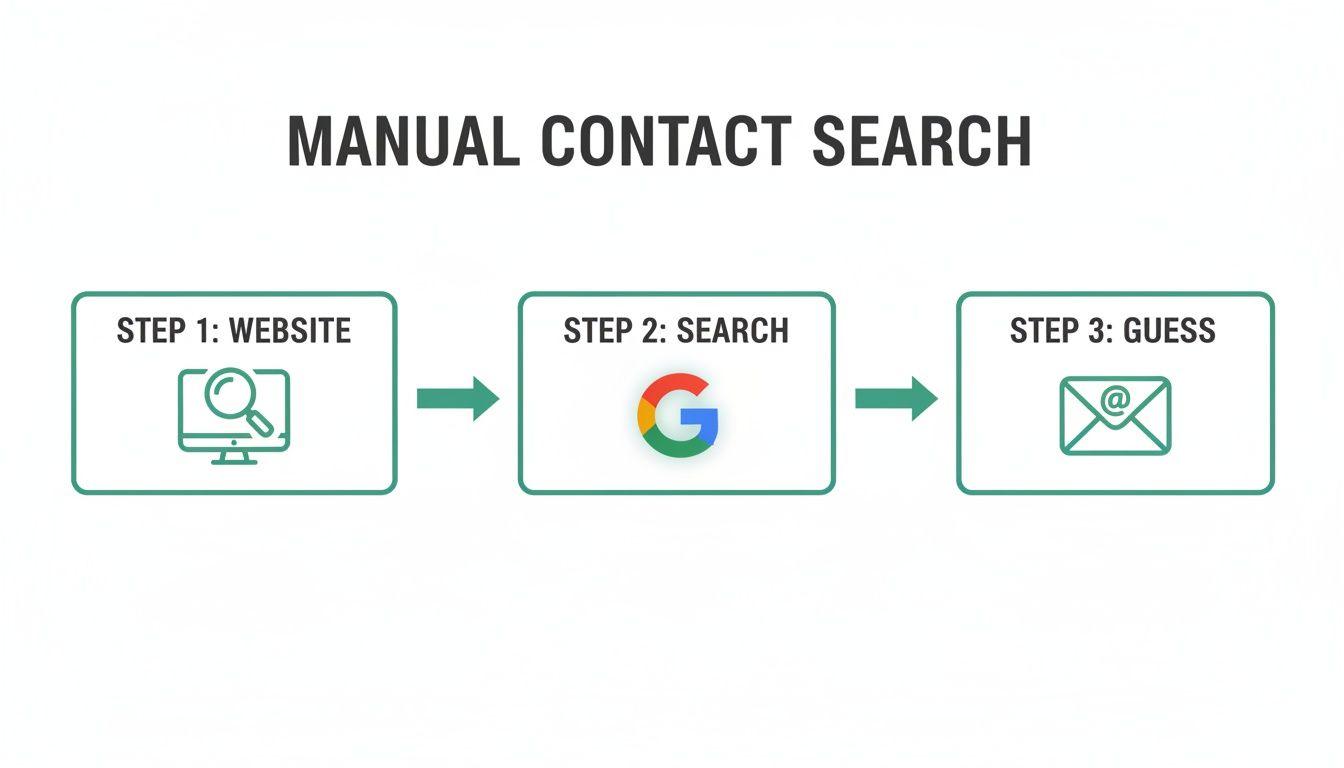
This flowchart really shows how a systematic, step-by-step manual approach can quickly narrow down your search for the right person.
The Art of The Educated Guess
So what do you do when you have a name and a company domain, but no email? It's time for an educated guess, a technique also known as email permutation. Most companies use a consistent format for their email addresses, and figuring out that pattern is a huge step in learning how to find business emails on your own.
Some of the most common patterns you'll see are:
firstname.lastname@company.com(john.doe@company.com)flastname@company.com(jdoe@company.com)firstinitiallastname@company.com(jdoe@company.com)firstname@company.com(john@company.com)
Jot down a list of these potential combinations. In the next section, we’ll get into how you can verify which of these addresses is the correct one—without sending a test email and getting a bounce. This manual prep work makes any automated tool you use later far more powerful and accurate.
Using Digital Tools for Efficient Prospecting
Mastering the manual techniques gives you a great foundation for finding contact info, but let's be honest—technology is what lets you do it at scale. Digital tools take the slow, methodical process of digging for details and turn it into a fast, efficient workflow. Instead of spending an hour hunting for a single email, you can uncover dozens in just a few minutes.
The best tools plug right into your existing process, whether you’re scrolling through LinkedIn profiles or checking out company websites. This is all about working smarter, not harder, and building a lead-gen engine that doesn't add a bunch of friction to your day.
Integrating Email Finders into Your Workflow
The most practical way to get started is with a browser extension that works where you already are. An email finder like EmailScout installs directly into Chrome, putting powerful contact discovery tools just a click away. It's way more efficient than constantly flipping between tabs to use some separate web-based tool.
Think about a real-world scenario. You land on the LinkedIn profile of a prospect who looks like a perfect fit. Instead of kicking off a manual search, a good extension will pop a button right there on the page. One click, and it finds and displays their verified professional email address.

As you can see, the tool overlays the interface without getting in your way, giving you exactly what you need, right when you need it. This immediate access to data is what transforms passive browsing into active prospecting.
Advanced Features for Bulk Discovery
While one-click discovery is great for snagging individual prospects, you need more firepower to really scale your efforts. This is where features designed for bulk processing come into play. They let you shift from finding one email at a time to finding hundreds.
Two powerful features you should look for are:
- URL Explorer: This function lets you drop in a list of company website URLs and automatically pulls any available email addresses from each site. So, instead of manually visiting ten different "About Us" pages, you can run the whole list through the tool and get a single, consolidated report.
- AutoSave Functionality: Imagine building a lead list without even trying. An AutoSave feature works quietly in the background, automatically grabbing contact information from the profiles you visit and adding it to a list you've designated. It’s passive lead generation at its finest.
These kinds of advanced capabilities are built for high-volume prospecting. They’re absolutely essential for sales teams and marketers who need to build large, targeted lists on the fly.
Comparing Your Tooling Options
The market for email finders is crowded, and picking the right one can feel a little overwhelming. A lot of tools run on a credit-based system, where you pay for each email you find or verify. That model can work, but it gets expensive fast, especially if you're a startup or freelancer.
Pro Tip: Keep an eye out for tools that offer a generous free tier or an unlimited model. This lets you scale your prospecting without constantly worrying about a running meter. Cost shouldn't be a barrier to finding valuable contact info.
EmailScout, for instance, offers an unlimited free model, which really sets it apart from the credit-based crowd. This approach lets you find as many emails as you need without ever hitting a paywall—a massive advantage for anyone doing consistent outreach. When you're weighing your options, think about the balance between cost, features, and how easy it is to use. You can get a much deeper look in our full guide to the best email finder tools available today.
Here’s a quick breakdown of the common pricing models you'll run into.
| Model Type | How It Works | Best For |
|---|---|---|
| Credit-Based | You buy a block of credits. Each email find or verification costs one or more credits. | Teams with a predictable, fixed budget and lower-volume needs. |
| Subscription Tier | You pay a monthly fee for a set number of credits or features, with higher tiers offering more. | Growing teams that need more features and a higher volume of searches. |
| Unlimited Free | The core email-finding feature is free and unlimited, with paid plans for premium features. | Startups, freelancers, and anyone wanting to prospect without budget constraints. |
Ultimately, the goal is to find a tool that fits your workflow and your budget. By moving from manual methods to a tool-assisted process, you can dramatically crank up the speed and scale of your prospecting. That frees you up to focus on what really matters—building relationships and closing deals.
Advanced Strategies for Hard-to-Find Contacts
Sometimes, the easy way just doesn't work. When you're trying to reach a high-value executive, an elusive founder, or any decision-maker who keeps a low profile, you need to start thinking like a detective. The standard methods fail because these people often have gatekeepers or a minimal digital footprint on purpose.
This is where you gain a serious edge by getting creative. It’s about digging deeper and looking in places your competition completely ignores. These tactics will help you uncover the direct lines of communication that you won't find on a company website or LinkedIn profile.
Go Beyond LinkedIn
Look, LinkedIn is the go-to for a reason, but it's not the only game in town. High-level prospects often hang out in niche communities where they feel more comfortable sharing ideas—and sometimes, their contact info.
Your mission is to find these digital watering holes. Think about industry-specific forums, private Slack communities, or even the comment sections on influential blogs. If your prospect runs a personal blog or has a GitHub profile, you’ve hit a goldmine. These are fantastic places to find a direct email they use for side projects or personal correspondence.
Engaging on these platforms feels more authentic. You're not just another salesperson in their inbox; you're part of their community.
Dig Into Public Company Documents
Publicly traded companies—and even many large private ones—leave a breadcrumb trail of documents that most people never think to check. This information isn't hidden; it's just buried in plain sight.
Here are a few places to start your search:
- Press Releases: Always scan for the "Media Contact" section. It often lists the direct name, email, and phone number of a communications director or a PR rep who can get your message to the right person.
- Investor Relations Reports: Annual reports and quarterly filings can name key executives. While a direct email is rare, you get a verified name to plug into your email permutation strategy.
- Conference Speaker Lists: Has your target ever spoken at an industry event? Conference websites frequently publish speaker bios that include direct contact details or links to their personal websites.
This approach takes a bit more patience, but the payoff can be highly accurate contact information for executives who are otherwise unreachable.
Check WHOIS Data for Smaller Companies
For smaller businesses and startups, a slightly more technical trick works wonders. Every domain name has a public record attached to it called WHOIS data, which lists the administrative and technical contacts for that domain.
Sure, privacy services can sometimes hide this info, but it's always worth a look. A quick WHOIS search on a company's domain might just reveal the founder's email address. In a small organization where everyone wears multiple hats, this contact can often point you exactly where you need to go.
Key Insight: The person who registered the company's domain is often a founder or an early, trusted employee. Reaching out to them can be a super effective backdoor approach.
The sheer volume of online communication shows why verified information is so critical. With a projected 376 billion emails sent daily in 2025, your success depends on finding accurate decision-maker info among 4.6 billion users. This is where business development teams get a crucial advantage with tools like EmailScout's URL Explorer, which can pull emails from multiple pages at once. Considering many employees spend over two hours a day on email, cutting through the noise is everything. You can read more on these trends by exploring workplace email statistics and their impact.
Ultimately, these advanced strategies are all about being resourceful and persistent. By combining a bit of digital sleuthing with creative thinking, you can find the contact info for almost anyone and start building the relationships that others can only dream of.
Verifying Emails to Protect Your Sender Reputation
That rush you get when you find what looks like the right email address? It's a great feeling, but it’s only half the job. Firing off a message to an unverified address is a gamble that can seriously backfire.
Email verification isn't just a "nice-to-have" step; it's a non-negotiable part of any outreach strategy. Without it, your entire campaign could fall apart before it even gets off the ground.
Every time you send an email that bounces, it’s a small red flag for email providers like Google and Microsoft. Let those bounces pile up, and your sender reputation takes a massive hit. Before you know it, even your emails to perfectly valid addresses are getting flagged as spam or blocked completely.
The True Cost of a High Bounce Rate
A high bounce rate is way more than just a failed delivery notice in your inbox—it's a direct threat to your domain's credibility.
When email servers see a constant stream of failed deliveries coming from you, their algorithms start to assume you're a spammer using a junky, outdated list. As a result, they stop trusting you, and your chances of landing in anyone's primary inbox plummet.
Think of your sender reputation like a credit score for your email domain. Each bounced email is a missed payment. Too many, and your score gets trashed, making it nearly impossible to get your messages delivered in the future.
This means all the hard work you put into finding contacts and writing the perfect email could be for nothing. Your carefully planned campaign dies a quiet death in the spam folder, never seen by the people you need to reach.
Understanding Different Types of Invalid Emails
Not all bad emails are created equal. To clean up your lists, you need to know what you’re looking for. Some are simple typos, but others are more devious.
- Syntax Errors: These are the easy ones to spot. Think
john.doe@company(missing the.com) orjane@doe..com(with double dots). Most are simple mistakes. - Non-Existent Addresses: The address looks perfect, but the account was deleted ages ago or never even existed. These cause a hard bounce, which is especially damaging to your reputation.
- Catch-All Servers: This is the tricky one. Some companies set up their servers to accept email sent to any address at their domain. You won't get a bounce, but your message often lands in an unmonitored black hole. It feels like a successful delivery, but it’s just a wasted effort.
Learning to spot these different types is the first move toward building a clean, powerful contact list that actually gets results.
Practical Verification Methods
The good news is you don't have to risk a bounce to see if an email is valid. There are several ways to confirm an address's deliverability without sending a single thing.
For those quick, one-off checks, plenty of free online tools let you paste in an email and get an instant verdict. They're perfect for when you've just tracked down a high-value prospect and need immediate confirmation before you hit "send."
When you're working with a bigger list, a bulk verification service is your best friend. These platforms let you upload a whole spreadsheet of contacts and run a deep check on every single one. They’ll analyze the syntax, check the server responses, and flag risky addresses like catch-alls.
For a closer look at the technical side of things, our guide on email address verification breaks it all down in more detail.
Ultimately, building verification into your process is a must. Whether you're finding one email or a thousand, that extra step protects your reputation, boosts your deliverability, and gives your message a real shot at being read.
Ethical Outreach and Data Privacy Practices
So, you've mastered the art of finding contact info. That's a powerful skill, but it comes with some serious responsibility. How you actually use that information is just as important as how you found it.
This isn't about finding legal loopholes. Ethical outreach is about building a sustainable strategy that creates positive, long-term relationships instead of just burning bridges with potential clients. When you access someone's data—even if it's publicly available—you need to handle it with respect. Following these principles doesn't just keep you out of legal trouble; it makes your outreach far more effective because it's built on a foundation of trust.
Navigating Key Data Privacy Regulations
You don't need to be a lawyer, but you absolutely have to know the rules of the road. The two big ones governing email outreach are the CAN-SPAM Act in the United States and the General Data Protection Regulation (GDPR) in the European Union.
These laws set the ground rules for commercial emails. Ignoring them can lead to massive fines and a permanently torched sender reputation.
Their core principles are pretty straightforward and all about protecting the recipient:
- Be Honest: Your "From" name, subject line, and the message itself must be accurate. No trickery.
- Provide an Exit: Every single email has to include a clear, easy-to-use unsubscribe link.
- Identify Yourself: You must include your valid physical postal address somewhere in your email.
To keep your outreach on the right side of the law, it's also smart to understand frameworks like ISO 27001 and specific regional rules, like the Australian Data Privacy Laws.
Key Takeaway: Compliance isn't optional. Think of the unsubscribe link as a non-negotiable part of your email signature. It gives the recipient control and shows that you respect their inbox.
Best Practices for Building Trust
Staying compliant is just the bare minimum. Truly effective outreach goes a step further by focusing on practices that build genuine trust and rapport from the very first message. This is what separates a professional from a spammer.
The goal is to start a conversation, not just blast a sales pitch into the void. This requires a shift in mindset from "what can I get?" to "what can I give?"
Lead with Value and Personalization
Generic, one-size-fits-all emails are a one-way ticket to the trash folder. Before you even think about hitting "send," ask yourself: what’s in it for them? Your first message should offer something genuinely useful.
This could be anything from:
- A helpful article relevant to a project they recently posted about.
- An interesting observation you made about their company or industry.
- A potential solution to a problem you've identified they might be facing.
Real personalization shows you’ve done your homework. Mentioning a specific article they wrote, a recent company achievement, or a shared connection instantly proves this isn't another mass email. That respect for their time and work is what earns you a response.
The incredible ROI of email marketing is built on this approach. Pros can see a 760% surge in revenue from well-built, targeted lists, but that only happens when you find the right people and approach them respectfully. With 82% of marketers using email, personalization is how you stand out. For anyone using a tool like EmailScout, that one-click email discovery can fuel campaigns with welcome email open rates as high as 80%—crushing the 20% average.
Ethical Outreach Quick Guide
The table below breaks down the clear difference between an ethical, effective approach and one that's destined to fail.
| Practice | Ethical Approach (Do This) | Unethical Approach (Avoid This) |
|---|---|---|
| Personalization | Reference specific details about their work or company. | Using generic templates with only the name changed. |
| Value Proposition | Offer a useful insight or resource in your first email. | Immediately asking for their time or money. |
| Unsubscribe | Include a clear, one-click unsubscribe link in every email. | Hiding the opt-out link or requiring a login to unsubscribe. |
| Transparency | Clearly state who you are and why you are contacting them. | Using misleading subject lines or a fake "From" name. |
At the end of the day, finding contact info is just the first step. When you combine your discovery skills with a solid commitment to ethical, value-first outreach, you turn a simple email address into a potential long-term business relationship built on mutual respect.
Got Questions? We've Got Answers
Even with the best tools and a solid game plan, you're going to hit a few snags trying to find someone's contact info. It happens to everyone. Here are some of the most common questions we get, along with some straightforward answers to help you get unstuck.
What’s the Best Way to Find an Email for Free?
Honestly, the most powerful free method is just a bit of clever detective work combined with a few free tools. It's a simple process that works surprisingly often, and it won't cost you a penny.
First things first, you need to confirm the person's full name and their current company. A quick look at their LinkedIn profile is usually the most reliable way to do this.
Next, head over to Google and use a specific search operator. Try a search like "[First Name] [Last Name]" email site:[companydomain.com]. You’d be surprised how often this uncovers an email address mentioned in a blog post, a press release, or a company bio.
If that doesn't work, it's time to make some educated guesses based on common email patterns:
f.lastname@domain.comfirstname.lastname@domain.comfirstinitiallastname@domain.com
Once you have a few possibilities, use a free email verifier or a tool like EmailScout's free extension to see if you've struck gold. This last step is key—it automates the verification and often finds the right email with a single click, saving you a ton of manual effort.
How Do I Find Someone Who Isn’t on LinkedIn?
When a prospect you really want to reach isn't on LinkedIn, it just means you have to get a little more creative. Think of it as looking for other digital footprints they’ve left behind. This is often how you find the contact info for decision-makers who fly under the radar.
Your first stop should be the company's website. Dig into the "About Us," "Press," or "Media" pages. Key people who aren't big on social media are often listed there.
If the company website is a dead end, broaden your search to other corners of the internet:
- Industry Forums: Are they active in any niche online communities related to their work?
- Event Speaker Lists: Check the websites for conferences, trade shows, or webinars where they might have spoken. Speaker bios are a goldmine for contact details.
- Articles and Interviews: Search for their name alongside podcast interviews, articles, or white papers they've written.
This kind of digging often uncovers direct contact info that isn’t listed anywhere else. It’s all about figuring out where they hang out online beyond the usual professional networks.
Is It Legal to Email Someone for Business After Finding Their Info Online?
Yes, it's generally legal to reach out for legitimate business reasons, but you must follow data privacy rules. The two big ones to be aware of are the CAN-SPAM Act in the United States and GDPR in the European Union.
Staying compliant isn't that difficult, but it's non-negotiable. Your email can't be misleading, you have to be clear about who you are, and—this is the most important part—you must give them an easy, obvious way to opt out of future messages.
The real key here is to stop thinking about it as just sending emails and start thinking about it as starting a valuable conversation. As long as your outreach is relevant, transparent, and respects their right to say "no thanks," you're on solid legal and ethical ground.
Ready to stop guessing and start connecting? EmailScout lets you find verified email addresses with a single click, right from a social profile or website. Give it a try and find unlimited emails for free.