
A better email list often starts with a smaller number. Average website opt-in conversion sits at 1.95%, while top-performing marketers reach about 6.5% or higher, according to industry opt-in benchmarks. That gap matters because list building isn't just about collecting addresses. It's about collecting permission-based contacts who want the follow-up, engage with it, and remain deliverable over time.
That's the lens I use when evaluating email list building strategies. Not just volume, but fit. Some channels produce high intent but take more setup. Others scale faster but need tighter quality control. The ten methods below cover owned traffic, conversion optimization, partnerships, paid acquisition, referrals, and conversational capture. Each one includes a decision rule, a simple implementation sequence, a quality-control step, and a relevant EmailScout use case.
Use these strategies based on four practical constraints: how much traffic you already have, how much budget you can spend, how clear your offer is, and how disciplined your follow-up process is. If you don't have a welcome sequence, tagging, and suppression rules in place, adding more acquisition channels usually creates mess faster than growth.
EmailScout fits into this process as a research and prospecting tool. It can help teams identify decision-makers and research companies for personalized outreach. That matters for partner sourcing, account targeting, and sales follow-up. But discovered contacts are not the same as opted-in subscribers, so they shouldn't be treated as permission-based email subscribers without the right consent and outreach practices.
If list quality is already slipping, fix that first with an email list cleaning guide.
1. Lead Magnet Opt-In Forms
Lead magnets still work when the offer is narrow and useful. A checklist for “everyone” usually underperforms. A template for one role, one job, and one problem tends to pull better subscribers because the person knows exactly why they're signing up.
That's why this method is usually the first one I'd launch for owned traffic. It's simple to deploy, easy to test, and naturally permission-based.
How to set it up
Use this when you already have website traffic or can send people to a focused landing page.
- Pick one urgent problem your audience already talks about.
- Turn the solution into one asset. A checklist, calculator, swipe file, workbook, or short template library.
- Build a landing page with one promise, one form, and one call to action.
- Keep fields minimal at first. Add segmentation later through onboarding or progressive profiling.
- Send subscribers into a short welcome flow tied to that exact offer.
A practical example is a B2B SaaS team offering a sales call planning template to revenue leaders, then tagging subscribers by company type and routing them into different nurture tracks.
Practical rule: If you can't explain the lead magnet in one sentence, the offer is too broad.
For implementation ideas, EmailScout's guide on how to build email lists is useful for connecting offer design with list growth workflows.
Quality control and EmailScout use case
The trade-off is that lead magnets can attract freebie seekers if the topic is too generic. A “marketing tips” ebook often creates a bloated top of funnel. A specialized asset usually creates fewer signups, but better ones.
Use EmailScout before launch to identify the decision-makers and companies you want this asset to reach. That helps you shape better copy, sharper examples, and more relevant distribution. For instance, if you're targeting RevOps managers, review the kinds of companies they work at and build the asset around their actual workflow, not a generic best-practices document.
2. Content Marketing and Blog Subscriptions
A blog subscription program is rarely the fastest way to grow a list. It is often one of the cleanest ways to build a list that keeps producing, because the signup happens next to a real question the reader is already trying to solve.
That only works if the article and the opt-in match the same intent. A visitor reading a pricing comparison wants a different follow-up than someone reading a beginner tutorial.
Here is the decision rule I use. Choose blog subscriptions if you already have steady search, direct, or community traffic to educational content, and your team can publish with enough consistency to build topic depth over time. Skip this channel as a primary growth bet if traffic is low, the content calendar is sporadic, or every post targets a different audience.
The implementation sequence is less about publishing volume and more about connection between page intent, offer, and follow-up:
- Sort existing posts by buying stage and topic. Separate problem-definition posts, evaluation posts, use-case posts, and comparison posts.
- Assign one subscription angle to each cluster. Examples include weekly operator notes, product teardown emails, compliance updates, or role-based briefings.
- Place opt-ins where commitment makes sense. Use inline forms inside long articles, end-of-post forms on high-intent pages, and slide-ins only after the reader has engaged.
- Write the CTA around the outcome. “Subscribe for updates” is weak. “Get weekly examples of onboarding emails for SaaS teams” gives the reader a reason.
- Route subscribers by entry page or topic tag. The welcome sequence should reflect what they just read, not a generic newsletter intro.
A practical workflow looks like this. A software company publishes guides for finance leaders, operations managers, and IT admins. Each content hub has its own subscription promise and welcome sequence, even if all contacts still live in one email platform.
The quality-control step is simple. Review signup source, activation, and unsubscribe patterns by article category each month. If a topic produces subscribers who never open, never click, or churn after one email, the issue is usually poor intent matching, not form placement.
Consent standards matter here. The EU ePrivacy Directive, adopted in July 2002 as Directive 2002/58/EC, helped establish prior consent as the standard for commercial electronic messages in Europe and defined the “soft opt-in” exception in customer-sale contexts, as outlined in this EU ePrivacy timeline. In practice, content subscriptions should be explicit, transparent, and easy to leave.
The trade-off is patience. Blog subscriptions tend to produce better context than broad giveaway campaigns, but growth is slower and editorial discipline matters more.
EmailScout fits on the planning side, not the consent side. Use it to identify the companies, job functions, and subject-matter experts your content should speak to. That helps teams choose sharper article angles, build more credible examples, and spot partner voices worth quoting or collaborating with, without treating researched contacts as newsletter subscribers by default.
3. Webinars and Virtual Events
Webinars earn email signups from people who are willing to spend time on a specific problem. That signal is stronger than a generic newsletter form, but it also raises the standard for follow-up. If the topic is broad, the form asks too much, or the post-event sequence is generic, registration volume can look healthy while list quality falls.

A simple decision rule helps here. Run webinars if your buyer needs explanation, comparison, or proof before taking the next step. Skip them if your audience wants pricing, a trial, or a quick transactional answer. Live events take planning time, speaker prep, reminder emails, and sales coordination, so they need a topic that benefits from depth or discussion.
Here is the operating sequence I use:
- Define one job to be done. Pick a narrow outcome, such as reducing onboarding drop-off, evaluating vendors, or fixing reporting gaps.
- Match the format to intent. Use a live webinar for Q and A, a workshop for tactical training, or a panel if outside credibility matters more than product explanation.
- Keep registration friction low. Ask for the fields your team will use. Name, work email, company, and role are usually enough.
- Build promotion around one promise. The title, landing page, invite email, and speaker intro should all point to the same concrete takeaway.
- Prepare segmented follow-up before the event starts. Attendees, no-shows, engaged viewers, and question-askers should not enter the same sequence.
A practical example makes the difference clear. A cybersecurity company can fill a webinar with a broad topic like "security trends," but that list will be mixed and hard to qualify. A session called "How IT teams compare endpoint vendors without stalling procurement" will usually get fewer registrations and better follow-up opportunities. I would take the second list every time.
The quality-control step starts after the event, not at the registration page.
Check these four signals within a week:
- Attendance rate by source. Partner traffic, paid traffic, and house-list traffic often behave differently.
- Engagement during the event. Questions, poll responses, and watch time tell you more than raw registrations.
- Conversion by follow-up path. Compare attendees, no-shows, and recording viewers separately.
- Unsubscribe and inactivity rates. If recording emails drive quick churn, the topic or signup promise pulled the wrong intent.
Post-event automation needs structure. Registrants who attended and stayed to the end can get a stronger next step, such as a demo, worksheet, or sales consultation. No-shows often need a recording, a short recap, and one related resource. Teams that need help mapping those branches can use these email automation workflow patterns to set up cleaner webinar follow-up.
EmailScout is useful before and after registration. Before the event, teams can use it to identify the companies, roles, and subject-matter contacts that match the webinar topic, then route invites through compliant outbound or partner channels. After the event, source and company data help sales and marketing decide which attendees deserve personal follow-up versus a standard nurture track.
The trade-off is workload. Webinars can produce high-intent subscribers and strong sales conversations, but only if the topic is specific and the follow-up is built with the same care as the event itself.
4. Strategic Partnerships and Co-Marketing
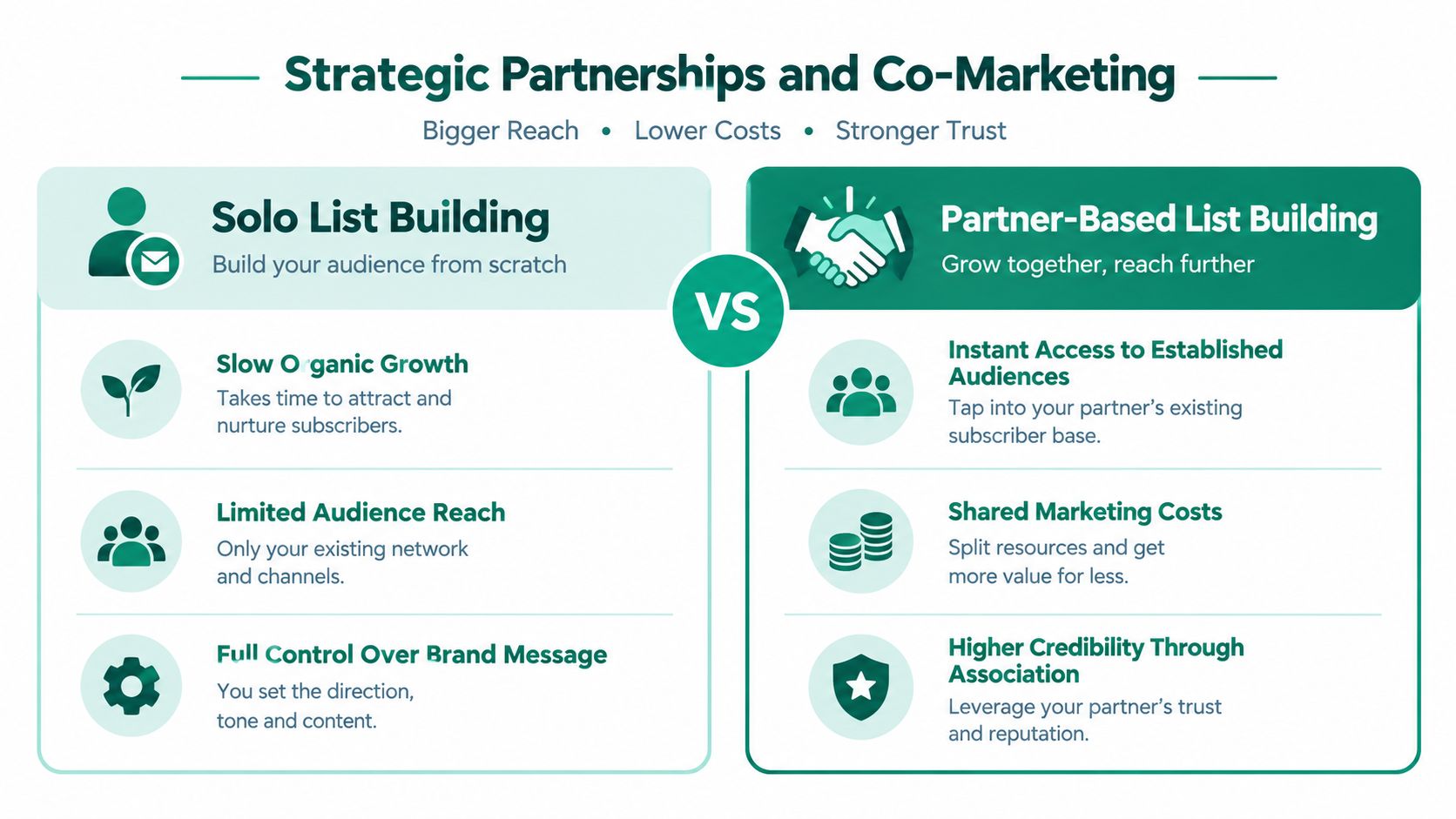
Partnerships can add subscribers faster than another round of publishing or site tests, but only when the audience match is tight and the signup path is clean. A bad partner brings volume, vague intent, and messy consent records. A good partner brings trust you did not have to build from zero.
The decision rule is simple. Use co-marketing when you can answer yes to three questions:
- Do both brands reach the same buyer?
- Does each brand solve a different part of the same problem?
- Can both teams agree on consent, lead ownership, and follow-up before launch?
If any answer is no, skip the campaign or reduce the scope to a smaller test.
A few partner shapes work well in practice. A CRM consultant can pair with a sales enablement platform. A recruiting software company can pair with an HR analytics firm. A legal SaaS vendor can pair with a compliance advisor. In each case, the overlap is the buyer, not the product.
Instead of another standard checklist, treat co-marketing like a short operating plan.
Start with partner selection, not the asset
Teams often choose the biggest logo available and then try to force a campaign around it. That usually creates approval delays and weak conversion because the audience fit was wrong from the start.
Use this sequence:
- List 10 to 20 adjacent brands your buyers already trust.
- Rank them on audience overlap, product complement, brand credibility, and execution speed.
- Pick one low-friction offer format. A joint webinar, benchmark summary, template pack, or live workshop usually works better than a broad “resource bundle.”
- Write the signup promise in one sentence. If both brands cannot agree on that sentence, the offer is still too loose.
Make the lead flow explicit before promotion
Co-marketing programs usually break.
One team assumes both brands can email everyone who registers. The other assumes only the host gets consent. Legal gets involved late. Launch slips. Follow-up becomes inconsistent.
Set the rules before creative work starts:
- Decide whether one brand hosts the form or each brand captures leads separately.
- State exactly who will email registrants and why.
- Add source tags at the form level so partner leads stay separate from house-list and paid leads.
- Map the first three follow-up emails before the campaign goes live.
Shared campaigns fail on operations more often than strategy.
Quality control matters more here than in solo campaigns
Partner traffic can look strong at the top of the funnel and still underperform later. Track list quality, not just registrations.
Check these points within the first campaign cycle:
- Conversion rate from click to signup by partner
- Confirmation and welcome email engagement
- Unsubscribe rate from the first nurture sequence
- Sales acceptance, if the list feeds pipeline
- Duplicate and invalid records before sync to the CRM
I prefer direct consent language over “one registration covers both brands” unless the form makes that arrangement unmistakable. A larger list is not helpful if half the audience did not expect your emails.
EmailScout is useful earlier in the process than many teams expect. Use it to build a shortlist of partner companies based on buyer overlap, then identify the teams or contacts responsible for partnerships, demand generation, or alliances. That helps you choose partners for audience fit and execution likelihood, not just brand recognition.
The trade-off is coordination cost. Co-marketing can produce warmer subscribers than cold paid traffic, but every campaign needs alignment on messaging, compliance, timelines, and lead handling. If your team cannot support that operational work, run fewer partnerships and make each one tighter.
5. Gated Content and Resource Library
A resource library is a list-building system, not a single offer. Use it when one lead magnet is too narrow because you serve multiple roles, buying stages, or use cases and need one place that routes people into the right next step.
The decision rule is simple. Build a library if you already have several useful assets and your traffic is broad enough that one generic opt-in would blur intent. If traffic is still low or you only have one strong asset, keep using a focused lead magnet and delay the library.
What matters here is structure.
Instead of treating every PDF, template, and guide as a separate campaign, set up the library so each asset helps qualify the subscriber and shape follow-up. A migration checklist should lead to a different email path than a budgeting worksheet. That distinction is the whole point of the library model.
A workable implementation sequence looks like this:
- Audit existing assets and remove weak, outdated, or overlapping pieces.
- Group the remaining resources by role, problem, or stage in the buying process.
- Choose a few high-intent entry assets to feature on the main library page.
- Leave some educational content open so visitors can assess quality before giving an email address.
- Gate the more actionable resources, such as templates, calculators, checklists, or detailed playbooks.
- Tag each conversion by asset topic and stage so nurture logic reflects what the person requested.
- Ask for additional profile fields only on later downloads if the first conversion quality is strong enough to justify it.
There is a trade-off. A larger library can improve coverage across segments, but it also adds maintenance work and raises the risk of clutter. If every asset is gated, search visibility drops and visitors start to question whether the exchange is fair. If nothing is gated, the library may drive traffic without producing enough subscriber growth.
Quality control should stay close to the workflow, not as a cleanup task later.
Review the library monthly using four checks:
- Which assets generate confirmed subscribers, not just form fills
- Which categories attract weak engagement in the welcome sequence
- Whether certain assets create high unsubscribe rates or poor sales acceptance
- Whether the asset map still matches current offers, positioning, and personas
Consent standards matter more than teams often assume. Mailgun notes in its state of email report that Gmail, Yahoo, and Apple recommend double opt-in as a preferred permissioning method. If your library attracts low-intent or mistyped signups, the problem usually appears later in engagement rates, complaint risk, and inbox placement.
EmailScout fits after the library and routing logic are in place. Use it to research the companies engaging with your highest-value resources so sales can prioritize account follow-up and marketing can see which topics attract the right buyers. That use case supports qualification. It does not replace opt-in consent.
6. Social Media Lead Generation Ads
Paid social is one of the few list-building methods that can scale volume on demand. It also exposes weak offers fast. If the ad promise, form, and follow-up do not match, you pay to add contacts who never wanted the emails in the first place.
Use this channel under one condition: you already know which audience segment you want and what that segment will exchange an email address for. If that is still unclear, fix the offer before buying traffic.
A practical way to run lead gen ads:
- Choose one platform based on buyer context. LinkedIn usually fits role-based B2B targeting. Meta can work for broader professional interest targeting or lower-cost top-of-funnel offers.
- Match one offer to one temperature level. Cold traffic responds better to checklists, templates, or briefings than to demo requests.
- Build one form for one segment. Separate campaigns for founders, operators, and marketers give cleaner data and cleaner follow-up.
- Keep the form short, but state consent clearly. Lower friction helps completion. Too little friction raises accidental and low-intent submissions.
- Route leads into a source-tagged welcome or nurture sequence within minutes, not days.
- Measure performance past cost per lead. Watch confirmed opt-ins, early engagement, and sales acceptance by campaign.
One useful test is to compare native platform lead forms against a landing-page conversion path. Native forms often produce cheaper leads because the handoff is faster. Landing pages usually filter intent better because the visitor has to take one more deliberate step. The right choice depends on whether your current bottleneck is volume or quality.
A simple example: a B2B SaaS team can run LinkedIn lead ads to operations leaders with a process template, send those contacts into a short email sequence tied to that use case, and compare downstream engagement against organic blog subscribers and webinar signups.
Here's a walkthrough if you want a visual angle on list-building campaign mechanics:
Keep quality control inside the campaign workflow.
Check these points every week:
- Lead-to-confirmed-subscriber rate by campaign
- Open and click patterns in the first two emails
- Sales acceptance rate if the list feeds pipeline
- Complaint, unsubscribe, and bounce patterns by source
- Form-to-offer alignment between ad copy, creative, and follow-up
If one audience clicks but does not engage after signup, the problem is usually targeting or offer fit, not email copy alone. Pause the campaign, tighten the segment, or swap the asset.
EmailScout is useful after the lead enters the system. Use it to validate company context, identify account relevance, and help sales prioritize follow-up on higher-fit paid subscribers. That supports qualification after consent has been captured.
7. Referral and Ambassador Programs
Referral programs add subscribers with built-in context. Someone the prospect already trusts has done part of the positioning work before the signup page appears.
Use this method after the product, newsletter, or event experience already creates a clear win for a specific segment. If people are lukewarm, adding rewards usually brings in low-intent names and more list cleanup work.
A useful way to structure this channel is to choose between two models first:
Referral model
- Best for broad customer or subscriber bases
- Works when the ask is simple and the reward is modest
- Easier to launch fast
- Harder to control message quality at scale
Ambassador model
- Best for smaller groups of highly credible advocates
- Works when audience trust matters more than raw volume
- Slower to set up
- Usually produces stronger downstream engagement
Pick one based on the bottleneck. Choose referrals if you need more top-of-funnel volume from an already engaged audience. Choose ambassadors if list quality matters more than reach.
Then build the motion in sequence:
- Set the trigger point. Ask after a clear success moment, such as onboarding completion, a positive support interaction, repeat newsletter engagement, or event attendance.
- Define the exchange. Give the advocate and the referred subscriber a reason to act. Product credit, bonus content, early access, or status can work. Generic cash rewards often attract weaker leads unless the product has strong fit and clear purchase intent.
- Control the message. Provide short copy, a referral link, and one clear benefit statement. Advocates should not have to write your pitch from scratch.
- Send referrals to a dedicated destination. The page should acknowledge the referral context and repeat the promised benefit. Referred traffic converts better when the handoff is explicit.
- Tag the source from day one. Separate referred subscribers by advocate, offer, and entry point so you can compare quality later.
Quality control matters more here than in almost any other list-growth tactic.
Rewards can distort intent. Watch whether referred contacts open the first emails, click into the promised resource, and remain engaged after the incentive is delivered. If one advocate sends a lot of signups but those contacts go quiet immediately, reduce that offer, tighten the copy, or remove that source from the program.
For teams building a formal system, these referral incentive programs for SaaS are a useful reference point for reward structure and program rules.
EmailScout fits best at the ambassador-selection and follow-up stages. Use it to identify customers, partners, or creators with relevant company context and audience fit, then prioritize outreach to a smaller advocate group instead of opening the program to everyone. That trade-off usually reduces signup volume, but it improves list quality and makes the channel easier to manage.
8. Exit-Intent Pop-Ups and Retargeting
Exit-intent pop-ups work best on traffic you already paid for, ranked for, or earned through partnerships. They are a recovery tactic for visitors who showed interest but were not ready to subscribe on the first pass.
Use them only after two conditions are true: the page gets steady relevant traffic, and the existing page CTA underperforms. If a page has weak traffic or weak message-market fit, a pop-up usually hides the problem instead of fixing it.
A practical setup looks different by page type. On a pricing page, offer a buyer guide or implementation checklist. On a blog post, offer a tightly related template or follow-up lesson. On a webinar page, offer the replay or a shorter summary for people who hesitate to register live.
Here is the operating sequence I recommend:
- Choose one high-intent page segment. Start with pricing, product comparison, demo, or bottom-of-funnel educational content.
- Set the trigger based on exit behavior or inactivity. Do not fire the form on arrival.
- Match the offer to the page's buying stage. Keep the CTA specific to what the visitor was already evaluating.
- Limit exposure. Cap frequency by session and by user so the form does not appear on every visit.
- Retarget non-subscribers with the same theme. Keep the ad message consistent with the pop-up offer instead of introducing a new pitch.
- Tag the capture source separately. Pop-up and retargeting leads should not be mixed with standard form fills in reporting.
The decision rule is simple. If the visitor has shown meaningful intent but has not taken the primary action, ask for a smaller commitment. If the traffic is broad or early-stage, skip the interruption and keep the page clean.
There is a trade-off. More aggressive triggers usually raise raw opt-in rate and lower list quality. That trade-off gets expensive fast if the welcome sequence, lead scoring, or sales follow-up treats every new subscriber the same.
Quality control matters more than design tweaks here. Review three things after launch: welcome-email engagement, unsubscribe rate by source, and the share of subscribers who take the next intended step. If pop-up leads collect the asset but ignore the next two emails, tighten the trigger, narrow the offer, or add stronger confirmation before they enter the main list.
Retargeting deserves the same restraint. Good retargeting reminds visitors about the offer they almost accepted. Bad retargeting follows everyone with a generic newsletter ad and collects low-intent subscribers who never asked for that relationship.
EmailScout is most useful after capture and before handoff. Teams can use it to enrich company context for subscribers coming from pricing-page pop-ups or retargeting campaigns, then route the strongest-fit leads into faster follow-up while leaving lower-intent contacts in a nurture track.
9. Email Newsletter Swaps and Cross-Promotions
A newsletter swap can add subscribers fast. It can also fill the list with people who never open again if the partner audience is too broad, too early-stage, or trained to click any free resource.
The deciding question is stricter than “Do they have our buyers?” Ask this instead: would their readers still care after the first click, once they start receiving your next few emails? If the answer is uncertain, skip the swap or narrow the offer.
Cross-promotions work best when the partner already publishes to a defined niche and your offer matches a current problem for that audience. They work poorly when both brands chase volume and treat the send as rented attention.
A practical setup looks different from a standard co-marketing campaign:
- Screen the newsletter, not just the brand. Read several recent issues and note the audience level, recurring themes, and call-to-action style.
- Choose one offer that matches that audience's intent. A tactical checklist, template, or niche briefing usually performs better than a generic “join our newsletter” pitch.
- Write copy in the partner's voice constraints. Short, specific copy tends to survive editing and feel native inside the issue.
- Send traffic to a dedicated page. Keep the headline and promise consistent with the placement that drove the click.
- Tag every signup by partner and placement date. Review welcome-email opens, clicks, and early unsubscribes before agreeing to another swap.
One extra control matters here. Swap partners should approve each other's positioning before the send. That reduces vague blurbs, overpromising, and audience confusion.
The trade-off is straightforward. Broad newsletters can produce more raw signups. Niche newsletters usually produce fewer, but the subscribers are more likely to stay engaged and fit the rest of your email program. For teams that care about pipeline, product adoption, or qualified lead flow, that quality gap matters more than the top-line opt-in count.
EmailScout fits the sourcing and vetting stage. Teams can use it to identify relevant operators, publishers, or partner companies behind niche newsletters, then research whether those audiences align before outreach starts. That helps avoid the common mistake of sending swap requests to every list owner with a visible subscriber base.
10. Live Chat and Chatbot Lead Capture
Chat capture earns its place on pages where visitors hesitate, ask the same pre-purchase questions, or need help choosing the right next step. The advantage is not volume. It is context.

A generic popup asks everyone for the same action. Chat lets the site respond to what the visitor is trying to do. That makes it a useful conversational capture method, especially on pricing pages, service pages, and high-intent resource pages where a little guidance can turn uncertainty into an email opt-in or booked conversation.
Here is the practical decision rule. Use chat capture if your team sees repeated questions in sales calls, support tickets, or demo requests, and if those questions can be answered with a short asset, a routing question, or a human handoff. Skip it if nobody will monitor replies or if the follow-up sequence cannot use the conversation details.
The setup works best as a short operating flow:
Map page intent first.
Pricing visitors usually need qualification, budget fit, or timeline guidance. Product visitors often need use-case clarification. Resource readers may want a checklist, template, or follow-up answer.Write one opening prompt per page type.
Keep it specific. “Need help choosing the right plan?” will outperform a vague “How can we help?” on pricing pages because it gives the visitor a clearer reason to respond.Ask for email after the exchange earns it.
Good moments include sending a quote checklist, a transcript, a follow-up answer, or a recommended resource. Asking too early reduces trust and lowers completion rates.Separate bot tasks from human tasks.
Bots should handle routing, common objections, and basic qualification. Human reps should take over when the visitor asks for nuanced advice, account-specific help, or anything that affects deal quality.Push chat context into CRM and email.
Topic, page path, stated problem, and requested follow-up should trigger the next email or sales action. If the contact enters a generic welcome flow, the value of chat drops fast.
One example: a service firm can place chat on its pricing page with a prompt offering a project scoping checklist. If the visitor selects budget range and timeline, the bot can collect the email, send the checklist, and tag the lead for a follow-up sequence tied to that buying stage.
Quality control matters more here than in standard form capture. Review transcripts every week. Look for weak prompts, early email asks, missed handoffs, and tags that never make it into downstream campaigns. Chat creates useful first-party intent signals, but only if marketing and sales use them.
For teams connecting chat capture to follow-up systems, EmailScout's guide on automating lead generation workflows is a useful reference. EmailScout also fits the post-chat research step when a visitor mentions a company and the sales team wants to identify likely stakeholders for separate outbound follow-up.
Used well, chat adds qualified subscribers with better context than a standard signup box. Used poorly, it creates one more inbox full of unworked conversations.
Email List-Building Strategies: 10-Point Comparison
| Method | Implementation complexity | Resource requirements | Expected outcomes | Ideal use cases | Key advantages |
|---|---|---|---|---|---|
| Lead Magnet Opt-In Forms | Medium, create focused asset + landing page | Content creation, landing page, email integration; moderate time | Moderate-to-high quality leads; measurable conversions | Niche targeting, list-building, lead qualification (B2B/B2C) | Targeted leads, cost-effective, builds authority |
| Content Marketing & Blog Subscriptions | High, ongoing publishing + SEO | Continuous content production, SEO, analytics; long-term time investment | Slow, steady organic growth; high engagement over time | Thought leadership, inbound strategy, long-term audience building | Sustainable traffic, credibility, low CAC long term |
| Webinars & Virtual Events | High, planning, production, promotion | Event platforms, presenters, promotion budget, technical setup | Fast capture of highly engaged, qualified leads; recordings usable evergreen | Product demos, B2B demand gen, educational outreach | High lead quality, real-time engagement, strong nurturing material |
| Strategic Partnerships & Co‑Marketing | Medium–High, partner selection & coordination | Partner outreach, co-created assets, shared promotion resources | Rapid audience access; quality varies by partner | Expanding reach, co-branded launches, B2B partnerships | Instant reach, shared costs, credibility via association |
| Gated Content & Resource Library | High, multi-resource creation + platform | Large content budget, CMS, gating logic, analytics | High perceived-value leads; deeper profiling; lower per-item conversion | Enterprise marketing, research-led industries, nurturing funnels | Progressive profiling, repeat engagement, thought leadership |
| Social Media Lead Generation Ads | Medium, ad setup and optimization | Paid ad budget, creatives, targeting expertise, analytics | Fast list growth; measurable CPL; lead quality depends on targeting | Rapid acquisition, targeted campaigns, product offers | Scalable, precise targeting, immediate measurable results |
| Referral & Ambassador Programs | Medium, incentives and tracking systems | Incentive budget, referral platform, program management | High-quality, trust-driven referrals; slower initial growth | SaaS, consumer apps, businesses with loyal customers | High conversion rates, low marginal CAC, builds advocacy |
| Exit‑Intent Pop‑Ups & Retargeting | Low–Medium, tool setup and testing | Pop-up/retargeting tools, compelling offers, modest budget | Quick uplift in captures from existing traffic; variable lead quality | Sites with traffic but low conversions, ecommerce, landing pages | Low cost, recaptures abandoning visitors, highly customizable |
| Email Newsletter Swaps & Cross‑Promotions | Medium, partner matching and scheduling | Partner research, outreach, promotional copy, tracking | Immediate access to warm audiences; modest, targeted growth | Creators, niche newsletters, SaaS with complementary audiences | High-quality referrals, low cost, rapid exposure to engaged lists |
| Live Chat & Chatbot Lead Capture | Medium–High, bot training or staffing | Chat platform, bot development or live agents, CRM integration | Contextual, qualified leads captured in real time; continuous capture | SaaS, support-heavy sites, high-consideration purchases | Real-time qualification, personalized experience, 24/7 availability |
Turn Ten Tactics Into a Focused Growth System
They shouldn't launch all ten strategies at once. They should build a controlled system in stages.
Start with one offer and one channel that fits your current reality. If you already have decent traffic, launch a focused lead magnet or content subscription path first. If you have a strong educational angle, use a webinar. If you have an engaged customer base, test referrals before you spend on ads. The right order matters because each tactic adds operational load, not just opportunity.
The next step is adding one conversion layer. Exit-intent capture, chat, or better in-content calls to action can increase returns from traffic you already have. This is usually easier than jumping straight into paid acquisition or complicated partnership campaigns. It also forces discipline around tagging, routing, and welcome flows.
After that, expand into amplification channels. Strategic partnerships, newsletter swaps, referral programs, and paid social all work better when your base funnel is already healthy. If your first-touch offer is weak, adding distribution just scales the weakness.
A few operating habits make these email list building strategies much more useful in practice:
- Segment by source: Keep subscribers tagged by signup path, offer, event, partner, or conversation entry point.
- Compare quality, not just volume: Look at welcome-sequence engagement, downstream sales conversations, and suppression rates.
- Review consent carefully: Make sure forms, checkboxes, and partner flows clearly reflect what people are signing up for.
- Protect deliverability early: Clean data, valid addresses, and predictable sending patterns matter before the list gets large.
- Coordinate sales and marketing: If one team sees high-fit accounts coming through content, events, or chat, the handoff should be immediate.
There's also a practical point that gets missed. Not every valuable contact starts as a subscriber. Some start as a researched prospect, a partner candidate, or a target account. That's where a tool like EmailScout can fit, especially for teams that need to identify decision-makers and company context while keeping subscribed audiences separate from outbound prospecting lists.
If you want a simple 30-day action sequence, use this one. Pick one audience problem. Build one offer that solves it. Publish one distribution asset, such as a landing page, article, or event registration page. Instrument the signup path with source tags and a welcome sequence. Then choose the next experiment based on what the first round produced, not what sounds exciting on a brainstorm board.
That kind of staged process is less flashy, but it's how useful lists get built. For founders and lean teams balancing acquisition with broader growth choices, this SleekPost guide to marketing for startups is a useful companion read.
EmailScout helps you find email addresses of decision-makers, research companies, and build targeted outreach lists while you're developing stronger list growth systems. That makes it useful for sourcing partners, identifying ideal accounts, and supporting follow-up around high-intent leads from forms, webinars, and chat. If that fits your workflow, visit EmailScout.