
Think of email validation as a quick, essential quality check before you hit "send." It's the process of confirming that an email address is real, active, and can actually receive your messages. This simple step ensures your outreach efforts aren't just disappearing into the digital ether, which is critical for protecting your sender reputation and making your campaigns count.
Why Email Validation Is Your First Line of Defense
Sending emails to a list you haven't verified is like a salesperson cold-calling random numbers from an old phonebook. It's a huge waste of time, costs you money, and frankly, makes you look bad. Email validation turns this around, shifting from a technical chore to a smart sales and marketing strategy. It's the crucial first move that separates campaigns that work from those that land straight in the spam folder.
A great way to think about it is like a bouncer at an exclusive club. The bouncer’s job is to make sure only legitimate guests get inside, which protects the vibe and safety of the event. In the same way, email address validation protects your sender reputation by filtering out the bad addresses before they can cause any trouble.
The True Cost of a Dirty List
Ignoring your email list hygiene has consequences, and they happen fast. Every time you send to an invalid email, it bounces back. Internet Service Providers (ISPs) like Gmail and Outlook are always watching your bounce rate. If it's too high, they assume you're a spammer and will start penalizing your domain.
"A proactive approach to validation is non-negotiable. It’s the foundation for higher deliverability, better engagement, and ultimately, more meaningful customer connections."
This isn't just a minor slap on the wrist. These penalties can get your emails automatically sent to spam or even blocked entirely. Suddenly, you can't even reach the people who want to hear from you. Things like costly data entry errors are often the culprit, so keeping your list clean is vital. You can learn more about how to improve email deliverability in our detailed guide.
Understanding the Risk Landscape
Most people seriously underestimate the scale of this problem. A massive 2025 study that looked at nearly one billion emails discovered that only 80.94% of emails in active databases are actually valid. That leaves a massive 19.6% as either invalid hard bounces or risky addresses like spam traps, which can absolutely demolish your sender score. You can find more of these email list quality insights over at SafetyMails.
This data paints a very clear picture: without a solid validation process, you're likely sending almost one out of every five emails straight into a black hole. It’s a drain on your resources, it messes up your campaign metrics, and it actively works against your goals. By checking contacts as you find them, you build a foundation for smarter, safer, and much more effective outreach right from the start.
Breaking Down the Layers of Email Validation
To really get what’s happening behind the scenes with email validation, it helps to think of it like a multi-stage security checkpoint. Every single email address has to pass through three distinct layers of inspection before it can be considered genuinely valid. If you skip a layer, it's like a security guard just glancing at the photo on an ID without checking if the ID itself is even real.
This structured approach is what makes validation so reliable—it's not just a surface-level check. Each layer builds on the last, systematically filtering out different kinds of bad emails along the way.
The diagram below shows what this process accomplishes: it separates the good, healthy contacts from the invalid ones, which is exactly what you want.
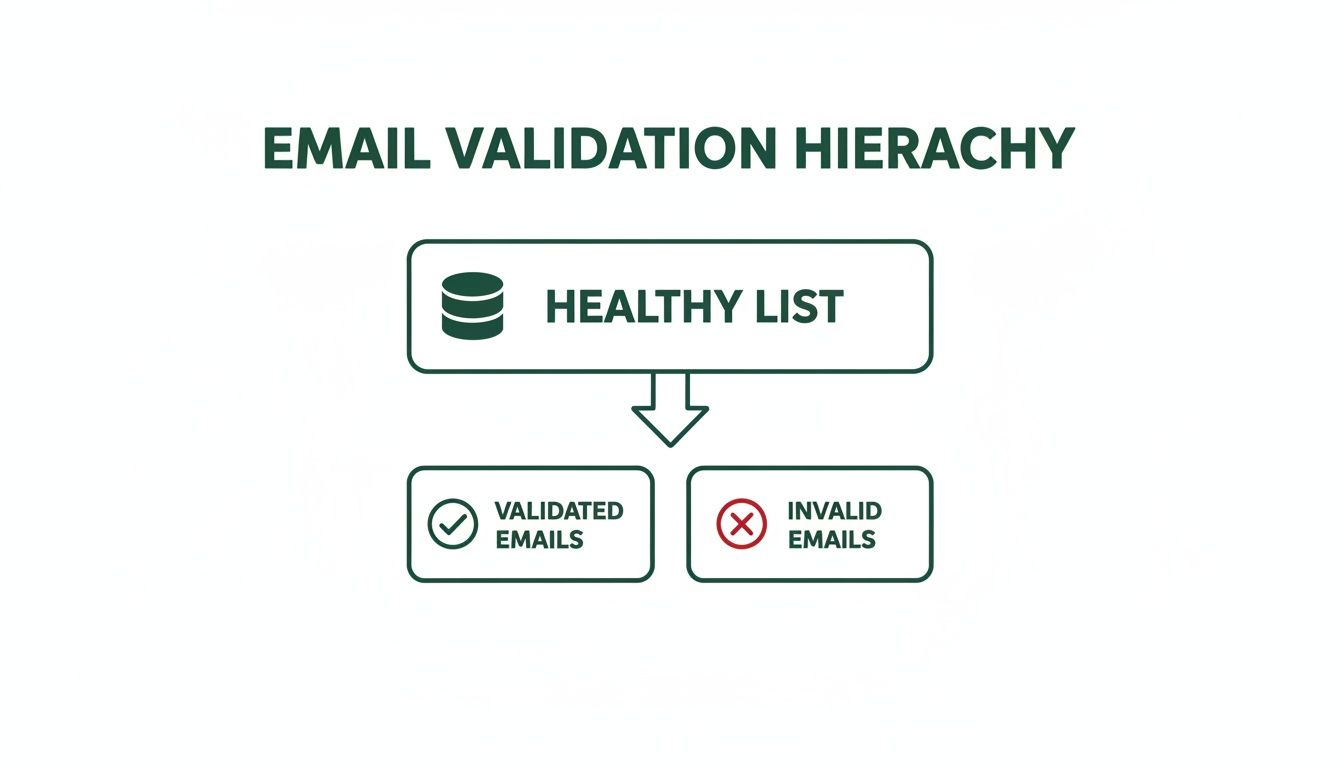
The result is a clean, validated list that protects your sender reputation and makes sure your campaigns actually perform by removing all the junk addresses holding you back.
This process can be broken down into three core stages, each serving a unique purpose.
The Three Layers of Email Validation
| Validation Layer | What It Checks | Example Error It Catches |
|---|---|---|
| Syntax Validation | The basic format and structure of the email address. | john.doe@example (missing .com) or jane doe@example.com (contains a space). |
| Domain/MX Validation | If the domain exists and is set up to receive email. | contact@nonexistentdomain123.com (domain isn't real). |
| SMTP Validation | If the specific mailbox exists on the server. | fake.employee@realcompany.com (the company is real, but the mailbox isn't). |
Let's dive into what each of these layers actually does.
Layer 1: Syntax Validation
The first and most basic check is syntax validation. This is the initial gatekeeper, and its only job is to inspect the fundamental structure of an email address. It couldn't care less if the email is real; it only cares if it looks like a proper email.
Think of it like proofreading a sentence for correct grammar and punctuation. This check just confirms that the address follows the universal local-part@domain format.
Here’s what syntax validation is specifically looking for:
- The "@" Symbol: It makes sure there is one—and only one—"@" symbol present.
- Valid Characters: It flags illegal characters like spaces, consecutive dots, or special symbols in the wrong places. An email like
john..doe@example.comwould fail instantly. - A Domain Part: It confirms there is text after the "@" symbol to represent the domain name.
While this step is great for catching obvious typos and formatting mistakes, it's just the beginning. An address like totally.fake@notarealdomain123.com would breeze right through this check, even though it's completely useless.
Layer 2: Domain and MX Record Validation
Once an address passes the syntax check, the next layer goes deeper by verifying the domain's legitimacy. This is domain and MX record validation, and it confirms that the domain (@example.com) actually exists and is configured to receive emails.
This is like checking if the issuing authority on an ID is a real, registered government agency. It's a big step up from just looking at the format.
At this stage, we move from checking the format to verifying the destination. An MX (Mail Exchange) record is a specific type of DNS entry that tells the internet where to send emails for that domain. If a domain doesn’t have an MX record, it simply can’t receive mail.
No MX record means no mailbox is even possible, making any email address at that domain instantly invalid. This check is incredibly effective at filtering out addresses tied to fake, expired, or misspelled domain names.
Layer 3: SMTP Validation
The final and most powerful layer is SMTP validation. This is a live, real-time check that actually communicates directly with the recipient's mail server to confirm if a specific mailbox exists. It's the ultimate confirmation.
Using our ID analogy, this is like calling the issuing authority and asking them to confirm that a specific ID number is active and belongs to a real person. The process involves a simulated email delivery without ever sending a message.
The validation service initiates a "handshake" with the mail server using the Simple Mail Transfer Protocol (SMTP). It basically asks, "Hey, can you accept mail for jane.doe@example.com?" The server's response tells you everything you need to know. This process can identify:
- Valid mailboxes that are active and ready to receive email.
- Invalid mailboxes that do not exist on the server.
- Catch-all domains that are configured to accept email for any address, which can be risky for deliverability.
Only by combining all three layers—syntax, domain, and SMTP checks—can you get a truly comprehensive and reliable validation. Each step plays a critical role in building a clean, high-performing email list.
Alright, you've got the basics down on what email validation is trying to protect you from. Now comes the important part: how do you actually do it?
The truth is, not all validation methods are created equal. They span a wide spectrum from quick-and-dirty DIY tricks to incredibly powerful automated services. Each one comes with its own trade-offs in accuracy, effort, and cost.
Choosing the right approach really boils down to your specific needs. What are your technical skills like? How much is a bad email address worth—or going to cost you? Let's break down the three main ways you'll see people tackle this.
The DIY Approach with Regex
The most fundamental way to check an email's format is with Regular Expressions, or Regex for short. If you're not familiar, just think of Regex as a way to create a rulebook for matching text patterns. For email validation, you'd write a pattern that looks for an "@" symbol, a domain name, and makes sure there aren't any obvious illegal characters.
It's lightning-fast and doesn't rely on any outside services, which makes it a really tempting first step for developers. But here's the catch: its limitations are huge, and it can be seriously misleading.
- It only checks syntax. A Regex pattern has no idea if a domain is real or if a mailbox actually exists. An email like
fake@thisisnotarealdomain.comwill pass a Regex check without a single red flag. - It’s notoriously complex. Honestly, writing a Regex pattern that correctly handles all the weird but valid email formats out there is a nightmare. Most of the patterns you'll find online are flawed and will either reject good emails or, worse, accept bad ones.
Regex is a pattern-matching tool, not a validation solution. Relying on it alone is like checking if a passport has the right number of pages without verifying if the country that issued it even exists. It's a surface-level check that provides a false sense of security.
Using Pre-Built Validation Libraries
Taking a big step up from Regex, you'll find validation libraries. These are essentially pre-packaged chunks of code that developers can plug into their applications. They offer a much more robust check than a simple Regex pattern because they're designed to handle more than just the basic format.
Many of these libraries can run syntax checks and even go a step further to verify that a domain has valid MX records. That adds a crucial layer of verification that Regex just can't touch. But this approach isn't without its own set of problems.
The biggest hurdle is that these libraries still demand a technical person to implement and maintain them. A developer has to handle the installation, configuration, and any ongoing updates. On top of that, most libraries stop right before the most important step: the SMTP handshake that confirms a mailbox is real. This means they'll still give a thumbs-up to emails for non-existent users at perfectly valid domains, leaving you wide open to hard bounces.
The Comprehensive Power of Third-Party APIs
For the highest accuracy and reliability, nothing beats a third-party API service. An API (Application Programming Interface) is just a way for your software to talk to a specialized validation service, letting them handle all the heavy lifting.
When you send an email to a validation API, it’s not just doing one check. It runs the address through all three critical layers of verification:
- Syntax Check: It instantly confirms the format is correct.
- Domain/MX Check: It verifies the domain is real and properly set up to receive email.
- SMTP Handshake: It pings the mail server to confirm the specific mailbox actually exists—all without ever sending an email.
This multi-layered process gives you a simple, clear answer: valid, invalid, or risky. By outsourcing the complexity, you get the best possible accuracy without having to build or maintain any of the tech yourself. For any business that relies on email outreach, using a quality email validation software is simply the most direct path to a clean and effective contact list.
Integrating Validation into Your Daily Workflow
Smart email validation isn't a "one and done" task—it's something you need to weave directly into your day-to-day sales and marketing work. Think of it like a quality control checkpoint on an assembly line. Instead of waiting until the very end to find a bunch of mistakes, you check for quality at every critical step.
By integrating email address validations at the right moments, you stop bad data cold before it ever has a chance to mess up your systems. This proactive habit saves a ton of time, protects your sender score, and makes every email you send that much more powerful.
Stopping Bad Data at the Source
Your single best opportunity to validate an email is right at the point of entry. Whether that's a signup form, a lead magnet download, or a demo request, this is your first and most effective line of defense.
Putting real-time validation on your web forms is like giving them an instant spell-checker for email addresses. It catches typos and obviously fake emails the second someone hits "submit," keeping that junk out of your database entirely. It's a simple, fundamental step for keeping your contact list clean and effective.
Cleaning Your List Before a Big Campaign
Even with the best real-time checks, email lists just naturally decay over time. It's a fact of life. People change jobs, companies get acquired, and old email accounts get shut down. Your once-perfect list will slowly accumulate bad addresses without you even noticing.
That's why running your entire list through a bulk validation service before any major email campaign is absolutely essential. This pre-flight check strips out all the dead weight, giving your message the best possible chance of hitting real inboxes. If you skip this, you risk a sudden spike in bounce rates that can seriously damage your sender reputation with providers like Gmail and Outlook.
A clean list isn't just about avoiding bounces; it's about maximizing ROI. Every dollar spent sending to an invalid address is a dollar wasted. Pre-campaign cleaning ensures your budget is focused exclusively on contacts who can actually convert.
Automating Prospecting and Validation
For sales and prospecting teams, the workflow is a little different, but the principle is exactly the same. The goal is to find new leads and make sure they're valid before they get added to your CRM or outreach sequence. This is precisely what modern tools like EmailScout are built for.
Instead of the old two-step dance—find an email, then go validate it somewhere else—these tools combine both actions into one. As you find a potential contact, the system automatically runs an email address validation check right then and there.
This integrated workflow pays off in a few huge ways:
- Time Savings: No more clunky exporting and importing between different tools.
- Instant Quality: Every lead that enters your pipeline is already pre-vetted and confirmed as deliverable.
- Increased Confidence: Your sales team can reach out to new prospects knowing their emails will actually land.
This is quickly becoming the new standard. In fact, the global market for these validation services is exploding and projected to hit $1.6 billion by 2033 as more businesses realize that solid deliverability is the foundation of any successful email strategy.
Scheduling Regular List Hygiene Checks
Finally, being proactive means getting on a regular maintenance schedule. Just like getting an oil change keeps your car running smoothly, periodic list cleaning prevents long-term deliverability headaches.
A fantastic best practice is to set a recurring calendar reminder to scrub your entire database every quarter. This simple habit catches any invalid emails that might have slipped through the cracks and accounts for that natural list decay. Our guide on how to verify an email address walks through more detailed steps you can follow for these routine checks. By making validation a consistent part of your workflow, you build a resilient and high-performing outreach engine.
How to Measure Your Validation Success
So you’ve put a solid email address validation system in place. That’s a huge win, but how do you actually prove it’s moving the needle? To really understand the payoff, you need to look past the validation process itself and zero in on the key metrics that a clean list directly impacts. This is where you connect your list hygiene efforts to real business results.
The most immediate and telling metric to watch is your Bounce Rate. More specifically, you need to keep a close eye on hard bounces—those are the permanent delivery failures that happen when an email address is fake, misspelled, or just doesn't exist. This number is the purest indicator of your list’s health. A high hard bounce rate screams "dirty list," while a consistently low one (you should be aiming for under 1%) proves your validation strategy is working as it should.

This single metric is what Internet Service Providers (ISPs) like Gmail and Outlook watch like a hawk. Getting your hard bounce rate down is the quickest way to build and protect your sender reputation, which in turn boosts your performance across the board.
Key Performance Indicators to Track
Beyond bounces, a few other metrics will naturally improve as you get consistent with email validation. Tracking these helps paint the full picture of your success and makes it easy to show the value of your work to your team.
Deliverability Rate: Think of this as the flip side of your bounce rate. It’s the percentage of your emails that actually land in a recipient's mail server. As hard bounces drop, your deliverability rate climbs, meaning more of your messages are getting where they need to go.
Sender Score: This is basically a credit score for your email domain, usually on a scale from 0 to 100. ISPs use it to decide if you’re trustworthy. By cutting out hard bounces and spam traps with validation, you’re sending all the right signals to boost your score and stay out of the spam folder.
Open and Click-Through Rates (CTR): Sure, great subject lines and content drive engagement, but a clean list is the foundation. When you stop sending emails to dead-end addresses, you stop diluting your metrics. This gives you a much clearer—and usually higher—read on how people are actually engaging with your campaigns.
When you connect the dots between a validated list and stronger campaign numbers, you turn the abstract idea of "list hygiene" into measurable business results—from more effective lead gen to higher sales conversions.
Translating Metrics into Business Value
At the end of the day, the goal is to show how these technical improvements create real-world value. When you talk about your results, frame them in terms of business impact.
For instance, a 2% drop in your bounce rate isn't just a nice number for a report. If you have a list of 50,000 contacts, that means 1,000 more potential customers are now getting your messages every single time you send a campaign. From there, it's easy to calculate the potential lift in leads, demos booked, or sales closed. This is how you prove that email validation isn't a cost—it’s a direct investment in revenue and growth.
Your Path to Smarter and Safer Outreach
Email validation isn't just a technical checkbox—it's the foundation of any good outreach strategy. We’ve walked through everything from the basic layers of validation to picking the right tools and weaving them into your daily workflow. The path forward is clear.
When you get proactive about validation, you're doing more than just tidying up a list. You’re protecting your brand, making the most of your resources, and building a stronger engine for both sales and marketing. This is the shift that separates the good from the great.
The big takeaway is simple: prioritize list hygiene today to unlock more conversations, build stronger relationships, and drive better results tomorrow. Every email you send should have a purpose and a real destination.
Think of each validated address as a confirmed opportunity—a real person waiting for the right message. Committing to this level of quality means you stop wasting time on digital dead ends and start focusing only on contacts that can actually move your business forward.
It’s time to make every single email count. Start with your next campaign and see the difference for yourself.
Common Email Validation Questions
Let's cut through the noise and answer the most common questions people have about email validation. Here are some straightforward answers to help you put these ideas into practice.
How Often Should I Validate My Email List?
The best approach is to validate every single email address the moment you capture it—like on a signup form or when someone downloads a lead magnet. Think of this real-time check as your first line of defense against bad data.
For your existing database, a full list cleaning at least twice a year is non-negotiable. Email addresses go stale faster than you'd think as people switch jobs or ditch old accounts. Consistent hygiene is the only way to protect your sender reputation over the long haul.
Can Validation Guarantee 100% Deliverability?
Nope, and any tool that claims it can isn't being honest. There's no magic bullet for 100% deliverability. Email validation gets you incredibly close by weeding out the biggest technical roadblocks: invalid syntax, fake addresses, and other high-risk accounts that cause hard bounces.
But remember, deliverability is a two-part equation. Validation gets your email to the front door, but things like your content, sending reputation, and even the recipient's server settings determine whether you actually get inside.
What's The Difference Between a Hard Bounce and a Soft Bounce?
A hard bounce is a permanent "return to sender." It means the email address is flat-out invalid, doesn't exist, or has been shut down. This is exactly what email validation services are designed to catch and remove before you hit send.
A soft bounce is a temporary problem. The address is valid, but something on the recipient's end is blocking delivery for now—maybe their inbox is full, or their company's email server is temporarily down. Since these are temporary issues, validation tools can't predict or prevent them.
Ready to stop guessing and start connecting? EmailScout finds and validates professional email addresses in a single click, ensuring every lead is a real opportunity. Start building your high-quality prospect list today by visiting https://emailscout.io.