Tag: cold email templates

  • 8 Prospecting Email Examples That Convert in 2026

    8 Prospecting Email Examples That Convert in 2026

    Stop sending prospecting emails that get buried. You've done the hard part, you found the right account, checked the title, and written a decent opener, then the message lands in silence. That's not a motivation problem, it's a framework problem, and the fix is usually a sharper angle, better personalization, and a sequence built for how buyers reply, not how sellers wish they did. For broader lead generation context, see this lead generation resource guide.

    The best prospecting email examples in 2026 do two things at once. They earn attention fast, then make the next step easy. That matters because the average cold email reply rate is 3.43%, which means roughly 97 out of 100 prospects do not reply. The same dataset shows 58% of all replies come from Step 1, so the first email carries more weight than many realize, even though strong campaigns can push past 5.5% and elite campaigns can exceed 10% (Prospeo's summary of Instantly data).

    What converts is not one magic template. It's matching the right framework to the right situation, then using tools like EmailScout to pull accurate contact data, recent company signals, and useful context without turning every send into manual research. A sequence built this way feels specific, not generic, and that's the difference between a deleted email and a real conversation.

    1. The Problem-Agitate-Solve Framework

    The PAS framework works because it starts where the prospect already feels friction. You name a pain point, show why it matters, then offer a clean way out. In prospecting, that usually beats a feature-first pitch because buyers don't wake up wanting software, they wake up wanting less chaos, less manual work, or less pipeline leakage.

    Subject line: Is your sales team drowning in manual data entry?

    A strong PAS email stays tight. Open with a problem the prospect will recognize, like slow lead enrichment, poor contact coverage, or reps wasting time on research, then agitate the cost in plain language. Not melodrama, just consequence. If the problem is operational, tie it to lost rep time or slower follow-up, then show how EmailScout's email discovery and URL Explorer can remove the manual step from the workflow.

    Practical rule: the agitation line should be one sentence, maybe two. If you keep pressing the pain point for too long, the message starts sounding like copywriting instead of a real sales note.

    The best versions use industry-specific language. A sales leader in staffing will react differently than a founder in SaaS, so the pain point needs to feel native to their world. EmailScout helps here because you can scan company pages, identify clues about hiring, expansion, or new offers, and write to a real business condition instead of a generic objection.

    A simple PAS body can look like this. “Noticed your team is scaling outbound. Most reps lose time bouncing between search tools, spreadsheets, and LinkedIn just to find one good contact. EmailScout pulls verified emails faster, so your team can spend more time booking meetings and less time hunting for data.”

    2. The Short and Sweet One-Liner

    Some prospects don't want a polished essay, they want a message that respects their time. The short and sweet one-liner is built for that reality. It works best with busy operators, senior leaders, and anyone who scans inboxes on a phone between meetings.

    Subject line guidance matters here, because the preview has to carry the message. If you want sharper subject line options, the internal playbook on email subject line best practices is the right companion to this format.

    The body should feel human and immediate. Start with the name, make one specific observation, then state the benefit in one sentence. “Hi Maya, noticed your team is hiring three SDRs. EmailScout finds verified emails in seconds, so new reps can start prospecting faster. Worth 5 minutes to see how it works?”

    That structure works because it removes ceremony. There's no long setup, no abstract positioning, and no forced narrative. The trade-off is obvious, though. Short emails only work when the observation is accurate and the value is obvious. If the opener is vague, the brevity just makes the weakness more visible.

    A good short email usually has three ingredients. A real trigger, a clear outcome, and a low-friction ask. If one of those is missing, the format can feel thin. The best teams use this style for first touches, then let follow-ups do the heavier lifting, since persistence matters more than a single shot. Salesgenie reports that campaigns with 4 to 7 emails per sequence generate three times as many responses as campaigns with fewer than 4 emails, and follow-up activity can double response rates (Salesgenie).

    3. The Social Proof and Authority Template

    Social proof works best after the prospect has already accepted that the problem is real, but still wants proof that you can solve it. This format puts credibility before persuasion, which matters in crowded categories where trust is thin and buyers are skeptical of generic claims. Keep the proof relevant, not decorative, so the email reads like evidence instead of padding.

    A professional man and woman smiling and shaking hands over a table during a business meeting.

    Subject line: How a similar team cut prospecting time

    A strong authority email usually starts with a peer group the reader recognizes, then moves quickly to a result that matters. “We've helped teams like yours reduce prospecting time by removing manual email lookup. One customer used that time to spend more hours on live outreach instead of list cleanup.” That works because it signals you have seen the problem before, and you are not guessing.

    The proof has to feel specific to the buyer's world. Case-study style proof is strongest when it shows before and after movement, not just a feature list. A template that frames the result as “went from {before metric} to {after metric} in {timeframe}” is more persuasive than a generic capabilities email, because it turns social proof into an outcome the buyer can picture (Prospeo's case study email template). For tighter targeting, pair that with personalization best practices so the proof mirrors the prospect's industry, role, and workflow.

    Practical rule: don't stack five claims in one message. One credible result, matched to one likely pain point, is usually enough.

    The trap is overclaiming. If the social proof sounds inflated, it destroys the trust it was meant to build. The better move is to match industry, role, and workflow as closely as possible. EmailScout can help with that by identifying companies and contacts that resemble your best customers, so the proof you cite sounds like the prospect's world, not a random testimonial page.

    4. The Curiosity Gap Template

    Curiosity works when it's anchored in relevance, not gimmicks. The goal is to create just enough tension that the prospect wants the next line, while still trusting that the payoff will be worth their time. That makes this format especially useful for inboxes full of generic outreach.

    Subject line: The biggest thing slowing your pipeline isn't volume

    The opener should suggest a counterintuitive insight, then offer a quick read or short explanation. “Many teams focus on sending more. We found the bigger issue is how much time reps lose before the first contact is even ready.” That kind of line works because it raises a question the prospect can't ignore, but it still sounds grounded.

    The important trade-off is credibility. If the curiosity gap is too wide, it feels clickbaity. If it's too narrow, it doesn't create any pull. The best version hints at a useful insight and then immediately promises delivery. That's why a subject line with a sharp twist paired with a brief, concrete body often performs better than a vague teaser.

    Use this pattern sparingly when the account has a clear trigger, like a hiring push, new region expansion, or a recent product launch. EmailScout's research workflow helps you find those signals quickly, so the gap can point to something real instead of a manufactured mystery. You want the prospect thinking, “That might be about us.”

    A simple curiosity email might read like this. “Hi Jordan, many outreach teams think more outreach fixes pipeline. The hidden problem is usually how long it takes to find the right contact data in the first place. I put together a short note on what changes when that step gets automated.”

    5. The Help-First Value Template

    This format wins by giving before asking. It's a clean fit for longer sales cycles, relationship-led selling, and accounts where you want to earn the right to a conversation. The email doesn't need to close immediately, it needs to be useful enough that the prospect doesn't mind hearing from you again.

    Subject line: [Name], quick tip for your sales team

    A help-first message usually starts with a specific observation, then shares a small actionable insight. If the prospect is hiring, expanding, or launching a new motion, the value can be a quick recommendation tied to that stage. The point is not to dump a white paper into the inbox. The point is to say, “I noticed something useful, and I thought it might save you time.”

    That's where research quality matters. EmailScout's URL Explorer can surface the kinds of signals that make a tip feel personal instead of generic. If the company's website shows a new market push, a new product line, or a revised positioning statement, your note can speak to that context without sounding intrusive.

    A strong help-first email also benefits from restraint. If you over-teach, the message becomes a blog post with a CTA stapled to the end. If you under-deliver, it feels like bait. Aim for one useful idea, then connect it to the next step with a soft ask. “If this is relevant, I can send a few more examples your team could use.”

    This style pairs naturally with a resource. A relevant guide or short checklist can give the prospect something practical while leaving the door open for a reply. For another set of examples and structure ideas, Yalc's guide to sales email templates is a useful reference point.

    6. The Referral and Warm Introduction Template

    Warm introductions change the frame before the prospect even reads the body. The message carries borrowed trust, so the goal is to honor that trust with brevity and clarity. This is not the place for a long pitch.

    Subject line: Following up from Priya's intro

    The message should mention the mutual contact by name, explain why the intro happened, and keep the ask simple. “Hi Daniel, Priya mentioned you're expanding the sales team and thought we should connect. We help teams reduce time spent finding verified contacts, so reps can start outreach faster. Open to a quick chat next week?”

    The strongest warm-intro emails do not oversell the connection. They acknowledge it, then move on. That matters because mutual trust works best when the message feels respectful, not opportunistic. A separate thank-you to the referring contact is smart, but the prospect-facing note should stay focused on relevance and next steps.

    This format also improves when your referral sources are intentional. EmailScout can help you build lists of likely connectors, partners, and adjacent contacts who already sit near your buyer. That makes warm outreach easier to scale without turning it into random networking.

    A warm intro is not a shortcut around relevance. It just gives relevance a better chance to be noticed.

    If the response is delayed, follow up politely and reference the original context once, not repeatedly. You don't need to re-explain the referral. You need to keep the conversation moving without making the prospect feel chased.

    7. The Specific Data Point and Research Template

    Specific research earns attention fast because it proves the message was written for one account. This format works especially well when the trigger is public and recent, like a funding round, a new hire, or a product launch. The research has to be accurate, though, because a wrong detail kills trust immediately.

    Subject line: Congrats on the Series B

    A clean research-led email opens with the finding, then ties it to a business implication. “Hi Leah, saw the team closed its Series B and added new sales leaders. That usually means more outbound motion to support. We help similar teams keep prospecting moving without forcing reps to spend hours finding verified emails.”

    The best version frames the data point as an opportunity, not surveillance. You are not saying “I've been watching you.” You are saying “I noticed a business change that affects your workflow.” That distinction matters a lot in prospecting because relevance lands better than overfamiliarity.

    Use public sources, company pages, and LinkedIn updates to verify the trigger before sending. EmailScout's research workflow can speed that up by helping you gather signals from company URLs and contact context in one pass. The result is a message that sounds informed, not scraped.

    The downside of this format is obvious. If you get the data wrong, the whole email collapses. So keep the claim simple, verifiable, and directly tied to why your offer matters now. Recent growth, new hiring, or a new product line are usually stronger than speculative assumptions about revenue or strategy.

    8. The Multi-Touch Sequence Campaign Template

    Single sends rarely carry the full load in prospecting. A sequence gives each email a role, which is why it usually outperforms one-off outreach. That idea is backed by response data too, since SalesHandy's 2026 analysis of 53M+ cold emails found that 44% of all positive replies come from follow-ups, and top-performing campaigns convert at about 2 to 3 meetings per 100 emails sent (SalesHandy).

    Video guidance can help teams think about sequence design in motion, so the embedded walkthrough is worth a look after the main structure is clear.

    The sequence itself should change angles without losing the thread. Email 1 can open with a problem or curiosity hook. Email 2 can add one researched insight. Email 3 can layer in proof. Email 4 can become a shorter personal note. Email 5 can offer a final resource before you exit the thread.

    The trade-off is patience. Teams often want every email to close the deal, which makes the sequence feel repetitive. Better sequences are spaced out, personalized by role or industry, and designed to move the conversation a little at a time. That's where tools like EmailScout matter, because you can build tighter lists, keep personalization consistent, and avoid burning time on manual research for each step.

    If you want a follow-up structure that supports this kind of cadence, the cold email follow-up sequence guide fits directly into the workflow. Partner setup can also matter when your outreach spans multiple inboxes or teams, which is why inbox routing tips like PartnerScanX's inbox unification guidance can be practical for larger outbound operations.

    8 Prospecting Email Templates Comparison

    Template Implementation complexity Resource requirements Expected outcomes Ideal use cases Key advantages
    The Problem-Agitate-Solve (PAS) Framework Medium, structured three-part copy Prospect research, careful tone control High engagement and conversation starts Cold outreach where prospect pain is identifiable Emotional resonance; creates urgency; adaptable across industries
    The Short & Sweet One-Liner Low, very concise copy Minimal research; strong subject line testing High open rates; quick responses or qualified dismissals Busy decision-makers; follow-ups and high-volume campaigns Fast to test/scale; low friction for recipient
    The Social Proof & Authority Template Medium–High, longer, evidence-driven copy Case studies, testimonials, verified metrics, permissioned logos Increased credibility and trust; higher conversions for premium offers Enterprise or premium B2B sales; risk-averse buyers Reduces perceived risk; provides decision-making anchor
    The Curiosity Gap Template Medium, craft intrigue without overpromising Creative copy, selective research to support payoff Very high opens; variable downstream engagement depending on payoff Breaking through noisy inboxes; viral or younger audiences Attention-grabbing; memorable and shareable
    The Help/Value-First Template High, bespoke, advice-driven content Deep research, content or resource creation Strong reply rates and long-term relationships; slower conversion Consultative selling, ABM, relationship-focused outreach Positions sender as trusted advisor; builds durable rapport
    The Referral/Warm Introduction Template Low–Medium, short and contextual Network coordination; named introducer and context Much higher response and faster meetings Warm leads, executive outreach, referral-driven campaigns Pre-established trust; higher conversion rates
    The Specific Data Point/Research Template High, highly personalized and verifiable copy Multiple data sources/tools; time per prospect Strong differentiation and relevance; higher engagement ABM, enterprise outbound, targeted accounts Demonstrates credibility and attention to detail
    The Multi-Touch/Sequence Campaign Template High, planning, sequencing, and testing Automation platform, varied content types, tracking 3–5x higher response vs single email; insights on messaging Scalable outbound programs and longer prospecting cycles Multiple touchpoints; allows message optimization and escalation

    Turn Examples into Your Winning Prospecting System

    The best prospecting email examples are not copy and paste assets. They're patterns you can test, adapt, and connect to a larger outbound system. PAS is useful when pain is obvious. Short and sweet works when the buyer is busy. Social proof helps when trust is the blocker. Curiosity, help-first, referral, research-led, and multi-touch sequences each solve a different part of the reply problem.

    The data makes the strategic choice pretty clear. Average reply rates are low, first-touch matters most, and follow-up drives a meaningful share of positive replies. That means your job is not to write one perfect message, it's to build a sequence that earns attention from the right accounts and keeps improving based on response patterns. The teams that win treat every send as a test of targeting, deliverability, timing, and message shape, not just writing quality.

    EmailScout fits naturally into that workflow because it helps you find contacts, gather context, and personalize faster without turning research into a bottleneck. Use it to pull verified emails, scan company URLs, and shape messages around real signals instead of assumptions. Then keep score on reply rate, positive reply rate, and meetings booked per 100 emails so you know which framework deserves more volume.

    Start with two or three formats that match your offer and your buyer. Test subject lines, compare reaction by segment, and let the market tell you which angle lands best. The goal is a repeatable playbook that feels human to the prospect and predictable to your team.


    If you want to build prospecting emails that are faster to personalize and easier to scale, EmailScout gives you the contact-finding and URL research workflow to do it. Use it to turn these examples into a live outbound system, then test what gets replies from the accounts you want.

  • 7 Winning Examples of Cold Emails That Get Replies in 2025

    7 Winning Examples of Cold Emails That Get Replies in 2025

    Cold emailing often feels like shouting into the void. Despite the effort, an overwhelming majority of outreach emails are ignored, deleted, or marked as spam. The reason is simple: they lack personalization, fail to offer immediate value, and follow a generic, self-serving structure. They ask for time without first earning attention.

    But what if you could craft emails that decision-makers actually want to read and reply to? It's not about a magic formula; it's about a repeatable method. This guide breaks down the proven strategies behind successful cold outreach, moving far beyond ineffective, copy-paste templates. We will dissect powerful examples of cold emails, exploring the psychology, structure, and specific tactics that make them work so effectively.

    You won't just see what to write; you will understand why it works. We’ll analyze several distinct approaches, from leveraging mutual connections to providing value upfront. By the end, you'll have a replicable framework to not only find the right contacts but also to engage them meaningfully. This is how you turn a truly cold lead into a warm conversation, opening doors that were previously locked shut.

    1. The Mutual Connection Email

    Leveraging a shared connection is arguably the most effective way to transform a cold email into a warm introduction. This approach, often called a referral email, immediately breaks down the recipient's natural skepticism by borrowing credibility from a trusted mutual contact. Instead of being an unknown sender, you become a recommended professional, dramatically increasing your chances of getting a response.

    The core principle is simple: social proof. When a prospect sees a familiar name, it triggers an immediate sense of obligation and curiosity. This is why it’s one of the best examples of cold emails for securing high-value meetings. The key is to get permission from your mutual contact first, ensuring the introduction is both genuine and expected.

    Example Template & Breakdown

    Here’s a practical template that puts this strategy into action.

    Subject: Introduction from [Mutual Connection's Name]

    Hi [Prospect's Name],

    My name is [Your Name], and I'm the [Your Title] at [Your Company].

    Our mutual connection, [Mutual Connection's Name], suggested I reach out to you. I was speaking with them recently about our work helping B2B SaaS companies streamline their lead qualification process, and they mentioned you were looking for innovative ways to improve your sales funnel efficiency.

    At [Your Company], we developed a platform that automates [specific task], helping teams like yours cut down on manual data entry by up to 40%. Given your role as [Prospect's Title] at [Prospect's Company], I thought our approach might be relevant.

    Would you be open to a brief 15-minute chat next week to explore if this could be a good fit?

    Best,

    [Your Name]

    Strategic Analysis

    • Immediate Credibility: The subject line and opening sentence instantly establish trust. Naming the mutual connection upfront ensures the email gets opened and read.
    • Contextual Relevance: The email explains why the connection was made, linking the referrer's suggestion directly to the prospect's potential needs.
    • Clear Value Proposition: It quickly pivots from the introduction to a concise and data-backed value proposition ("cut down on manual data entry by up to 40%").
    • Low-Friction Ask: The call-to-action is a simple, time-boxed request ("brief 15-minute chat"), making it easy for the prospect to say yes.

    Before you can send an email like this, you'll need the right contact information. If you're struggling to find verified addresses, you can discover more about how to find anyone's email address.

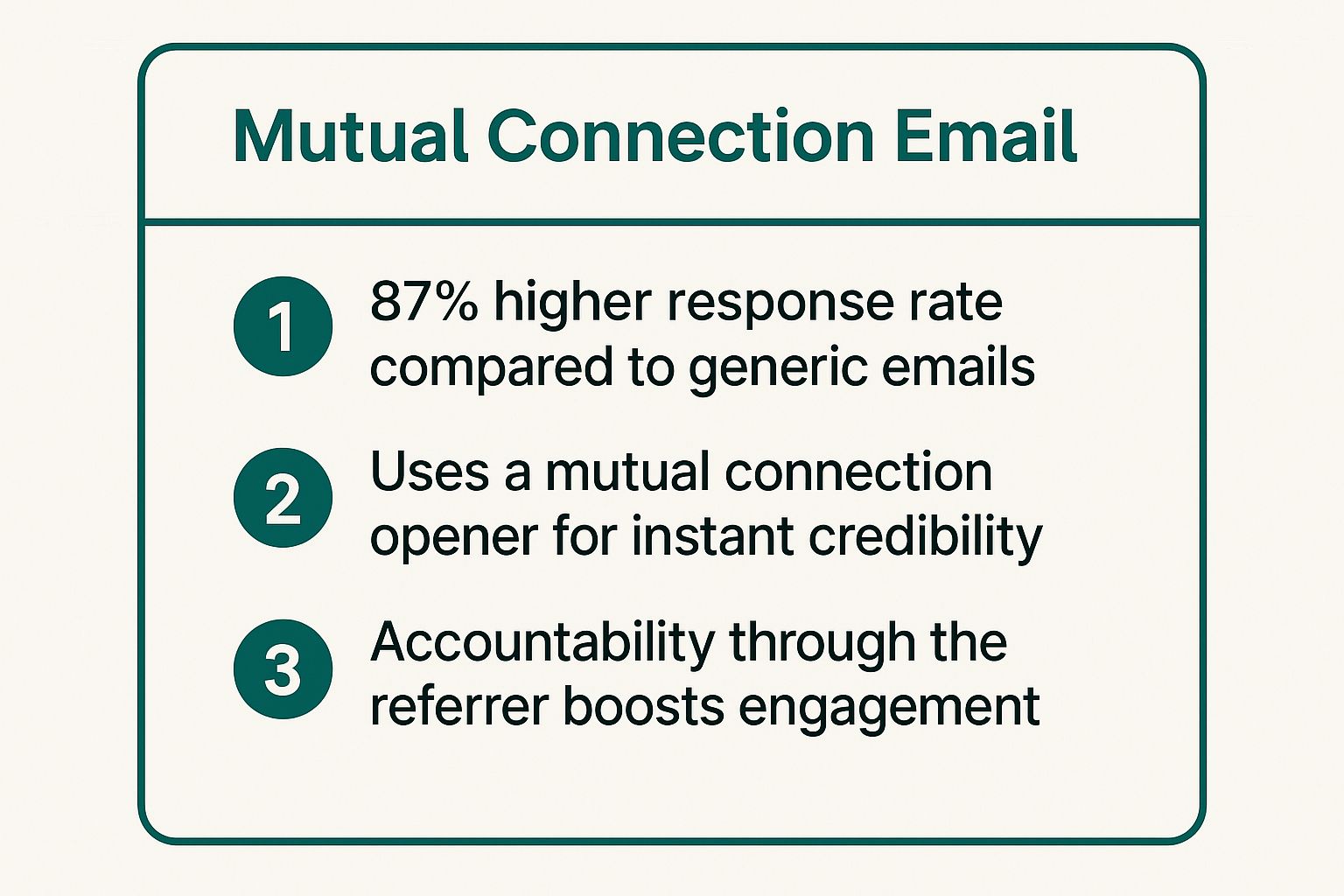
    The following summary box highlights the key reasons this email strategy is so powerful.

    Infographic showing key data about The Mutual Connection Email

    As the data shows, the combination of a trusted referrer and the inherent accountability it creates makes this approach a top performer in any outreach campaign.

    2. The Problem-Solution Email

    This classic approach works by directly addressing a specific pain point the recipient likely experiences in their role. It demonstrates that you've done your research, understand their challenges, and have a relevant solution. By leading with empathy and insight, you immediately position yourself as a valuable consultant rather than just another salesperson.

    The goal is to make the prospect feel understood. When you accurately diagnose a problem they are facing, it creates an instant connection and builds credibility. This is why it’s one of the most effective examples of cold emails for B2B SaaS, consulting, and marketing agencies, as it frames the conversation around value from the very first sentence.

    The Problem-Solution Email

    Example Template & Breakdown

    Here’s a template designed to pinpoint a specific business challenge.

    Subject: A thought on improving [Prospect's Company]'s user onboarding

    Hi [Prospect's Name],

    I was reviewing the user journey for [Prospect's Company] and noticed that new sign-ups must complete a 7-step setup process. Based on our work with other SaaS platforms, we've found that multi-step onboarding flows like this can sometimes lead to a 30% drop-off rate before a user ever reaches the "aha!" moment.

    At [Your Company], we help businesses like yours simplify this process. We recently helped [Similar Company] redesign their onboarding and they increased new user activation by 22% in the first month.

    I have a couple of specific ideas for streamlining your flow that I’d be happy to share.

    Do you have 15 minutes next Tuesday or Thursday for a quick call?

    Best,

    [Your Name]

    Strategic Analysis

    • Hyper-Specific Observation: The email opens with a precise, researched observation ("7-step setup process"). This proves you aren't just sending a generic blast.
    • Problem Agitation: It quantifies the potential negative impact ("30% drop-off rate"), making the problem feel more urgent and tangible.
    • Relevant Social Proof: The solution is introduced through a success story with a similar company ("increased new user activation by 22%"), making the value proposition credible and concrete.
    • Value-First Ask: The call-to-action offers immediate value ("I have a couple of specific ideas… to share"), which incentivizes the prospect to agree to a meeting.

    3. The Compliment and Question Email

    Opening a cold email with a genuine compliment is a powerful way to disarm the recipient and demonstrate that you’ve done your homework. This approach immediately sets you apart from generic, mass-blasted emails by showing you value the recipient’s work. By following the praise with a relevant, insightful question, you create a natural bridge to a business conversation.

    This method builds rapport before you ever make a pitch. The compliment must be specific and recent, such as referencing a recent company achievement, a well-written blog post, or a successful product launch. This authenticity makes it one of the most effective examples of cold emails for engaging busy decision-makers who appreciate being seen for their accomplishments.

    The Compliment and Question Email

    Example Template & Breakdown

    Here is a template demonstrating how to combine sincere praise with a strategic question.

    Subject: Big fan of your recent [Achievement]

    Hi [Prospect's Name],

    I just wanted to say congratulations on your recent Series B funding. Scaling a tech company in this climate is incredibly impressive, and your team's work on [Specific Project or Product] is clearly paying off.

    As you prepare to scale operations, I was curious how you're planning to maintain your award-winning customer support quality with a rapidly growing user base. It's a challenge many companies in your position face.

    My team at [Your Company] specializes in helping post-funding SaaS businesses implement scalable customer success platforms without sacrificing personalization. We’ve helped partners like [Similar Company] reduce their ticket resolution time by 30%.

    Would you be open to a quick 15-minute call next week to discuss some of the strategies we've seen work?

    Best regards,

    [Your Name]

    Strategic Analysis

    • Flattery with a Purpose: The email starts with a specific, timely compliment ("Series B funding") that feels genuine, not generic. This builds immediate goodwill.
    • Insightful Question: The question ("how are you planning to maintain…quality") is thoughtful and directly ties their recent success to a common business challenge, positioning you as a strategic thinker.
    • Pivots to Value: It smoothly transitions from the question to a solution-oriented value proposition, backed by a relevant data point ("reduce…resolution time by 30%").
    • Problem-Aware CTA: The call-to-action offers a discussion around "strategies," which is more appealing than a generic sales pitch, making it an easy "yes" for a leader focused on growth challenges.

    4. The Research-Heavy Personalized Email

    In a world of automated outreach, demonstrating genuine effort is a powerful differentiator. This approach involves deep, specific research into the recipient's company, recent achievements, or public commentary. It proves you've invested time to understand their world before asking for theirs, immediately elevating your email from spam to a bespoke communication.

    The goal is to move beyond generic compliments and connect your value proposition directly to a recent, relevant event. By referencing a specific podcast appearance, a company milestone, or a quote from an article, you create an undeniable and authentic hook. This makes it one of the most effective examples of cold emails for targeting high-value prospects or executives who are inundated with generic requests.

    Example Template & Breakdown

    Here’s a template demonstrating this highly personalized strategy.

    Subject: Your recent interview on the "Growth Unpacked" podcast

    Hi [Prospect's Name],

    My name is [Your Name], and I'm the [Your Title] at [Your Company].

    I was listening to your interview on the "Growth Unpacked" podcast last week and was really impressed by your point about the challenges of scaling customer support while maintaining a human touch. Your focus on proactive engagement over reactive ticket-handling is a philosophy we share.

    At [Your Company], we help B2B tech leaders like you solve this exact problem. Our platform uses AI to identify at-risk customers and provides your team with actionable insights to engage them proactively, reducing churn by an average of 18%.

    Given your priorities at [Prospect's Company], I thought our approach might resonate. Would you be open to a 15-minute call to discuss how we could help your team get ahead of customer issues?

    Best,

    [Your Name]

    Strategic Analysis

    • Ultra-Specific Hook: The subject line and opening sentence are hyper-personalized and timely, guaranteeing the prospect’s attention and demonstrating genuine interest.
    • Intelligent Connection: The email doesn't just mention the research; it connects the prospect's stated challenge directly to the sender's solution, creating a logical bridge.
    • Clear, Relevant Value: The value proposition ("reducing churn by an average of 18%") is concise and directly tied to the problem discussed in the podcast interview.
    • Respectful Call-to-Action: The ask is low-commitment and frames the conversation around the prospect's already-stated goals, making it an easy "yes."

    Before you can send an email this targeted, you'll need the right contact information to ensure it reaches the decision-maker's inbox. If you need help finding accurate addresses for key executives, you can discover more about how to find anyone's email address.

    5. The Value-First Email

    The Value-First email flips the traditional sales model on its head. Instead of asking for something, you give something away freely, positioning yourself as a helpful expert rather than just another salesperson. This strategy is built on the principle of reciprocity; by providing genuine value upfront, you create a positive impression and make the recipient more inclined to engage with you later.

    This approach is highly effective because it disarms the prospect's natural defenses. You aren't pitching a product or requesting a meeting. You are simply sharing a valuable resource, like an industry report, a custom insight, or a helpful tool. This makes it one of the most powerful examples of cold emails for building long-term relationships and establishing thought leadership. The initial goal isn't a sale, but to become a trusted resource.

    Example Template & Breakdown

    Here’s a practical template that demonstrates how to lead with value.

    Subject: A few thoughts on [Prospect's Company]'s content strategy

    Hi [Prospect's Name],

    I’m a big admirer of the work your team at [Prospect's Company] is doing, especially your recent [mention a specific project or piece of content].

    As the [Your Title] at [Your Company], I spend a lot of time analyzing marketing trends in the [Prospect's Industry] space. I was looking at your main competitor, [Competitor's Name], and noticed they are gaining significant traction with video testimonials on LinkedIn.

    I put together a brief, one-page document outlining three actionable video strategies that could help you capture some of that market share. It’s not a sales pitch, just some ideas I thought you'd find useful.

    You can view the document here: [Link to resource]

    Hope it helps!

    Best,

    [Your Name]

    Strategic Analysis

    • No Initial Ask: The email's power lies in what it doesn't do. It doesn't request a meeting or a call, which completely removes pressure from the recipient.
    • Highly Personalized Value: The value provided isn't generic. It’s a customized insight based on research into the prospect's company and their direct competitors.
    • Builds Authority and Trust: By offering free, expert advice, you immediately establish credibility and position yourself as a helpful authority in your field.
    • Creates a "Reason to Follow Up": This email perfectly sets the stage for a future conversation. You can later follow up to ask what they thought of the insights, making the next email much warmer.

    Crafting an email that provides value without selling can be a delicate balance. To perfect this approach, you can explore detailed guides on how to write cold emails that convert.

    The following summary box highlights the key reasons this email strategy is so powerful.

    As the data shows, leading with genuine helpfulness not only builds goodwill but also creates a foundation for future, more direct sales conversations.

    6. The Broken Link Building Email

    This strategy, a cornerstone of modern SEO, turns a website maintenance issue into a valuable opportunity. Instead of asking for something outright, you start by giving something valuable: a heads-up about a broken link on their website. By identifying a non-functioning link on a prospect's page, you create an immediate opening to offer your own relevant content as a superior replacement.

    The principle here is reciprocity. You provide a helpful fix for their website, which makes them far more likely to consider your suggestion. This approach is one of the most effective examples of cold emails for content marketers and SEO specialists looking to earn high-quality backlinks, as it solves a real problem for the recipient while achieving your goal.

    Example Template & Breakdown

    Here is a template that demonstrates how to execute this technique effectively.

    Subject: Broken link on your [Page Title] page

    Hi [Prospect's Name],

    I was doing some research on [Topic] today and came across your excellent article: [Link to Their Article].

    I noticed that the link pointing to "[Anchor Text of Broken Link]" is no longer working and leads to a 404 error page. It's the one that originally pointed to this URL: [Dead URL].

    I actually just published a comprehensive guide on a similar topic: [Link to Your Content].

    It might make a great replacement for the broken link, and I thought it could be a helpful resource for your readers.

    Either way, hope this helps you clean up the page!

    Best,

    [Your Name]

    Strategic Analysis

    • Value-First Approach: The email immediately offers value by pointing out a technical issue. This positions you as a helpful expert rather than a self-serving marketer.
    • Specific and Actionable: It clearly identifies the exact location of the broken link and the dead URL, making it easy for the website owner to verify and fix.
    • Seamless Pivot: The transition from identifying the problem to suggesting a solution (your content) is natural and non-aggressive.
    • No-Pressure CTA: The call-to-action is soft. By framing the suggestion as a helpful option, you reduce friction and avoid sounding demanding, which increases the likelihood of a positive response.

    This video from Ahrefs provides a great visual walkthrough of the broken link building process.

    By leading with a helpful gesture, this type of cold email builds goodwill and dramatically increases your chances of securing a valuable backlink.

    7. The Short and Direct Email

    In a world of overflowing inboxes, brevity is a superpower. This minimalist approach respects the recipient's time by getting straight to the point in two or three sentences, making it one of the most effective examples of cold emails for reaching busy executives and decision-makers. It cuts through the noise by eliminating fluff and focusing on a single, compelling idea.

    The core principle is to trade elaborate introductions for immediate value. By condensing your entire pitch into a powerful, data-driven statement and a simple call-to-action, you make it incredibly easy for the recipient to understand your offer and make a quick decision. This high-impact, low-friction method is designed for a fast 'yes' or 'no', maximizing efficiency for both parties.

    The Short and Direct Email

    Example Template & Breakdown

    Here is a template that embodies the short and direct philosophy.

    Subject: Quick question about [Prospect's Company]

    Hi [Prospect's Name],

    My name is [Your Name]. I help [industry] companies like yours reduce customer acquisition costs by up to 25% using a proprietary data enrichment framework.

    Would you be open to a 15-minute call next week to see how we do it?

    Best,

    [Your Name]

    Strategic Analysis

    • Radical Brevity: The email is extremely short and can be read and understood in under 10 seconds. This respects the recipient's time and increases the likelihood of a response.
    • Punchy Value Proposition: It leads with a specific, quantifiable outcome ("reduce customer acquisition costs by up to 25%"). This immediately answers the "what's in it for me?" question.
    • Laser-Focused Ask: The call-to-action is a simple, singular request for a brief meeting. There are no confusing options or multiple links, making the next step clear.
    • Low Cognitive Load: By removing unnecessary details, the email makes it easy for the prospect to process the information and decide whether to engage.

    This direct approach relies on having the correct contact information to ensure deliverability. To improve your campaign's success rate, you should understand the importance of email address verification.

    The following summary box highlights the key reasons this email strategy is so powerful.

    Strategy Key Benefit Best For
    Brevity Respects recipient's time, boosts replies Busy C-level executives, decision-makers, and high-volume outreach
    Direct Value Communicates ROI immediately Products/services with a clear, quantifiable benefit
    Simple CTA Makes it easy to say yes Securing initial meetings, gauging interest, and starting conversations
    Confidence Projects authority and self-assurance Sales professionals and founders who are confident in their offering

    As the data shows, the combination of a concise message and a clear value proposition makes this approach a standout performer for professionals who value efficiency.

    7 Cold Email Types Comparison

    Email Type Implementation Complexity Resource Requirements Expected Outcomes Ideal Use Cases Key Advantages
    The Mutual Connection Email Medium Requires research on network Higher open and response rates, instant trust When shared connections exist Builds credibility quickly, lowers spam risk
    The Problem-Solution Email Medium to High In-depth industry research Demonstrates expertise, creates urgency B2B outreach with clear pain points Highly relevant, easy to personalize at scale
    The Compliment and Question Email Medium Significant research time Positive impression, encourages dialogue Building rapport and low-pressure sales Creates genuine interest, fosters conversation
    The Research-Heavy Personalized Email High Extensive detailed research Extremely high relevance and credibility High-value prospects with big deals Shows serious intent, reduces spam perception
    The Value-First Email Low to Medium Content creation Builds goodwill and trust, long-term relationships Brand building and awareness efforts Low pressure, positions sender as helpful
    The Broken Link Building Email Medium Technical SEO and link tools High success in link-building, mutual benefit SEO/content marketing Immediate value, builds industry relationships
    The Short and Direct Email Low Minimal Quick reads, higher engagement Busy executives and decision-makers Concise, confident, easy to respond to

    From Template to Triumph: Your Next Steps in Cold Email Mastery

    We’ve navigated through a diverse landscape of cold email strategies, from leveraging mutual connections to offering upfront value and conducting deep-dive research. The common thread weaving through all these powerful examples of cold emails is not a magic formula but a fundamental mindset shift: from sender-centric broadcasting to recipient-focused conversation starting.

    The goal was never to hand you a script to copy and paste. Instead, these templates are strategic frameworks, blueprints you can deconstruct and rebuild to fit your unique voice, industry, and prospect. The most successful cold outreach is born from this process of adaptation, not blind adoption.

    Your Action Plan for Effective Outreach

    True mastery comes from implementation and refinement. Moving forward, focus your efforts on these three critical pillars:

    1. Personalization with Purpose: Ditch generic compliments and surface-level observations. The Research-Heavy and Compliment-and-Question examples demonstrate that powerful personalization connects your solution directly to a specific, observable detail about their work, a recent company achievement, or an articulated challenge. Your research should always serve the purpose of building a relevant bridge to your value proposition.

    2. Strategic Variability: Don't become a one-trick pony. The Short and Direct email works wonders on a busy C-level executive, while the Value-First approach is perfect for building trust with a technical manager. Your ability to choose the right strategy for the right audience is what separates amateurs from professionals. Use these examples as a menu of options, not a single recipe.

    3. Ruthless Iteration: Your first cold email campaign will not be your best. Your tenth will be better, and your hundredth will be a finely tuned machine. Track your open rates, reply rates, and positive response rates. Test subject lines, opening sentences, and calls to action relentlessly. Every email you send is a data point that can inform a more effective strategy tomorrow.

    Ultimately, the power of a great cold email lies in its ability to make the recipient feel understood and respected. It signals that you’ve done your homework, you value their time, and you have a genuine reason for being in their inbox. This is how you transform a cold lead into a warm conversation and, eventually, a valuable partnership. The journey from template to triumph is paved with genuine curiosity, strategic thinking, and a commitment to continuous improvement.


    Ready to ensure your perfectly crafted emails land in the right inbox? The best templates in the world are useless if they never get delivered. Use EmailScout’s powerful email finder and verification tools to get accurate, up-to-date contact information, so your strategic outreach always reaches its target. Start finding verified emails today with EmailScout.