Tag: cold email strategy

  • Best Time to Send Cold Emails: Get Higher Reply Rates

    Best Time to Send Cold Emails: Get Higher Reply Rates

    Ask ten different sales reps about the best time to send a cold email, and you'll probably get ten different answers. But what if there was a data-backed starting point?

    Turns out, there is. The consensus points to early Monday morning, specifically between 5 AM and 8 AM in your prospect's local time. Sending in this window consistently gets your email to the top of the inbox right before the workweek chaos officially kicks in, leading to a noticeable bump in reply rates.

    While a good old midweek morning is still a solid bet, that early Monday slot often lets you sneak in before the competition really wakes up.

    The Surprising Truth About Cold Email Timing

    Figuring out the "perfect" time to send a cold email can feel like a guessing game. Hit send too early, and your message is buried under a pile of weekend notifications. Send it too late, and it's lost in the shuffle of a busy workday.

    The good news? It's not about luck. Decades of email data have revealed clear patterns in how professionals work, giving us a huge strategic advantage. It's less about guessing and more about aligning your outreach with your prospect's daily rhythm.

    Think of it like this: your prospect's inbox is a crowded train station. Your goal is to show up when the platform is clear, and your target is actually paying attention. A Friday afternoon email is like arriving during the 5 PM rush hour—pure chaos. But a Monday morning email? That's like catching the very first train of the day. You get seen before the station fills up.
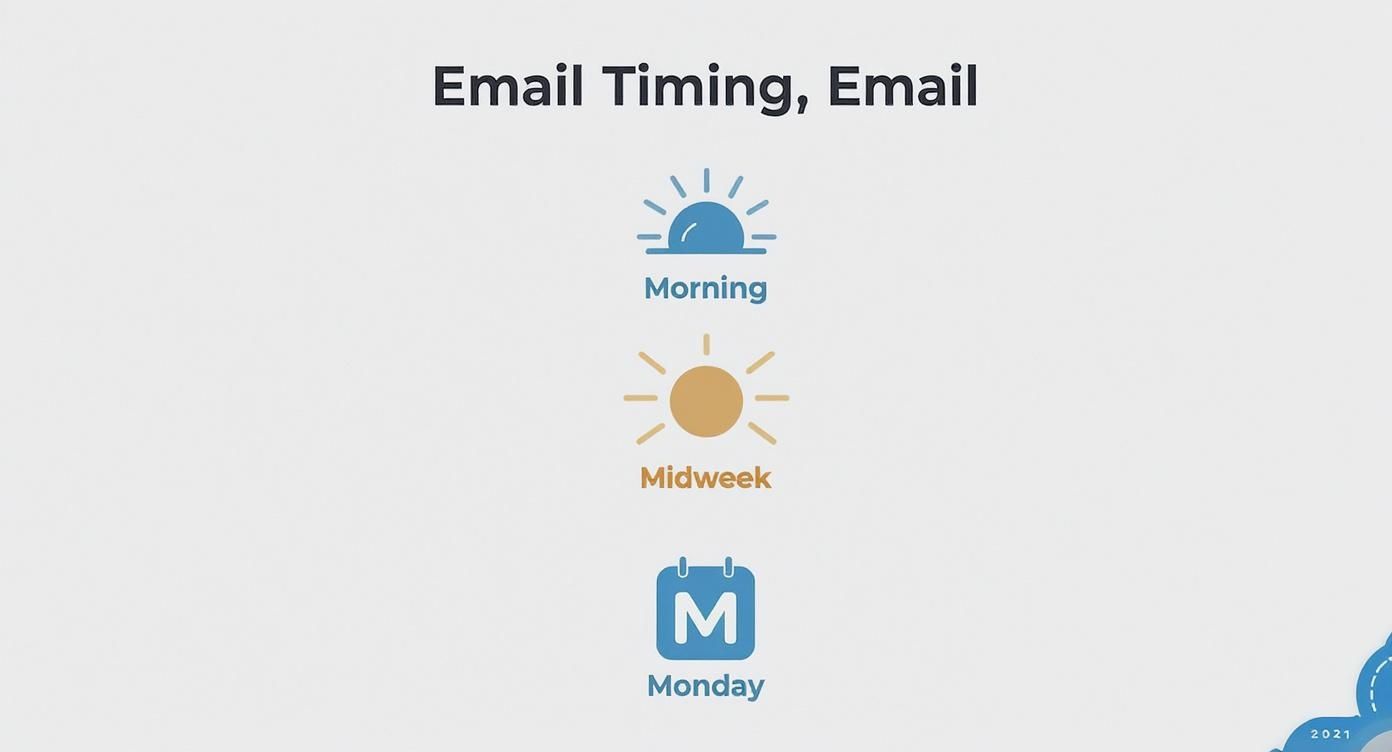
    Email timing guide with icons showing morning, midweek, and Monday as suggested optimal sending times.

    As the visual shows, early mornings and midweek days are your prime opportunities. It's all about catching someone when they're focused and ready to tackle what's in front of them.

    Finding Your Foundational Send Window

    While every industry and role has its own quirks, broad data gives us a powerful place to start. One of the most consistent findings is that the early morning hours just work better.

    For instance, one analysis found that emails sent between 5 AM and 8 AM on a Monday hit an average reply rate of 2.3%. That might not sound like a lot, but it’s significantly higher than emails sent later in the day.

    This early window is effective for a simple reason: your email is one of the first things a professional sees. They’re often clearing out their inbox with a fresh mind before the day's meetings and urgent tasks take over. By landing at the very top of their list, you dramatically increase the odds of getting an open and maybe even a thoughtful reply.

    Improving your cold email response rate starts right here, with getting your timing right.

    Here's a quick summary of the data-backed sweet spots for sending cold emails.

    Quick Guide to High-Performing Cold Email Send Times

    This table breaks down the most effective days and times, based on aggregated industry data. Use this as your starting point, but always remember to test what works for your specific audience.

    Day of the Week Optimal Send Window (Local Time) Why It Works
    Monday 5 AM – 8 AM Catches prospects at the start of the week before their schedule fills up. Low competition.
    Tuesday 8 AM – 10 AM The week is in full swing. Prospects are settled in and actively working through their inbox.
    Wednesday/Thursday 9 AM – 11 AM Peak productivity days for most professionals. Emails are often addressed promptly.
    Friday Before 12 PM Morning is okay, but engagement drops sharply in the afternoon as people wind down.

    While these times are backed by strong data, think of them as your baseline. The real magic happens when you start testing and tailoring this to your own campaigns.

    Why Midweek Sends Consistently Win

    Sending a cold email on a Monday morning might feel like you're getting a jump on the week, but the real magic happens in the middle. The heart of the professional week—Tuesday through Thursday—is the undisputed sweet spot for getting your emails opened and read. This isn't just a gut feeling; it’s a pattern tied directly to the rhythm of a typical workweek.
    A laptop on a wooden desk displays data, beside a clock and a 'TIMING MAP' sign on the wall.

    Think of the workweek like a short story. It has a beginning, a middle, and an end, and each part has a totally different energy. Your goal is to make sure your email lands in the right chapter.

    Deconstructing the Workweek Flow

    Mondays are for planning and putting out fires. Professionals are digging out from a weekend's worth of emails, jumping into kickoff meetings, and just trying to get their bearings. An unsolicited email from a stranger during this phase often feels like one more thing to deal with, not an opportunity.

    On the flip side, Fridays are for winding down. By Friday afternoon, everyone's focus has shifted to tying up loose ends before the weekend. Inboxes get ignored, and the mental energy required to consider something new is pretty much gone.

    The core idea is simple: You want to send your emails when people are deep in their work, not when they’re just starting their week or already mentally checking out.

    The Midweek Advantage in Action

    Tuesday, Wednesday, and Thursday are peak productivity. The Monday chaos has settled, but the weekend is still a distant thought. This is when people are in execution mode, and that creates the perfect window for your outreach.

    This isn't just a theory; it's backed by data. Countless studies show that Tuesday, Wednesday, and Thursday consistently deliver the highest open and response rates for cold emails. If you want to dig deeper into the numbers, you can explore some great AI-powered insights on why midweek sends perform so well on AnyBiz.io.

    Here’s how it breaks down:

    • Tuesday: Prospects are settled in. They’re actively clearing their inbox and are receptive to messages that can help them hit their weekly targets.
    • Wednesday & Thursday: These are often the most productive days of the week. People are tackling their biggest projects and are looking for solutions to immediate problems.

    By timing your outreach for this midweek window, you’re aligning your message with your prospect’s mindset. Your email shows up not as a distraction, but as a potential solution right when they need it most. That strategic timing is often what turns a cold lead into a warm conversation.

    Pinpointing the Golden Hours for Maximum Opens

    While sending mid-week is a solid starting point, the exact hour your cold email lands is what can really move the needle. Think of it like this: you want to show up right when your prospect is most likely to be checking their inbox, not when they're swamped with other things. It’s the difference between having a real conversation and leaving a voicemail that gets forgotten.

    Through tons of data and real-world testing, two specific windows have consistently proven to be the "Golden Hours" for outreach. These are the moments in a typical workday when professionals are most tuned into their email, giving your message its best shot at getting noticed.

    The Early Morning Advantage

    The first—and arguably most powerful—window is early in the morning, usually between 6 AM and 9 AM in your prospect’s local time. Why? Because you’re getting in at the very top of their inbox before the day's chaos really kicks off.

    Most professionals start their day by scanning their email to triage tasks and set priorities. Their minds are fresh, and they're actively looking to clear out clutter. An email that arrives during this time has a much higher chance of being read and considered before back-to-back meetings and urgent projects dominate their attention.

    Sending an email at 8 AM is like being the first person to speak in a meeting—you get undivided attention before the conversation gets crowded.

    The data backs this up. One huge analysis of over 10 billion emails pinpointed the absolute best time for open rates as being between 8 AM and 9 AM. If you're looking for more on this, you can explore the research on high-performing send times on EmailChaser.com. Hitting this window is your single best bet for catching a prospect when they’re most receptive.

    The Afternoon Wind-Down Window

    If you miss the morning slot, don't worry. The second key window opens up in the mid-afternoon, from around 3 PM to 5 PM. This timing is strategic because it catches people as they start to wind down their day. They've likely tackled their biggest tasks and are often doing a final sweep of their inbox before logging off.

    This creates another prime opportunity for your email to get seen. The mid-day rush is over, where your message might get quickly archived or lost in the noise. An afternoon email can feel like a welcome distraction, arriving when your prospect isn't deep in focus mode and might actually have a few minutes to consider something new.

    Of course, timing is just one piece of the puzzle. Nailing the send time is crucial, but even a perfectly timed email needs a killer subject line to actually get opened. Make sure you combine a great send time with our email subject line best practices to give your outreach the best possible chance of success.

    How to Adapt Send Times for Different Industries

    Treating email timing with a "one-size-fits-all" approach is a fast track to a miserable reply rate. The generic advice—send midweek in the morning—is a decent starting point, but it completely falls apart when you consider the unique rhythms of different industries.

    Think about it. If you email a restaurant owner at 10 AM, you’re hitting their inbox right as they’re prepping for the lunch rush. Your message is dead on arrival. Same goes for a teacher at 1 PM; that email is landing mid-lesson and getting buried.

    The key is to stop hunting for a single "best time" and start thinking about your specific prospect's day. When you adapt your send time to their schedule, it shows you’ve done your homework and, more importantly, that you respect their time.

    A gold watch and smartphone on a wooden desk during the golden hour, with a city view outside a window.

    Researching Your Prospect’s Day

    To really nail your timing, you need to create a "day in the life" profile for your ideal customer. This isn’t about being a private investigator; it’s about making educated guesses based on their role and industry. The goal is to map out their schedule and pinpoint those quiet moments when they might actually check their inbox with some focus.

    Here are a few industry-specific examples to get you started:

    • Tech Startups: Founders and developers are notorious for keeping weird hours. Early mornings (7-8 AM) can be great, but don't discount late evenings (8-10 PM) when the office has cleared out and they finally have time to think.
    • Restaurants & Hospitality: Your best bet is to aim for the lulls between service. The mid-afternoon slot from 2-4 PM is often a sweet spot, right after the lunch chaos and before dinner prep kicks into high gear.
    • Corporate Finance: These folks are often at their desks before the sun comes up. Sending an email before the market opens (6-8 AM) can get you in front of them before their day explodes.
    • Real Estate Agents: Agents are always on the go. Try mid-mornings (10-11 AM), when they might be back at their desk catching up on admin between property viewings.

    Thinking like your prospect is the most powerful optimization you can make. Ask yourself: When would they have a moment of quiet to thoughtfully consider a new email?

    Building a Targeted Outreach Strategy

    Once you have a solid hypothesis, the next step is building segmented lists that match these different timing strategies. This level of precision is what separates amateurs from pros. Smartly adapting send times goes hand-in-hand with smart lead generation. A modern outbound lead generation playbook will always emphasize defining your ICP and building hyper-specific lists first.

    This all circles back to truly understanding who you're trying to reach. Before you even think about timing, you need to be obsessed with their pain points, goals, and daily workflow. Learning how to identify your target audience isn't just a preliminary step; it's the foundation of any campaign that actually gets replies.

    When you combine deep audience knowledge with strategic timing, your cold outreach is no longer a shot in the dark. It becomes a calculated, data-informed strategy that gets results.

    Testing to Find Your Perfect Send Time

    Industry benchmarks are a fantastic starting point, but they're not the final word. The real truth about the best time to send cold emails is hiding in your own data.

    Your audience, your product, and your unique outreach style create a situation that generic advice just can't cover. This is where A/B testing becomes your most powerful tool.

    Think of it like a science experiment for your sales process. You start with a hypothesis—for example, "Sending at 7 AM will get more replies than sending at 10 AM"—and then run a controlled test to see if you're right. It takes the guesswork out and replaces it with cold, hard data.

    Setting Up Your A/B Test

    The golden rule of A/B testing is to change only one variable at a time. In this case, that variable is the send time. Everything else—the subject line, the email copy, the CTA, and the target audience—has to stay exactly the same for both test groups.

    Ready to get started? Just follow these simple steps:

    1. Segment Your List: Grab a large, uniform chunk of your prospect list. Let's say, 500 VPs of Sales in the software industry. Split this list randomly and evenly into Group A and Group B.
    2. Schedule Campaign A: Set up your email campaign for Group A to go out on Tuesday at 7:30 AM local time.
    3. Schedule Campaign B: Duplicate that exact same campaign for Group B, but this time, schedule it for Tuesday at 4:00 PM local time.
    4. Measure and Wait: Let the campaigns run for at least a week. You need to give prospects enough time to open and reply, so don't jump to conclusions after just one day.

    Tools like the EmailScout extension shown above are a lifesaver here. They help you quickly build the clean, segmented lists you need for an accurate test. A well-defined audience is the bedrock of any good A/B test.

    Interpreting Your Results

    Once your test is over, it’s time to compare the numbers. While open rate is a nice vanity metric, the number that really matters in cold outreach is the reply rate. A high open rate with zero replies doesn't start any conversations.

    Look for a statistically significant difference. This just means the difference in your results is big enough that it's probably not due to random chance. If Group A gets a 4% reply rate and Group B gets 3.8%, the difference is likely meaningless. But if Group A hits 6% and Group B is stuck at 3%, you've found a clear winner.

    Rinse and repeat this process with different days and times to keep sharpening your approach.

    For a deeper dive into optimizing your outreach, exploring AI-powered lead generation strategies can show you how modern tech can enhance your entire process, including dialing in the perfect send times.

    Common Questions About Cold Email Timing

    Even with a solid strategy in place, a few nagging questions always seem to pop up right before you hit "send." Let's clear the air and tackle some of the most common ones so you can fine-tune your approach with confidence.

    A laptop displaying A/B test results and marketing analytics, with a notebook and pen on a wooden desk.

    Think of your send time as the key that gets you in the door. It's crucial, but what you say once you're inside is what actually closes the deal.

    Does Send Time Matter More Than the Subject Line?

    This is a classic "chicken or the egg" debate in cold email. The reality? Send time, subject line, and the email copy itself are like three legs of a stool. If one is weak, the whole thing topples over.

    A perfectly timed email can't save a boring subject line, and a killer subject line won't matter if it's sent at 2 AM on a Saturday. They all have to work together.

    A great send time gets your email to the top of the inbox. A compelling subject line earns the open. Persuasive copy drives the reply. You need all three.

    So, timing isn't more important—it's equally important. You have to nail every element, from the moment of send to the final call-to-action.

    How Do I Handle Sending Emails to Different Timezones?

    This is one of the biggest, yet most easily avoidable, blunders in cold outreach. Never, ever send a mass email blast based on your own timezone.

    An email sent at 9 AM from your desk in New York lands at 6 AM in Los Angeles (which is good!), but it also hits London at 2 PM (not great) and Dubai at 6 PM (terrible). The solution is simple: always send based on the recipient's local time.

    Modern outreach tools make this a breeze. When you set up a campaign, just look for the setting that lets you schedule sends for a specific time—say, 8:30 AM—in your prospect's timezone. This simple click ensures your "golden hour" email actually arrives during their golden hour, not yours.

    What Is the Best Cadence for Follow-Up Emails?

    Persistence pays, but being annoying just gets you marked as spam. A smart follow-up cadence keeps you top-of-mind without overstaying your welcome. While you should always test what works for your specific audience, a fantastic starting point is the "2-4-7" rule.

    Here’s the breakdown:

    1. First Follow-up: Send 2 days after your initial email.
    2. Second Follow-up: Send 4 days after that first follow-up.
    3. Third Follow-up: Send 7 days after the second follow-up.

    This spacing gives your prospect room to breathe but keeps the momentum going. And remember, every follow-up needs to add new value. Ditch the "just checking in" line and instead share a relevant case study, ask a different thought-provoking question, or reference another pain point.

    Should I Avoid Sending Cold Emails on Weekends?

    For nearly all B2B outreach, the answer is a hard yes. Steer clear of weekends and major public holidays. Professionals are checked out, and by the time Monday morning rolls around, your email will be buried under a mountain of other messages.

    Sure, there are a few rare exceptions, like targeting industries that operate seven days a week. But for over 95% of campaigns, sticking to midweek business hours is your safest and most effective bet. Send your emails when people are actually in a work mindset.


    Ready to find the perfect contacts for your next timed campaign? With EmailScout, you can build hyper-targeted prospect lists in minutes. Find verified email addresses for decision-makers and segment them for precise A/B testing, ensuring your perfectly timed emails reach the right people every time. Try it for free and start building your ideal outreach list today at https://emailscout.io.

  • No Response Follow Up Email Strategies That Work

    No Response Follow Up Email Strategies That Work

    A no response follow up email is your secret weapon for turning radio silence into a real conversation. Think of it as a brief, strategic nudge sent after your first email goes unanswered, designed to gently resurface in your recipient's inbox and dramatically boost your chances of getting a reply.

    Why Your Follow-Up Email Is Your Strongest Tool

    Let's get real for a moment: most first emails are just the opening act. An ignored email isn’t a dead end—it's an opportunity. The modern inbox is an absolute battlefield for attention. With the average professional getting hit with over 120 emails a day, it’s just plain easy for a good message to get buried.

    A smart follow-up acknowledges this reality. Thoughtful persistence isn't annoying; it's genuinely helpful. Decision-makers are busy, and they often welcome a gentle reminder because your first email might have just shown up at the wrong time or slipped through the cracks.

    The Power of Professional Persistence

    Sending a follow-up isn't about being pushy. It’s about being professional. It shows you value the potential connection and are confident in what you’re offering. I like to think of it less as a "reminder" and more as a simple continuation of the conversation.

    The single biggest mistake in outreach is giving up too soon. Silence is rarely a definitive 'no.' More often, it's just a 'not right now.' A well-crafted follow-up is what bridges that gap.

    This simple act of circling back can completely change your engagement rates. The data doesn't lie. Most replies don't come from the first message. In fact, one study I often refer back to found that over 50% of all replies to cold email campaigns were triggered by follow-up emails, not the initial outreach. If you want to dive deeper, learning more about these compelling cold email statistics really drives home the impact of persistence.

    Before we get into the templates, let's look at the numbers and what they mean for your strategy.

    The Impact of Following Up At a Glance

    This table breaks down why a solid follow-up strategy is non-negotiable for anyone serious about outreach. The stats make a clear case for not giving up after one try.

    Metric Key Statistic What This Means For You
    Replies from Follow-Ups 50%+ Over half of your potential conversations are waiting in your follow-ups. Skipping them means leaving the majority of your results on the table.
    Campaign Success Up to 27% reply rate Campaigns with 4-7 follow-ups significantly outperform those with only 1-3. Persistence pays off directly in your reply rates.
    Inbox Overload 120+ emails/day Your first email is easily missed. A follow-up gives you a second (or third) chance to be seen by a busy prospect.
    Giving Up Too Soon 44% of salespeople Nearly half of salespeople give up after just one follow-up, creating a massive opportunity for those who are willing to be more persistent.

    The takeaway here is simple: if you're not following up, you're competing with less than half of your potential.

    This isn’t about just blasting more emails into the void. It’s about building a thoughtful sequence that adds a little more value with each touchpoint. Every follow-up is a fresh chance to:

    • Provide Context: Briefly and politely remind them why you reached out.
    • Offer New Value: Share a relevant article, a quick tip, or a powerful case study.
    • Simplify the Ask: Make your call to action even clearer and easier to act on.

    When you adopt this mindset, you can turn that initial silence into a genuine conversation and massively improve your odds of getting that all-important reply.

    Mastering the Timing and Cadence of Your Follow Ups

    When you send a follow-up is just as crucial as what you write. I’ve seen incredible messages fall flat simply because the timing was off. The real art is finding that sweet spot between being helpfully persistent and just becoming an inbox pest.

    Silence doesn't always mean "no." Sometimes, your email just got buried. Other times, the person saw it but got pulled into a meeting. A well-timed no response follow up email respects their busy schedule while gently popping your message back to the top of their list.

    The Critical First Follow Up Window

    The timing of your very first follow-up is the most important one. Jump the gun, and you look desperate. Wait too long, and they've already forgotten your original email. Through years of trial and error, I've found the ideal window is 2-3 business days after your initial outreach.

    This short pause gives them enough time to read and process your message without letting it get lost in the digital abyss. It establishes a professional rhythm that says you're on top of things, but not pushy.

    Silence is rarely a hard 'no.' More often, it's a 'not right now.' Your follow-up timing is what helps you determine the difference and stay top-of-mind for when 'right now' happens.

    The data backs this up, too. That little window between emails can make a huge difference. For instance, waiting three days before that first nudge can boost reply rates by a whopping 31%. But if you delay for more than five days, you're looking at a 24% drop in responses. You can dig into more of these fascinating cold email statistics and their impact to see for yourself.

    Building a Professional Follow Up Cadence

    One follow-up is good, but a planned-out sequence is what separates the pros from the amateurs. You need a cadence—a schedule for your follow-up attempts. This keeps you from sending random, one-off messages and makes every touchpoint feel deliberate.

    A rookie mistake is firing off follow-ups too close together. A much better strategy is to gradually increase the time between each email. This approach keeps you on their radar without completely overwhelming them.

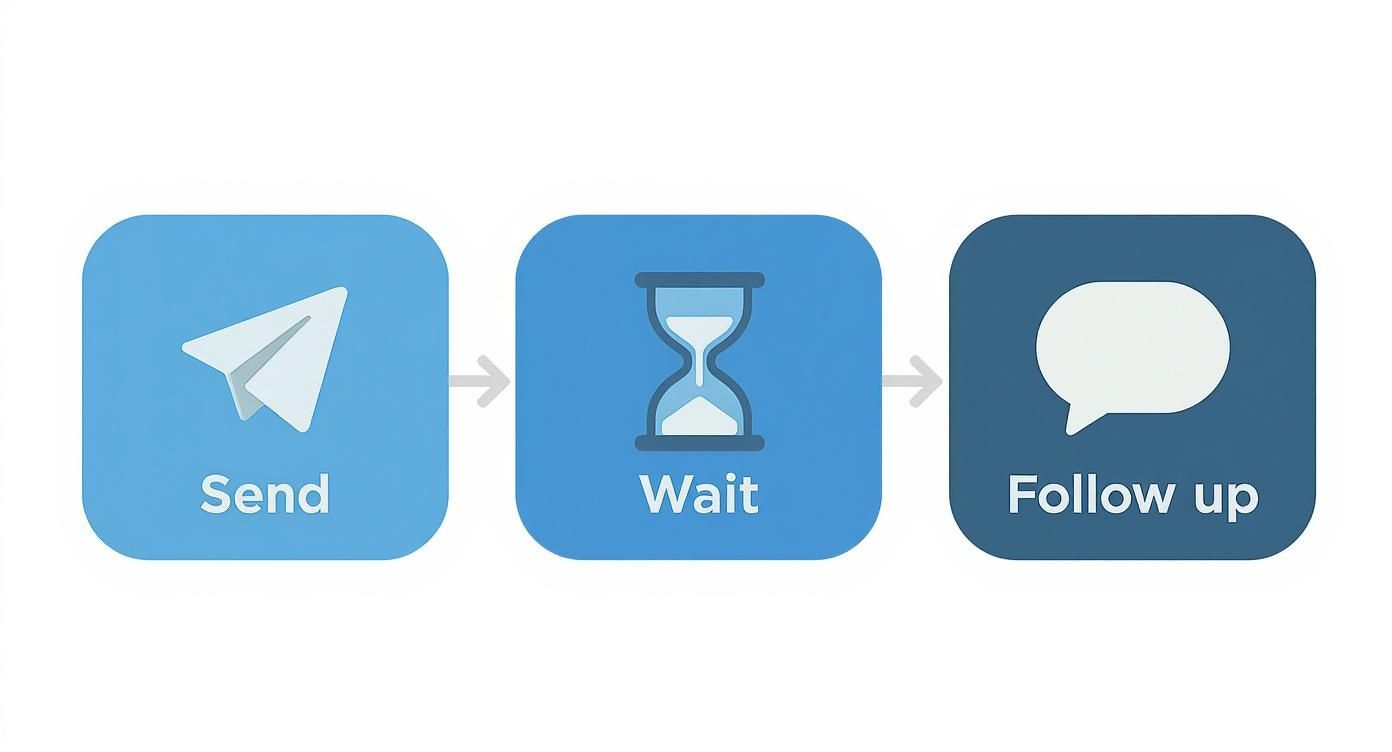
    This simple visual breaks down the core rhythm: send, wait, then follow up.

    An infographic showing a three-step process: Send (paper airplane), Wait (hourglass), and Follow up (speech bubble).

    The key thing to remember is that the 'wait' period isn't just a passive delay; it's an active part of your strategy.

    Here’s a practical, multi-touch cadence that I've seen work wonders for B2B sales and general outreach:

    • Follow-Up 1: Send 3 days after the initial email.
    • Follow-Up 2: Send 5 days after the first follow-up.
    • Follow-Up 3: Send 7 days after the second follow-up.

    If you get radio silence after three attempts, it's usually best to press pause on that sequence. This schedule gives your contact plenty of breathing room while still giving you multiple, well-spaced chances to connect. It strikes that perfect balance, making sure your no response follow up email lands with professional grace every time.

    Field-Tested Follow Up Email Templates That Get Replies

    We’ve all been there. Staring at a sent email, waiting for a reply that never comes. The temptation to just send a generic "just checking in" is strong, but it's also a fast track to the trash folder. Let's ditch that approach.

    To help you get unstuck, I’ve pulled together a few of the exact, field-tested templates I use every day. Think of them less as copy-paste formulas and more as battle-tested frameworks. They’re built on real human psychology to re-engage your prospect without being annoying.

    Of course, the golden rule is to never be generic. A little personalization goes a long way in showing you’ve actually done your homework. Use these templates as your starting point, but always add your own voice.

    A flat lay of a workspace with a laptop, notebook, pen, and a 'FOLLOW UP TEMPLATES' speech bubble.

    Template 1: The Quick Bump

    This is your first move, usually 2-3 days after your initial email goes unanswered. It's designed to be light, polite, and respectful. The whole point is to assume they’re just swamped—because most people are.

    It works because it isn’t demanding. It’s a simple nudge that brings your original message right back to the top of their inbox.

    Subject: Re: [Original Subject Line]

    Hi [First Name],

    Just wanted to quickly follow up on my email about [briefly mention original topic].

    I know how easy it is for things to get buried in a busy inbox. Just wanted to gently bump this to the top for you.

    Best,
    [Your Name]

    This template is all about being low-pressure. It gives them context without making them dig through their inbox, making it super easy to fire back a quick reply. If you need some inspiration for that first email, these https://emailscout.io/cold-email-example/ offer a great look at what actually gets opened.

    Template 2: The Value-Add

    Okay, so the quick bump didn't work. Time for a new tactic. Instead of asking for their time again, you’re going to give them something useful. This move instantly repositions you from a salesperson to a helpful resource. It's a perfect play for your second or third follow-up.

    Subject: A resource for [Their Company Name]

    Hi [First Name],

    Following up on my last note about [original topic].

    I actually came across this [article/case study/report] today and immediately thought it might be relevant to your work on [mention a specific project or goal of theirs]. It has some great insights on how to [achieve a specific positive outcome].

    No reply needed, just thought it might be helpful.

    Cheers,
    [Your Name]

    The real magic here is in its selflessness. By saying "no reply needed," you remove all the pressure, which—paradoxically—often makes people want to reply out of genuine appreciation.

    Template 3: The Breakup Email

    You've sent a few polite, value-driven follow-ups, but you're still hearing crickets. It's time to close the loop with the "breakup" email. This one works surprisingly well because it taps into a powerful psychological trigger called loss aversion.

    By politely signaling you're going to stop contacting them, you create one last chance for them to act if they ever had even a flicker of interest.

    Subject: Closing the loop

    Hi [First Name],

    I've reached out a few times about [original topic] but haven't heard back, so I'll assume this isn't a priority for you at the moment.

    I won't follow up on this again, but please don't hesitate to reach out if things change down the road.

    All the best,
    [Your Name]

    This approach is pure professionalism. It shows you respect their time and inbox, leaving the door open on a positive and memorable note. For more ideas on handling different follow-up situations, check out these 7 Sample Follow-Up Email After No Response Templates.

    Choosing Your No Response Follow Up Email Template

    To make it even clearer, here’s a quick breakdown of when to pull each template out of your toolkit.

    Template Name Best For Key Goal Tone
    The Quick Bump First follow-up (2-3 days after) Gentle reminder & easy reply Polite & brief
    The Value-Add Second or third follow-up Build credibility & offer help Resourceful & generous
    The Breakup Email Final follow-up (after 3-4 attempts) Prompt a final decision Professional & respectful

    Having a few distinct plays like this for your no response follow up email strategy is a game-changer. It lets you create a thoughtful sequence that adapts to the silence, rather than just hitting "send" on the same boring message again and again.

    Common Follow-Up Mistakes That Land You in Spam

    Even a perfectly crafted no response follow up email can misfire and tank your sender reputation if you’re not careful. Let’s be honest, many follow-ups are doomed from the start, loaded with rookie mistakes that get them instantly deleted—or worse, flagged as spam. Avoiding these common traps is just as crucial as knowing what to write in the first place.

    When your email lands in the spam folder, it's not just a wasted effort. It actively hurts your chances of reaching anyone's inbox down the road. The goal is to be persistent without being a pest, and that's a fine line to walk.

    Computer screen displaying 'AVOID SPAM' and an email icon, with crumpled paper on a wooden desk, symbolizing email management.

    Vague Subject Lines and Lazy Language

    Want a one-way ticket to the trash folder? Use a lazy, generic subject line. Phrases like "Just checking in" or "Following up" scream low effort and offer zero value to the person reading it. They give no context and force the recipient to do the mental gymnastics of remembering who you are and what you wanted.

    Just as bad is using passive-aggressive or guilt-tripping language.

    Avoid phrases like, "Just bumping this to the top of your inbox." It can come across as entitled and impatient, which is rarely a good look.

    The solution is simple: always reply in the same thread to keep the conversation history intact. And for your subject line? Add a new piece of information or a clear question to make it worth their while to open.

    The Failure to Personalize and Add Context

    Blasting out a generic, impersonal follow-up is another huge mistake. An email that just repeats the same request without adding anything new feels automated and spammy. You have to remind them of the original context and then give them a fresh angle or a new piece of value.

    It's shocking how few sales pros actually follow up, especially when the data proves it works. Industry benchmarks show that a staggering 48% of reps never even send a second message, and 44% give up after just one attempt. This massive drop-off is a huge opportunity for anyone willing to follow up thoughtfully. You can dig into more of these B2B cold email statistics on martal.ca.

    Here are a few common slip-ups that will absolutely destroy your deliverability:

    • Forgetting Context: You don't reference the original email or your last conversation.
    • No New Value: You're just nagging them with the same ask over and over.
    • Incorrect Contact Info: You're sending messages to outdated or wrong email addresses, causing high bounce rates.

    Ultimately, a massive number of follow-up failures happen before you even hit "send." Blasting emails to unverified addresses is one of the fastest ways to destroy your domain's reputation. We put together a guide on how to verify emails before you start your outreach—it’s a crucial step to protect your deliverability.

    Using EmailScout to Supercharge Your Outreach

    Let's be honest. All the clever templates and perfect timing in the world are completely worthless if your emails just land in a dead inbox. A truly great no response follow up email strategy starts long before you ever write a single word—it begins with a clean, verified list of contacts.

    This is exactly where having the right tool becomes your biggest advantage.

    Plugging a platform like EmailScout into your workflow isn't just a nice-to-have; it's a foundational move to protect your sender reputation and actually get a return on your outreach. Every email sent to an invalid address spikes your bounce rate, which email providers see as a huge red flag.

    Too many bounces will absolutely tank your domain's credibility. Before you know it, even your valid emails struggle to get through. It's the silent killer of so many outreach campaigns.

    Verify Before You Send

    The single most effective way to boost your follow-up success is to guarantee deliverability from the jump. That means verifying every single email address before it ever touches your sequence.

    Using an email verification tool is like basic digital hygiene. It scrubs your list of typos, old contacts, and those tricky catch-all addresses that almost always bounce. This one simple step has a massive impact on your campaign's health and ensures your carefully written messages actually have a chance of being seen by a real decision-maker.

    The EmailScout dashboard gives you a clean, at-a-glance view of this whole process.

    This interface lets you quickly upload lists, check verification results, and manage your contacts without any fuss, making that pre-campaign cleanup dead simple.

    Find Accurate Contact Information

    Beyond just verifying addresses, real success comes from contacting the right person. A follow-up sent to a generic info@company.com inbox is a shot in the dark. One sent directly to the department head? That’s how you start a conversation.

    Your outreach is only as good as your contact data. Spending a few extra minutes to find the direct email of a key decision-maker can be the difference between a closed deal and a deleted email.

    Tools like EmailScout were built to solve this exact problem. They help you pinpoint the correct contacts inside a target company and give you their direct email addresses. If you're looking to build hyper-targeted lists, you can learn more about how to find business emails with precision on our blog.

    When you combine accurate contact discovery with pre-send verification, you create a powerful one-two punch. This ensures your no response follow up email sequence not only dodges the spam folder but lands right in the inbox of the person who can actually say "yes." It's a proactive approach that saves you time, protects your sender score, and dramatically boosts the effectiveness of your entire outreach effort.

    Your Follow-Up Email Questions, Answered

    Even with the best templates, you'll run into situations that feel a bit tricky. When it comes to the no response follow up email, there isn't always a single right answer. This is where experience comes in handy.

    I've rounded up some of the most common questions we get, with practical advice to help you navigate those gray areas and send every follow-up with confidence.

    How Many Follow-Ups Is Too Many?

    Ah, the million-dollar question. While there's no magic number, a good rule of thumb for most cold outreach is 3-5 follow-ups spread out over a few weeks. If you send fewer, you’re probably giving up too soon. Any more than that, and you're venturing into annoyance territory, which is a quick way to get marked as spam.

    The real key, though, is to add value every single time. If all you're doing is sending "just checking in" pings, even two follow-ups will feel like too many. But if each message offers a new resource, a relevant case study, or a fresh insight, a longer sequence can feel helpful and natural.

    A good follow-up sequence shouldn't feel like a countdown. It should feel like a series of helpful nudges. When you run out of genuine value to add, it's time to send the breakup email and close the loop.

    What’s the Best Day and Time to Send a Follow-Up?

    The technically correct answer is "it depends," but we've seen enough data to spot some pretty clear trends. For most B2B communication, the sweet spots are during standard work hours.

    • Best Days: Tuesday, Wednesday, and Thursday consistently win. Mondays are a mad dash of catching up from the weekend, and people are often checked out by Friday afternoon.
    • Best Times: Mid-morning (around 10 AM) and early afternoon (around 2 PM) tend to perform best. This timing helps you avoid the morning inbox tsunami and the end-of-day scramble to wrap things up.

    Of course, use your judgment. Think about your prospect's world. An email to a restaurant owner might land better outside of the lunch and dinner rush, while a contact at a global tech company might be online at all hours.

    Should I Send a New Email or Reply in the Same Thread?

    Always, always, always reply in the same thread. I can't stress this one enough. It's a non-negotiable for sending a no response follow up email.

    Keeping the conversation in one place provides instant context. Your prospect doesn't have to go digging through their inbox to remember who you are or what you were talking about. You're making their life easier, which dramatically boosts your chances of getting a reply.

    Starting a new email for every follow-up shatters the conversational flow. It feels disjointed and, frankly, can come across like a brand new, unsolicited email each time—a surefire way to get ignored or flagged.


    Ready to make sure every follow-up has the best chance of landing in the right inbox? EmailScout helps you find and verify accurate contact information for key decision-makers, so your perfectly crafted messages never go to waste. Start building cleaner, more effective outreach lists today.