
When it comes to the great cold calling vs. cold emailing debate, the difference boils down to this: cold calling is immediate and personal but tough to scale. Cold emailing is scalable and efficient but feels less direct. Your choice really depends on what you value more—high-touch, personal engagement for big-ticket sales, or broad, efficient outreach to fill a volume-based pipeline.
The Modern Sales Debate: Cold Calling vs. Cold Emailing
Picking the right outreach method is a massive decision for any sales team. This isn't just about choosing a channel; it's about making sure your strategy clicks with your target audience, sales cycle, and the bigger picture of your business goals. While both are designed to turn strangers into customers, they work off completely different playbooks for engagement and resource management.
Cold calling is the old-school heavyweight of sales, relying on direct, real-time phone conversations. It's fantastic for building instant rapport and crushing objections on the spot. You'll often see this method used for high-value, complex deals where a genuine human connection can seal the deal.
On the other hand, cold emailing is the modern, asynchronous approach. It's text-based and lets prospects engage whenever it suits them. The biggest wins here are scalability and efficiency. A single rep can hit up hundreds of potential leads in the time it takes to make just a handful of calls. This makes it a go-to for SaaS companies, startups, and any team aiming for a wide market.
Cold Calling vs. Cold Emailing Quick Comparison
To help you quickly grasp the fundamental differences in efficiency and outcomes, here’s a side-by-side comparison of key performance indicators.
| Metric | Cold Calling | Cold Emailing |
|---|---|---|
| Speed of Connection | Immediate (if answered) | Delayed (hours or days) |
| Scalability | Low (one-to-one) | High (one-to-many) |
| Prospect Disruption | High (interruptive) | Low (non-intrusive) |
| Personalization | Adaptive, in-the-moment | Data-driven, at scale |
| Cost Per Lead | Higher | Lower |
| Ideal For | High-value, complex sales | Volume-based pipelines, SaaS |
As you can see, each channel has its clear strengths. The key is understanding how these metrics align with your specific sales motion and resources.
Core Comparison Criteria
To really get to the bottom of the "cold calling vs. cold emailing" dilemma, we need to measure them against the same yardstick. Throughout this guide, we'll break down each strategy using four crucial factors:
- Cost and Scalability: A hard look at the financial and operational muscle needed to run each strategy effectively.
- Response and Conversion Rates: Digging into which method actually gets more replies and, more importantly, books more meetings.
- Lead Quality: An honest assessment of the engagement quality and how that translates to real pipeline value.
- Ideal Use Cases: Pinpointing the exact scenarios where one channel is the obvious winner over the other.
The smartest outreach strategy is rarely a choice between one or the other. The truly successful sales teams know exactly when to shoot off an email and when to pick up the phone, weaving them together into a powerful, multi-touch sequence.
This guide gives you a data-backed framework to help you make smarter decisions, making sure your outreach efforts hit the mark every time.
Comparing Scalability and Return on Investment

When you get down to the brass tacks of running a sales team, two things matter more than anything: scalability and return on investment (ROI). It's here that the differences between cold calling and cold emailing really come into sharp focus. For any team trying to build sustainable growth, these numbers tell the real story of what each channel costs and what it can deliver.
Cold calling, at its core, is a one-to-one game. Every single dial demands a rep's undivided attention—from the prep work to navigating the call itself and logging the notes afterward. This human touch is exactly what makes it great for building rapport, but it's also its biggest operational weakness.
On the other hand, cold emailing is practically built for scale. You can take one well-written template, personalize it, and get it in front of hundreds of prospects in the time it takes a rep to make a handful of calls. It's a one-to-many approach that's just flat-out more efficient.
The Economics of Outreach Volume
This gap in scalability directly shapes how many people a single rep can actually reach in a day. The numbers don't lie, and they paint a pretty clear picture.
A dedicated sales rep who is purely cold calling might manage 6-9 calls per hour. That number isn't just dialing—it's everything that goes with it, like getting past gatekeepers, leaving voicemails, and having the actual conversations. It's a slow, methodical grind.
Now, flip that. A rep armed with an email automation platform can send 80-120 personalized emails per hour. That massive difference in sheer output means your team can test markets, collect data, and pack the top of your funnel at a speed that's impossible to match with manual dialing.
The scalability debate boils down to simple math. One channel is linear—you add one prospect at a time. The other is exponential—you can engage entire segments of your market all at once.
For any team with aggressive growth targets, that distinction is a game-changer. Email lets you build momentum fast, whereas calling requires a much larger—and more expensive—team to get anywhere near the same reach.
Analyzing the Return on Investment
At the end of the day, the only metric that truly matters to a sales leader is ROI. When you stack up the costs against the results, cold email pulls way ahead. That efficiency translates directly to a better cost-per-lead and a much healthier return.
The data shows cold emailing just crushes cold calling from a financial standpoint. On average, email marketing can bring in up to $42 for every $1 you spend. Cold calling? It generates about $1.80 per dollar invested. That massive gap is exactly why so many modern sales teams build their outreach strategy around email first.
This all comes back to the high labor costs tied to calling. A sales rep's salary is your biggest expense, and because their time results in fewer contacts per hour, the cost for each interaction is naturally much higher. While tools like a CRM with VoIP integration can certainly make calling more efficient and trackable, they can't change the fundamental economics.
Even with the best tech, the math is what it is. For businesses that need to stretch every dollar in their outreach budget and show a clear, positive return, cold emailing is the smarter financial bet. Its low overhead and incredible scalability make it a powerhouse for generating leads without draining your bank account.
Analyzing Response Rates and Lead Quality
Beyond the costs and scalability, the real debate between cold calling and cold emailing boils down to a simple question: which one actually gets a response? And just as important, which one delivers leads who are genuinely ready to talk? This is where we stop looking at volume and start focusing on the quality of engagement.
A successful cold call can feel like a massive win, but the data often shows email pulling in a higher number of initial replies. Cold emailing just works on a different psychological level. It’s less intrusive, and it gives prospects the space to engage when they’re ready, which often translates to more thoughtful initial interest.
On the other hand, a cold call is an interruption by nature. When a rep manages to get a decision-maker on the line, the conversation is immediate and alive. That real-time interaction is unmatched for instantly qualifying a lead, handling objections on the spot, and building a human connection.
Dissecting the Numbers: Open Rates vs. Conversation Rates
To figure out which channel really performs, we need to look at their core engagement metrics. For email, it's all about opens and replies. For calls, it’s connection and conversation rates.
When you compare response rates, cold emailing usually has an advantage in raw volume, especially for B2B teams focused on scalable growth. The numbers show that cold emails can average a 24% open rate and an 8.5% response rate. Highly tuned campaigns can even push opens to 55% and responses to an incredible 30%.
In contrast, a solid cold calling strategy might hit a 13-14% response rate, but getting there takes serious persistence—we’re talking up to six calls to land a single conversation. You can learn more about how to boost these numbers by checking out our guide on improving your cold email response rate.
Research from Cognism drives this point home, showing a 65.6% success rate for calls that actually lead to a conversation. The catch? The overall success rate for calling has plummeted to just 2.3%, mostly because a staggering 80% of calls go straight to voicemail. These numbers, which you can find more of over on HubSpot's blog, clearly show the uphill battle callers are facing.
The Quality of Engagement: Direct vs. Asynchronous
The raw numbers are one thing, but the quality of the lead you get from each channel is a whole different story. A positive reply to a cold email often signals genuine, considered interest. The prospect took the time to read your message, think about your offer, and decide to respond on their own terms. That lead has essentially pre-qualified themselves.
A great cold call, however, can produce an exceptionally high-quality lead. A direct conversation lets a skilled rep dig into deep pain points, answer complex questions, and forge a personal connection that email just can't replicate.
A great cold call can turn a lukewarm prospect into a hot lead in five minutes. A great cold email plants a seed that requires careful nurturing to grow into a qualified opportunity.
This fundamental difference in engagement style has a huge impact on the sales cycle.
- Cold Calling Leads: These leads often move faster through the sales funnel. The direct qualification and rapport built during that first call give them momentum. They're typically a better fit for high-value, complex sales where building trust is everything.
- Cold Emailing Leads: These leads might need more follow-up and nurturing, since the initial connection is less personal. But the scalability of email lets you fill the top of your funnel with a much larger pool of these interested prospects.
Ultimately, deciding between cold calling and cold emailing for lead quality comes down to your sales model. Are you hunting for a few big "whales" where that personal touch is critical? Or are you casting a wide net, hoping to catch as many potential customers as you can? Answering that question is the key to aligning your outreach with your business goals.
Choosing Your Outreach Strategy: When to Call vs. Email
Picking between a cold call and a cold email isn't about which one is "better"—it's about knowing which tool to pull out of the toolbox for a specific job. The right choice depends entirely on your ideal customer, how complex your product is, and the typical length of your sales cycle. Instead of a hard-and-fast rule, think of it as a strategic framework that guides you to the best channel for each scenario.
For instance, if you're chasing a high-value enterprise deal with a long, complicated sales process, the direct, personal connection of a cold call is almost always the way to go. On the flip side, a SaaS startup that needs to get in front of a huge audience quickly will find cold emailing a much more powerful engine for growth.
This infographic breaks down the core engagement numbers, showing how the high conversation rate from calling stacks up against the typical open rate for emailing.
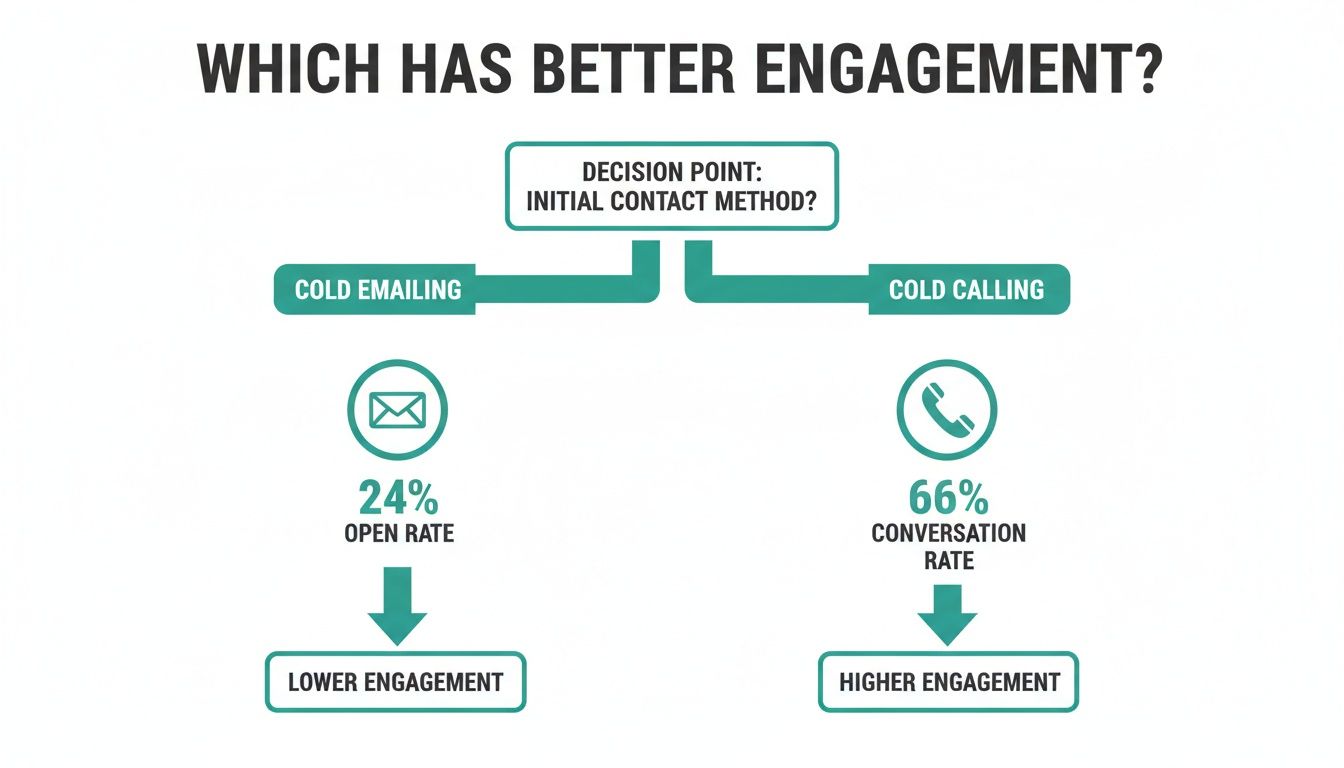
The data is pretty clear: while you might connect on fewer calls, the ones that get through have a much higher chance of becoming a real conversation than an email has of just being opened.
When Cold Calling Wins
Cold calling shines in situations where building instant, personal rapport is what moves a deal forward. It's the right move for high-stakes scenarios that need a human touch to cut through complexity and build real trust.
You should be cold calling when:
- Your Deal Size is Large: For six-figure contracts or major enterprise solutions, the time invested in a direct conversation is a no-brainer. Handling objections on the fly and making a personal connection can make or break the deal.
- The Product is Complex: If what you're selling needs a detailed explanation or a consultative approach, a phone call beats an email every time. You can pivot your pitch in real-time based on how the prospect reacts.
- You're Targeting Senior Executives: C-level leaders are usually guarded by gatekeepers. A confident, well-timed phone call can often slice through the noise better than an email that gets buried in a crowded inbox.
- Urgency is a Factor: When a market shift or competitor move creates a time-sensitive opening, a direct call telegraphs that urgency and lets you qualify the opportunity immediately.
Cold calling is an act of precision and impact. It’s not about the volume of dials but the quality of the conversation. Use it when the value of the potential relationship outweighs the inefficiency of the method.
Cold calling still holds its ground for landing high-quality leads in complex B2B sales. Research shows a conversation success rate of 65.6% for calls that actually connect, with average call times stretching to 93 seconds. Digging deeper, some data suggests that 51% of leads can come from cold calls, a channel that 80% of sales directors still see as essential. However, the overall B2B cold call success rate hovers around 5%, even though 82% of buyers have accepted meetings from calls—often after an average of eight attempts. You can see more cold calling statistics from Cognism to get the full picture.
When Cold Emailing is the Smarter Choice
Cold emailing is the engine of modern, scalable outreach. Its power is in efficiency, data-driven optimization, and its non-intrusive nature. This makes it perfect for reaching a broad audience without a massive time sink.
Choose cold emailing when:
- Scalability is the Goal: If your business model depends on a high volume of leads at the top of your funnel, nothing beats email. A single sales rep can reach out to hundreds of prospects in the time it takes to make a dozen phone calls.
- Your Target Audience Prefers It: Let's be honest, many professionals—especially in tech and SaaS—prefer to communicate on their own time. An email lets them review your pitch without being interrupted.
- You Need to Reach Multiple Stakeholders: For deals that require buy-in from a whole committee, an email is easily forwarded and shared among decision-makers. It ensures your message gets seen by the entire team.
- Your Offer is Straightforward: For products with a simple value proposition that doesn't need a long explanation (like a free SaaS trial), email is the perfect vehicle for sparking initial interest and driving clicks.
Building a Hybrid Outreach Strategy That Works

The best sales teams I know have stopped debating "cold calling vs. cold emailing." They've moved on. They figured out that the real magic happens when you stop picking sides and start combining them into a smart, multi-touch sales cadence. This hybrid approach gives you the best of both worlds: the sheer scale of email and the personal punch of a phone call.
When you blend both channels, you meet prospects on their own turf. An initial email warms up a completely cold lead, making a follow-up call feel less like an interruption and more like a continuation of a conversation. It's a simple, powerful formula that consistently beats single-channel efforts every time.
The Modern Hybrid Sequence Framework
A great hybrid sequence isn't just about sending emails and making calls; it's about timing and telling a cohesive story. You want each step to build on the last, creating a flow that feels helpful, not harassing.
Here’s a tried-and-true five-step sequence that just works:
- Day 1: The Personalized Email. Kick things off with a well-researched email. This isn't a template blast. It should hit on a specific pain point and offer a clear bit of value, ending with a low-pressure call-to-action.
- Day 3: The Follow-Up Call. Did they open your email but not reply? That's your green light to call. You can immediately reference the email to give the call context, making it feel ten times warmer.
- Day 5: The Voicemail and Email Combo. If the call goes to voicemail, leave a short, compelling message. Then, right away, shoot them a quick email saying, "Just left you a voicemail." It’s a simple way to reinforce the touchpoint.
- Day 7: The Value-Add Email. Send another email, but this time, don't ask for anything. Share a genuinely useful resource—a case study, a relevant blog post, or an interesting industry article. This positions you as an expert, not just another salesperson.
- Day 10: The Final Call and Breakup Email. Give them one last call. If you still don't connect, send a polite "breakup" email to close the loop respectfully. This often gets a response and leaves the door open for later.
This structured cadence ensures you're persistent without being a pest. You can dive deeper into structuring these multi-step plans by checking out these sales cadence best practices.
Best Practices for a Seamless Experience
For a hybrid strategy to really click, every touchpoint needs to feel connected. Your messaging should evolve with each step, referencing what came before to create one continuous conversation. It shows you’re actually paying attention.
A hybrid strategy works because it adapts to the prospect. An email gives them control, while a call offers a direct connection. By offering both, you empower them to engage on their terms, which dramatically increases your chances of getting a positive response.
A truly comprehensive approach means understanding how all your channels work together. It’s worth learning more about building a multi-channel communication strategy to refine your outreach even further. At the end of the day, your goal is to create a persistent, professional, and personalized experience that guides your prospect into a real conversation, no matter how they prefer to communicate.
Finding Accurate Emails to Fuel Your Outreach
While the whole cold call vs. cold email debate usually focuses on strategy, the success of any email campaign really comes down to one thing: accurate contact data. A perfectly written email is completely worthless if it just bounces back. This is where the real work starts—making sure your outreach actually lands in front of the right person.
Bad data is the silent killer of email campaigns. I’ve seen sales teams waste countless hours digging around for contact info, only to wind up with a list of old or wrong addresses. That doesn't just waste time; it hurts their sender reputation and tanks deliverability. Effective cold emailing demands a clean, verified list of prospects who actually fit your ideal customer profile.
Streamlining Your Prospecting Workflow
This is the exact problem a dedicated tool like EmailScout was built to solve. Instead of spending all day on manual research, it lets sales teams build highly targeted and verified email lists in just a few clicks. It shifts the focus from hunting for data to crafting messages that actually connect with people.
The platform takes the whole prospecting process and makes it simple, hitting common pain points like data decay and inefficient research head-on. By automating the discovery of verified email addresses, it ensures your messages get to the right inbox and gives every campaign you launch the best possible chance of success.
This screenshot shows just how clean the interface is. You can start a search right away, making the process of finding contacts incredibly straightforward.
The simple design really highlights what the tool is all about: making email finding fast and efficient for anyone.
The biggest bottleneck in scaling cold email outreach isn’t writing the emails—it’s finding the right people to send them to. Solving the data accuracy problem is the first and most critical step to building a predictable sales pipeline.
When you use a reliable email finder, you fundamentally change the math of your outreach efforts. All those hours you save on manual prospecting can be put back into personalization and follow-ups—the activities that actually get replies and book meetings. For any team trying to maximize ROI, that kind of efficiency is a total game-changer.
Ultimately, tools like EmailScout are the fuel for your cold email engine. They provide the high-quality data you need to run scalable, effective campaigns that drive real results. To get a better handle on this, you can learn more about how to find anyone's email address in our detailed guide. This makes sure your efforts in the cold calling vs. cold emailing debate are built on a solid foundation, giving your email outreach its best shot at winning.
Frequently Asked Questions
Let's dig into some of the most common questions that pop up when you're weighing cold calls against cold emails. These are the details that often make or break an outreach strategy.
Is Cold Calling Still Effective Today?
Absolutely, but its job has changed. Blasting a generic list with hundreds of calls a day? That's dead. It's inefficient and, frankly, a bit annoying.
But strategic, well-researched cold calling is more powerful than ever. When you're trying to land a high-value client or navigate a complicated deal, a direct conversation is often the only way to cut through the noise. Think of it as a precision tool for building immediate rapport, not a sledgehammer for generating volume.
What Is a Good Success Rate for Cold Emailing?
Success rates can swing wildly depending on your industry and how clean your contact list is. That said, some solid benchmarks to aim for with a good campaign are a 20-30% open rate, a 5-10% reply rate, and ultimately, a 1-2% meeting booked rate. Hitting these numbers means your process is working.
Keep in mind, these are just baselines. If you're running a hyper-personalized campaign to a small, niche audience, you can blow these numbers out of the water. The three things that always move the needle are the quality of your list, how well your message solves a real problem for the prospect, and simple, clear writing.
A strong cold email campaign isn't just about getting a "yes." It's about starting a conversation. Even a "not right now" reply is a valuable piece of feedback that helps you refine your targeting and messaging for the future.
How Do I Best Combine Calling and Emailing?
The magic happens when you stop thinking of them as separate tactics and start weaving them into a multi-touch sales cadence. This approach leverages the strengths of both channels and respects your prospect's time.
A sequence that consistently gets results looks something like this:
- Start with a Personalized Email: Lead with a thoughtful, well-researched email. It's a low-pressure way to introduce yourself and provide immediate context.
- Follow Up with a Call: A day or two later, pick up the phone. You can reference the email you sent, which instantly makes the call feel warmer and less "cold."
- Use a Voicemail and Email Combo: If they don't pick up, leave a short, compelling voicemail and immediately send a follow-up email. This creates a powerful one-two punch across two different channels.
- Continue the Sequence: Keep mixing your touchpoints over the next several days, alternating between calls and value-packed emails.
This integrated strategy meets prospects where they are and dramatically increases your odds of getting a meaningful conversation started.
Ready to supercharge your cold email outreach with verified contacts? EmailScout helps you find accurate email addresses for decision-makers in seconds, ensuring your messages always land in the right inbox. Start finding unlimited emails for free today.