Tag: chrome extensions

  • 12 Best Chrome Extensions for Productivity in 2025: Sales & Marketing Tools

    12 Best Chrome Extensions for Productivity in 2025: Sales & Marketing Tools

    Chrome extensions can transform routine sales, marketing, and biz-dev tasks into powerful automated workflows. From capturing leads on the fly to managing dozens of tabs without losing context, the right toolkit helps outreach teams do more with less effort.

    In this guide we’ve hand-picked the 12 best chrome extensions for productivity. Each tool includes real-world use cases, honest pros and cons, pricing details, integration tips, and direct links. You’ll learn to skip trial and error by choosing platforms proven in sales, marketing, and biz-dev workflows.

    • Automate cold email campaigns with EmailScout for faster follow ups
    • Organize research and assets across campaigns with tab managers
    • Secure and auto-fill credentials in one click
    • Record quick video demos for async collaboration
    • Pin important tabs with Workona for focused project sessions

    Every entry includes screenshots and direct links for quick access. We also highlight practical implementation notes so you can:

    1. Identify extensions that fit your workflow
    2. Balance free features versus paid plans
    3. Integrate tools into CRMs and project boards

    Whether you’re a sales professional chasing quotas, a marketer juggling campaigns, or a founder flying solo, this list will point you to the best chrome extensions for productivity. Let’s dive in and supercharge your outreach.

    1. EmailScout

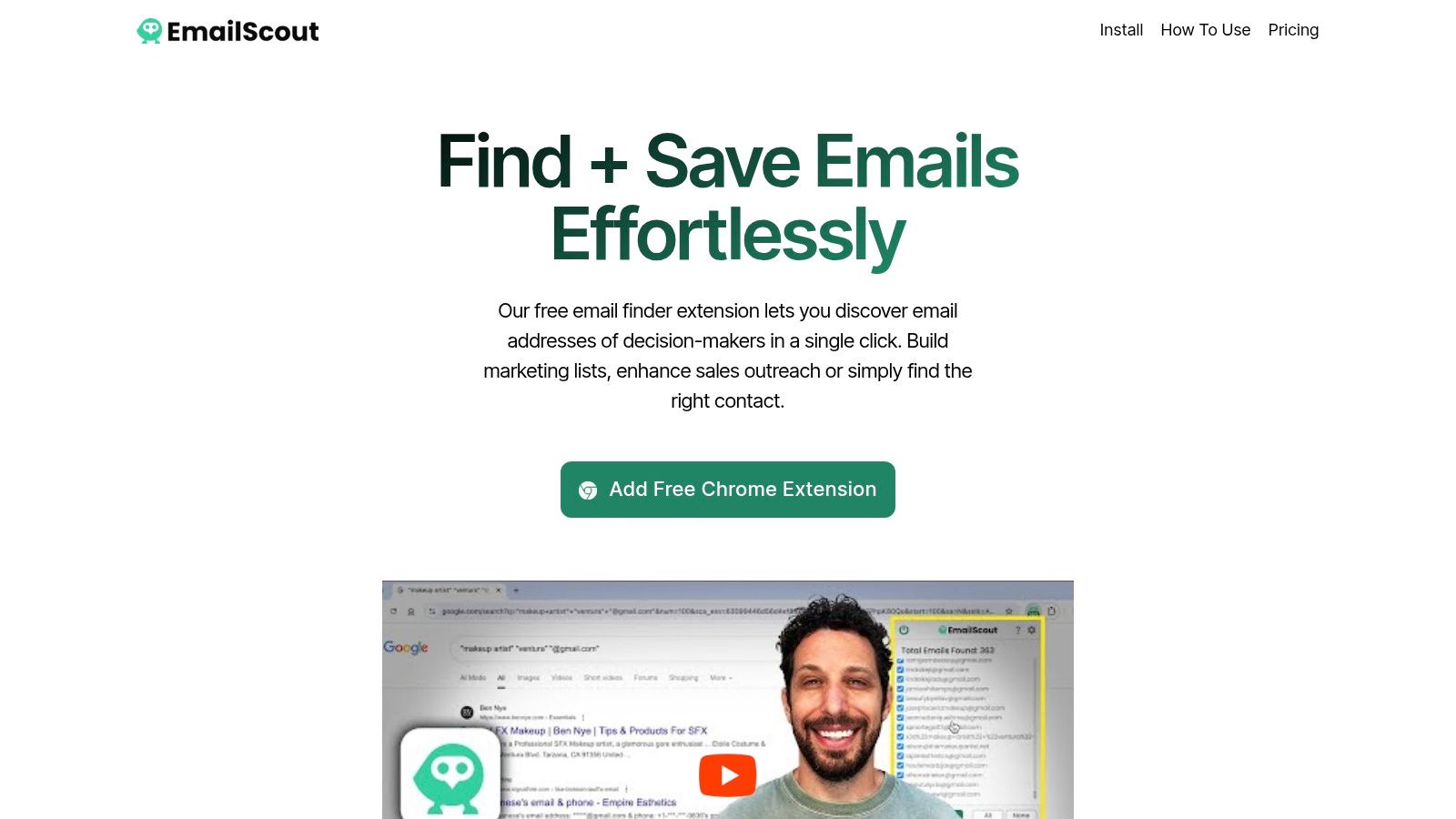
    EmailScout is a lightweight, one-click Chrome extension that turns any website or Google search into a lead generation source for sales teams, marketers, and entrepreneurs. Its Zero-config setup and intuitive interface position it as one of the best chrome extensions for productivity in outreach workflows. Its minimal learning curve and responsive support team reduce onboarding friction. Support is available via live chat or email.
    EmailScout

    Key Features

    • AutoSave background captures emails as you browse
    • URL Explorer scans batches of URLs (up to 1,500)
    • One-click extraction directly from page source or search results
    • Export options: CSV or TXT with unlimited free-tier exports

    Typical Use Cases

    1. Building targeted B2B contact lists during market research
    2. Automating bulk lead collection for cold email campaigns

    Pricing & Plans

    Feature Free Tier Premium ($9/mo)
    URL Explorer Manual Bulk up to 1,500 URLs
    AutoSave Not available Background capture
    Monthly Exports Unlimited 5,000 emails

    Pros and Cons

    • Pros
      • Free, unlimited email finding and exports
      • Easy setup, click-and-go interface
      • Affordable scaling to 1M emails per month
    • Cons
      • No built-in verification; results depend on public data
      • Users must manage GDPR and CAN-SPAM compliance

    Quick Tip

    Pin the extension to your toolbar and activate AutoSave before hitting industry directories to streamline lead capture.

    Learn more about EmailScout on emailscout.io

    2. Chrome Web Store – Productivity Collection

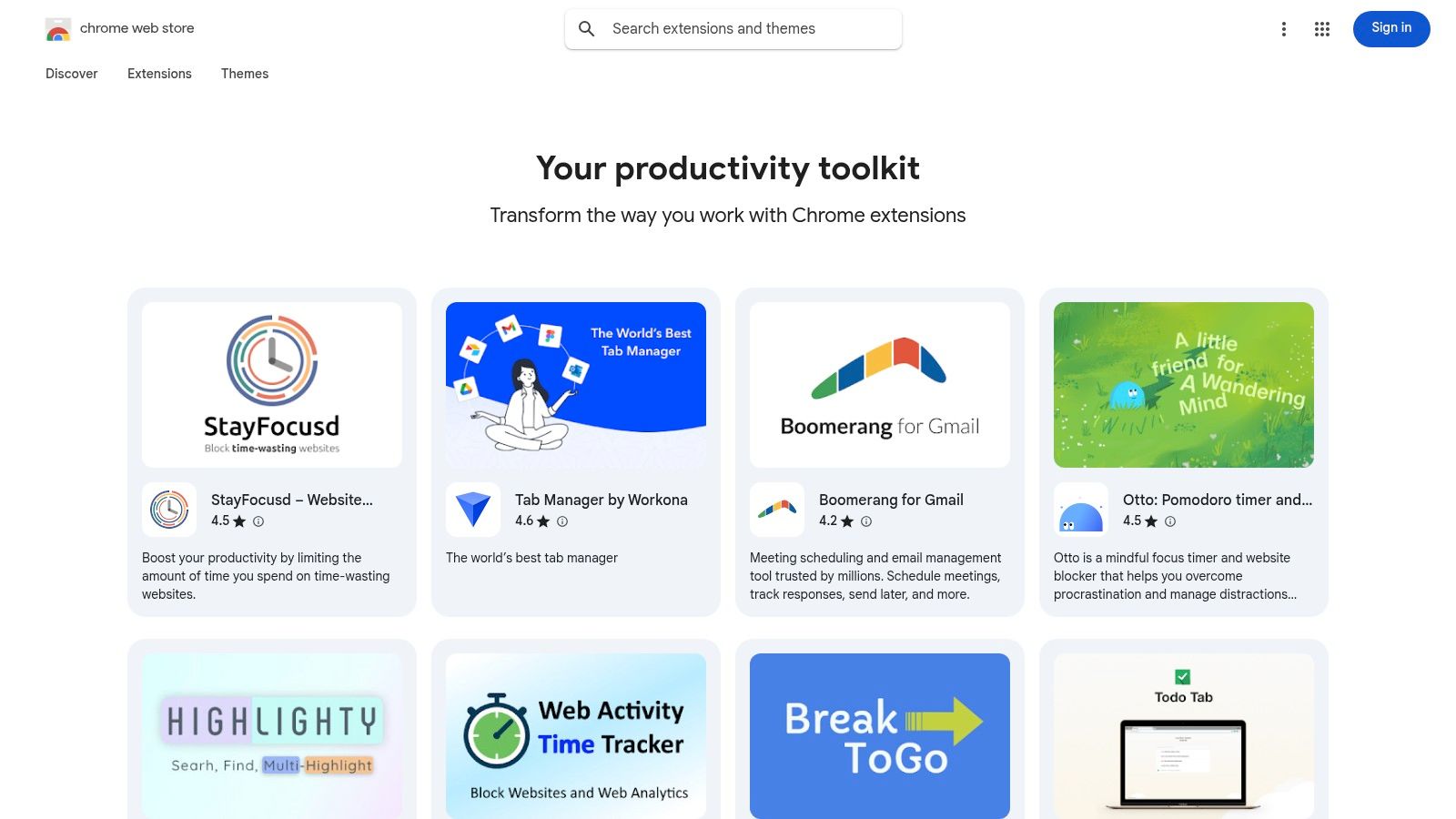
    The Chrome Web Store is Google’s official marketplace for discovering and installing browser add-ons. Its “Your productivity toolkit” collection features top-rated extensions vetted by Google’s editorial team. Automatic updates and detailed permissions make it a trusted hub for sales and marketing professionals.
    Chrome Web Store – Productivity Collection

    Navigating the productivity collection gives real user reviews, install counts, and enterprise controls. A Google account and Chrome browser suffice for access. Pricing is free for most extensions; some premium tools offer paid tiers.

    Key Features

    • One-click install to Chrome with automatic updates
    • Curated productivity collections edited by Google’s team
    • Granular permissions and user rating transparency
    • Enterprise controls for managed users in Chrome Enterprise

    Pricing and Access

    • Free to use for most extensions; paid tiers for advanced features
    • Accessible via Chrome browser and Google account
    • Enterprise licensing required for managed controls

    Pros and Cons

    Pros

    • Safest direct source for Chrome extensions
    • Automatic updates and permission prompts

    Cons

    • Overwhelming selection may hinder discovery
    • Extensions can change ownership over time

    Quick Tip

    Use starred collections to save high-value extensions and monitor update notes for best performance.

    Learn more about Chrome Web Store – Productivity Collection on emailscout.io.

    3. Product Hunt – Chrome Extensions Category

    Product Hunt is a product-discovery platform with a dedicated Chrome Extensions category that surfaces recent launches and top-reviewed productivity tools. Community rankings and discussion threads help sales and marketing teams evaluate emerging extensions before they hit mainstream lists.
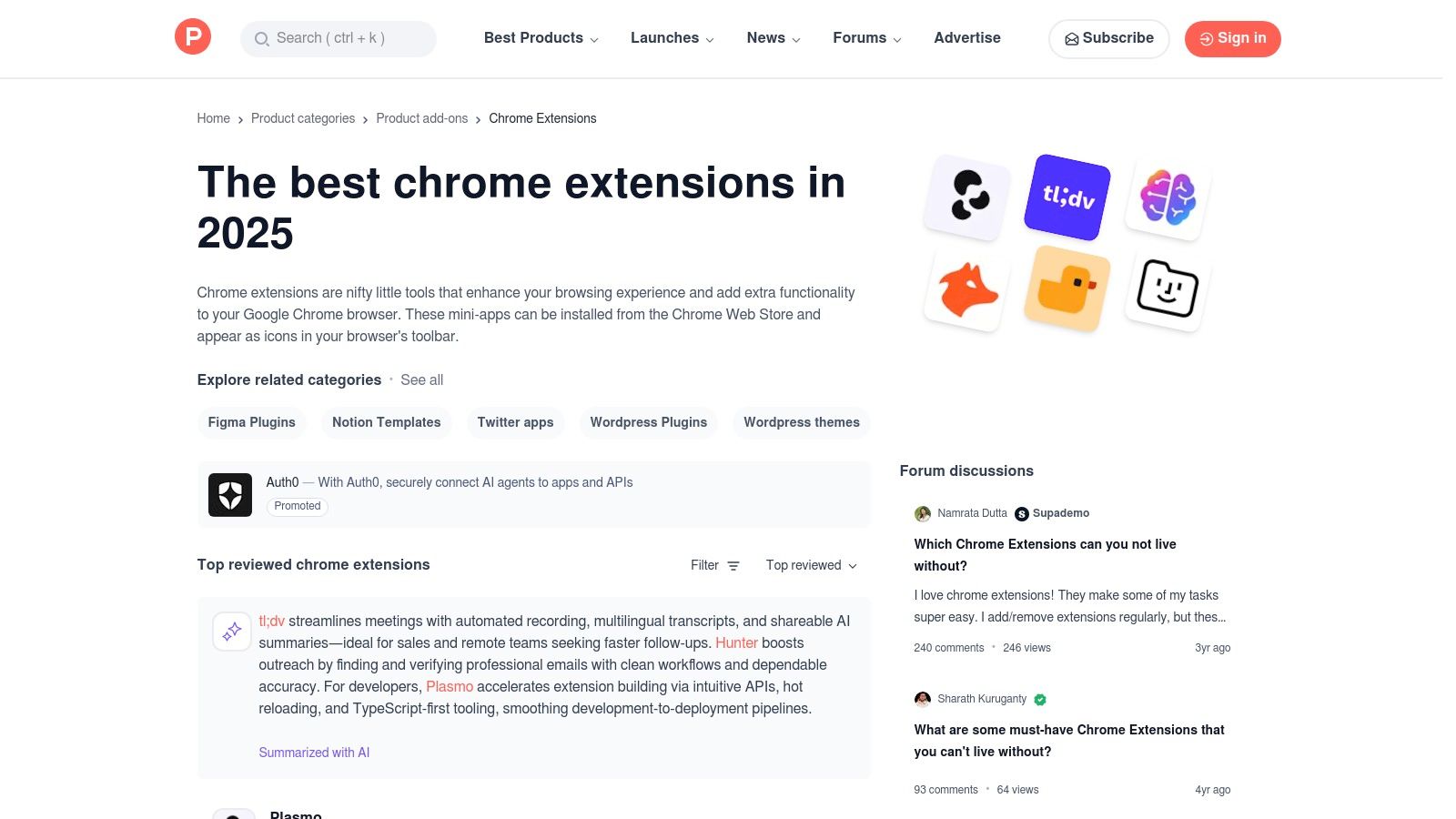
    Product Hunt – Chrome Extensions Category

    Browsing this category lets you filter by “Top reviewed” and “Newest” to find cutting-edge tools. Each listing links directly to vendor sites and the Chrome Web Store, while user comments and upvotes reveal real usage insights.

    Key Features

    • Community upvotes and aggregate review scores
    • Filters for Top reviewed, Trending, and New launches
    • Direct links to Chrome Web Store and developer websites
    • Comment threads for hands-on feedback and use cases

    Pricing and Access

    • Completely free to browse and use
    • Requires a Product Hunt account for upvoting and commenting
    • No premium tiers; extensions may include paid features separately

    Pros and Cons

    Pros

    • Great for discovering early-stage, innovative tools
    • Honest community feedback highlights strengths and pain points

    Cons

    • Quality varies; some launches may be experimental
    • Fewer enterprise controls compared to official marketplaces

    Quick Tip

    Follow the Chrome Extensions category and enable email alerts to spot high-potential productivity tools before competitors do.

    Learn more on Product Hunt – Chrome Extensions Category.

    4. G2 – Best Chrome Extensions Roundup

    G2 is a leading B2B review and editorial platform that curates top Chrome extensions by productivity use case. Its “Best Chrome Extensions Roundup” offers contextual summaries, buyer guidance, and real user ratings to help sales, marketing, and business development pros discover tools that match their workflows.

    G2 – Best Chrome Extensions Roundup

    The roundup groups extensions by function – task management, ad-blocking, email automation – with pros, cons, and installation links. G2’s verified reviews and scoring system provide honest insights, while detailed buyer guides explain which features matter most for your team’s goals.

    Key Features

    • Curated lists organized by productivity use cases
    • In-depth editorial summaries and buyer guidance
    • Verified user reviews with star ratings and comments
    • Direct links to Chrome Web Store for each extension
    • Comparison tables highlighting feature differences

    Pricing and Access

    • Free access to all articles and roundups
    • No account required for browsing reviews
    • Installations occur via Chrome Web Store links

    Pros and Cons

    Pros

    • Trusted community reviews for workplace adoption
    • Clear buyer guidance streamlines decision making
    • Easy primer for newcomers to extension ecosystems

    Cons

    • Not a direct storefront – redirects to Chrome Web Store
    • May not cover niche or very new extensions

    Quick Tip

    Bookmark G2’s roundup and subscribe to update alerts so you never miss newly published productivity extension reviews.

    Learn more about G2 – Best Chrome Extensions Roundup on G2.

    5. Zapier Blog – “Best Productivity Extensions for Chrome”

    Zapier’s annual guide to the best chrome extensions for productivity offers a vendor-neutral, workflow-focused roundup of proven tools. It highlights clear “best for” labels, up-to-date pricing snapshots, and direct links to official extension pages, making it ideal for sales professionals and digital marketers.

    Zapier Blog – “Best Productivity Extensions for Chrome”

    Each entry is organized by use case, from task management to ad-blocking, with annual refreshes that keep recommendations current. No login or subscription is required to access the full guide, and readers can click through to vendors’ pages for detailed feature and pricing information.

    Key Features

    • “Best for” labels categorizing each extension by workflow need
    • Annual update cycle with fresh insights on new releases
    • Pricing callouts for popular free and paid tools
    • Direct links to official extension pages for quick install

    Pricing and Access

    • Free to read on Zapier Blog, no account needed
    • Vendor pricing varies; links direct to latest plans
    • Bookmark or subscribe to RSS feed for update alerts

    Pros and Cons

    Pros

    • Credible, vendor-neutral editorial perspective
    • Workflow-focused recommendations tailored to roles

    Cons

    • Not exhaustive; prioritizes widely used tools
    • Pricing and features may change between updates

    Quick Tip

    Subscribe to Zapier’s RSS feed or email alerts to catch new extension reviews as they publish each year.

    Learn more about Zapier Blog – “Best Productivity Extensions for Chrome” on emailscout.io.

    6. Android Police – “Essential Chrome Productivity Extensions”

    Android Police is a trusted tech publication delivering hands-on picks for the best chrome extensions for productivity with practical usage notes and real world tips. You get clear, tested recommendations tailored to both desktop and mobile Chromebook users.

    Android Police – “Essential Chrome Productivity Extensions”

    Navigating this curated guide links directly to official listings. Each extension is tested in plain English with performance observations on page load, resource use, and UI. Free access, no sign-up required, works in any Chrome or Chromium based browser.

    Key Features

    • Practical usage notes based on hands-on testing
    • Mobile and Chromebook perspective for on-the-go workflows
    • Direct links to Chrome Web Store entries
    • Plain-English explanations of setup and best practices

    Pricing and Access

    • Completely free to read and implement
    • No account or subscription needed
    • Compatible with Chrome, Edge, Brave, and other Chromium browsers

    Pros and Cons

    Pros

    • Real-world performance insights
    • Advice on when each tool shines on mobile or desktop

    Cons

    • Selections may update over time
    • Not a full extension marketplace

    Quick Tip

    Bookmark key extension notes as a cheat sheet, then test alongside your cold email and outreach tools for smooth integration.

    Learn more about Android Police – “Essential Chrome Productivity Extensions” on Android Police.

    7. SlashGear – “Best Chrome Extensions to Boost Productivity”

    SlashGear curates concise collections of leading Chrome add-ons for productivity, perfect for sales reps and marketers needing a quick shortlist of high-impact tools. Its editorial picks include top-rated options with direct install links and brief pros for swift decision making. SlashGear’s interface is minimalist and easy to scan on the go, helping busy entrepreneurs find tools in seconds.

    SlashGear – “Best Chrome Extensions to Boost Productivity”

    Key Features

    • Short lists of popular extensions with clear pros and pricing context
    • Direct links to Chrome Web Store for one-click install
    • Editor notes on use cases for sales, marketing, ecommerce
    • Mobile-friendly summaries optimized for quick reading
    • Regular updates reflecting newest and top-rated tools

    Pricing and Access

    • Free to browse and read on SlashGear
    • Extensions may offer free or paid tiers on the Web Store
    • No registration required to access lists
    • Compatible with any desktop or mobile Chrome browser
    • Accessible worldwide without geo restrictions

    Pros and Cons

    Pros

    • Fast insight into best chrome extensions for productivity
    • Clear pricing and usage takeaways
    • Editorial curation reduces decision fatigue

    Cons

    • Not a purchase portal – must click through to install
    • Editorial bias may skip emerging niche tools

    Quick Tip

    Bookmark the SlashGear list and enable Chrome sync to keep your productivity toolkit consistent across all devices.

    Learn more on SlashGear: https://www.slashgear.com/1621931/best-chrome-extensions-productivity-boost/

    8. The Keyword (Google Blog) – “5 Chrome extensions to increase productivity”

    The Keyword is Google’s official blog highlighting a select group of Chrome extensions that streamline everyday workflows. Each post offers detailed examples of how to integrate tools like tab managers or grammar checkers directly into your browser.
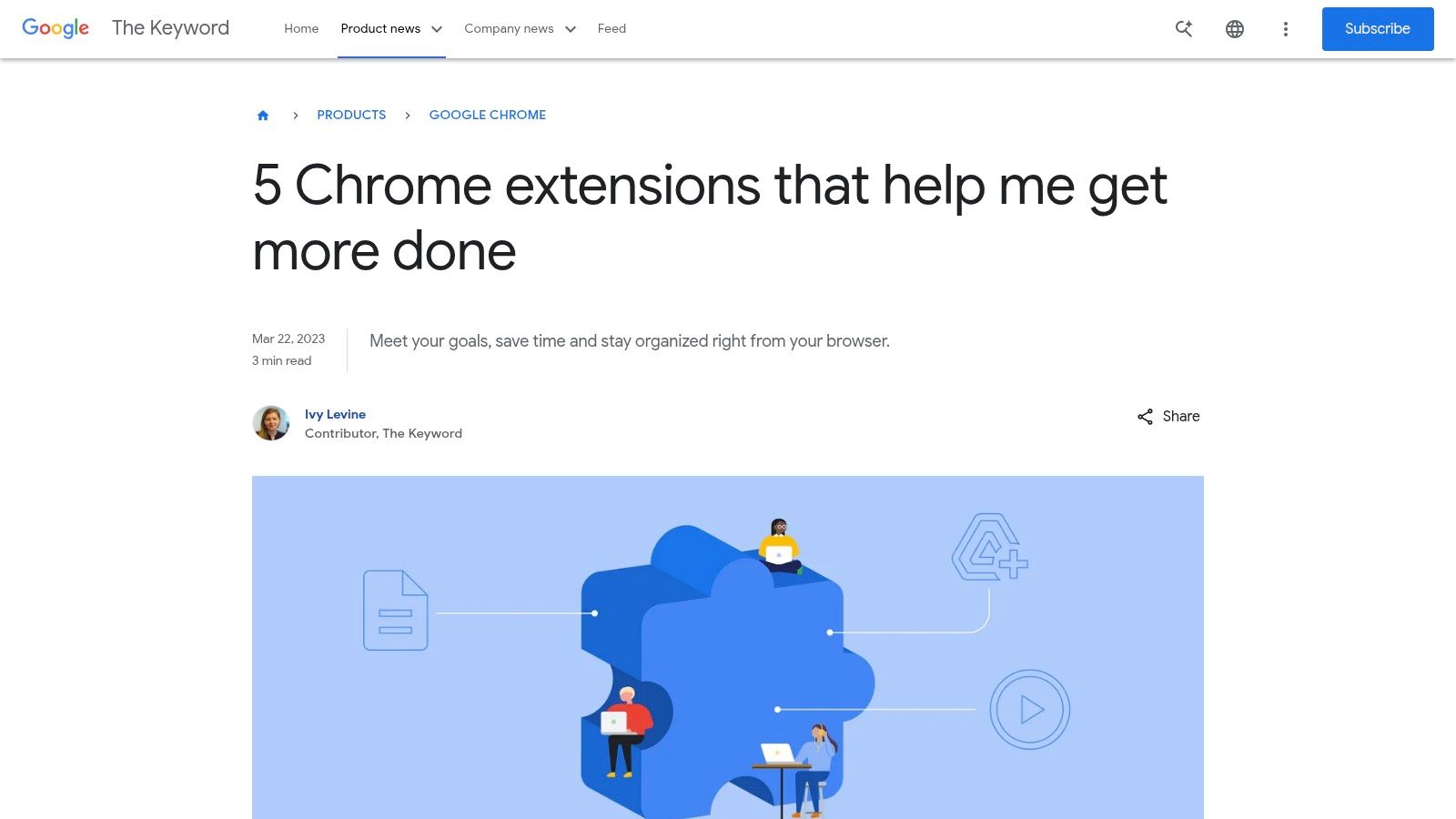
    The Keyword (Google Blog) – “5 Chrome extensions to increase productivity”

    With clear screenshots and direct links you can install recommended extensions in seconds. Posts include real world scenarios such as using a screenshot tool for sales demos or a time tracker for freelance billing. No third party marketing fluff, just hands on advice that aligns with Chrome features.

    Key Features

    • Official curation by Google’s editorial team
    • Practical use case scenarios for each extension
    • Direct links with install and permission details
    • In-post screenshots showing real interface steps

    Pricing and Access

    • Free to read with no login required
    • Extensions often free or freemium via Chrome Web Store
    • Requires Chrome browser for direct install

    Pros and Cons

    Pros

    • Trusted source with deep UX insights
    • Examples tailored to common sales and marketing tasks

    Cons

    • Limited to five extensions per post
    • Not a marketplace for paid tier tools

    Quick Tip

    Subscribe to The Keyword RSS feed to catch new extension roundups as soon as they publish.

    Learn more about The Keyword (Google Blog) – “5 Chrome extensions to increase productivity” on The Keyword.

    9. Workona – Tab Manager & Workspaces (official site)

    Workona is the official site for a leading tab and workspace manager with a Chrome extension that helps sales and marketing teams keep projects organized. With its intuitive interface users can group tabs into workspaces, suspend idle tabs to reduce memory usage, and search across sessions from any new tab.
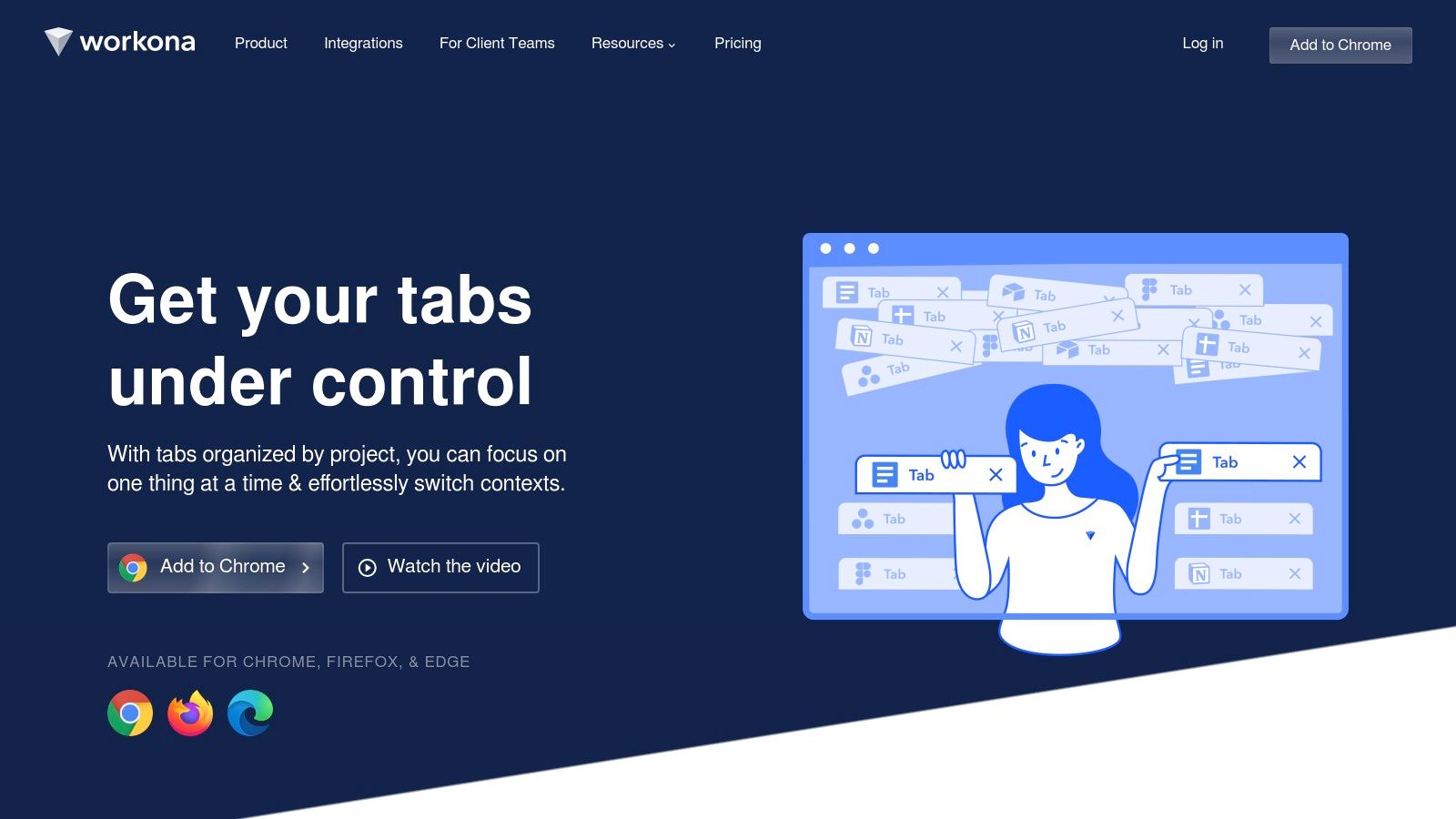
    Workona – Tab Manager & Workspaces (official site)

    On the Workona platform teams can share workspaces, assign tasks, and sync context across devices. Its powerful search engine surfaces open tabs, pinned resources, and saved projects in seconds. A clean dashboard offers quick access to current workflows without clutter.

    Key Features

    • Spaces and workspaces for project-based tab organization
    • Tab suspension to free up RAM and speed up Chrome
    • Cross-tab search and new-tab integration for rapid retrieval
    • Collaboration options for shared team workspaces

    Pricing and Access

    • Free plan includes 10 workspaces and up to 20 tabs synced
    • Paid plans start at $10 per user per month for unlimited workspaces
    • Requires Chrome browser and a free Workona account

    Pros and Cons

    Pros

    • Noticeable performance and focus gains for heavy tab users
    • Business-friendly features enabling team collaboration

    Cons

    • Advanced collaboration features are locked behind a paid plan
    • Some users may face a learning curve with complex workspace setups

    Quick Tip

    Pin your most critical workspaces to the sidebar and use custom labels to switch contexts quickly between client outreach and content research.

    Learn more about Workona – Tab Manager & Workspaces on workona.com.

    10. Todoist – Official Plans (Todoist for Chrome extension)

    Todoist’s official pricing page outlines everything you need to maximize the Todoist for Chrome extension, a top-rated task manager that captures to-dos on any webpage and syncs seamlessly across devices. You can compare plan levels to unlock features like labels, filters, and project templates.
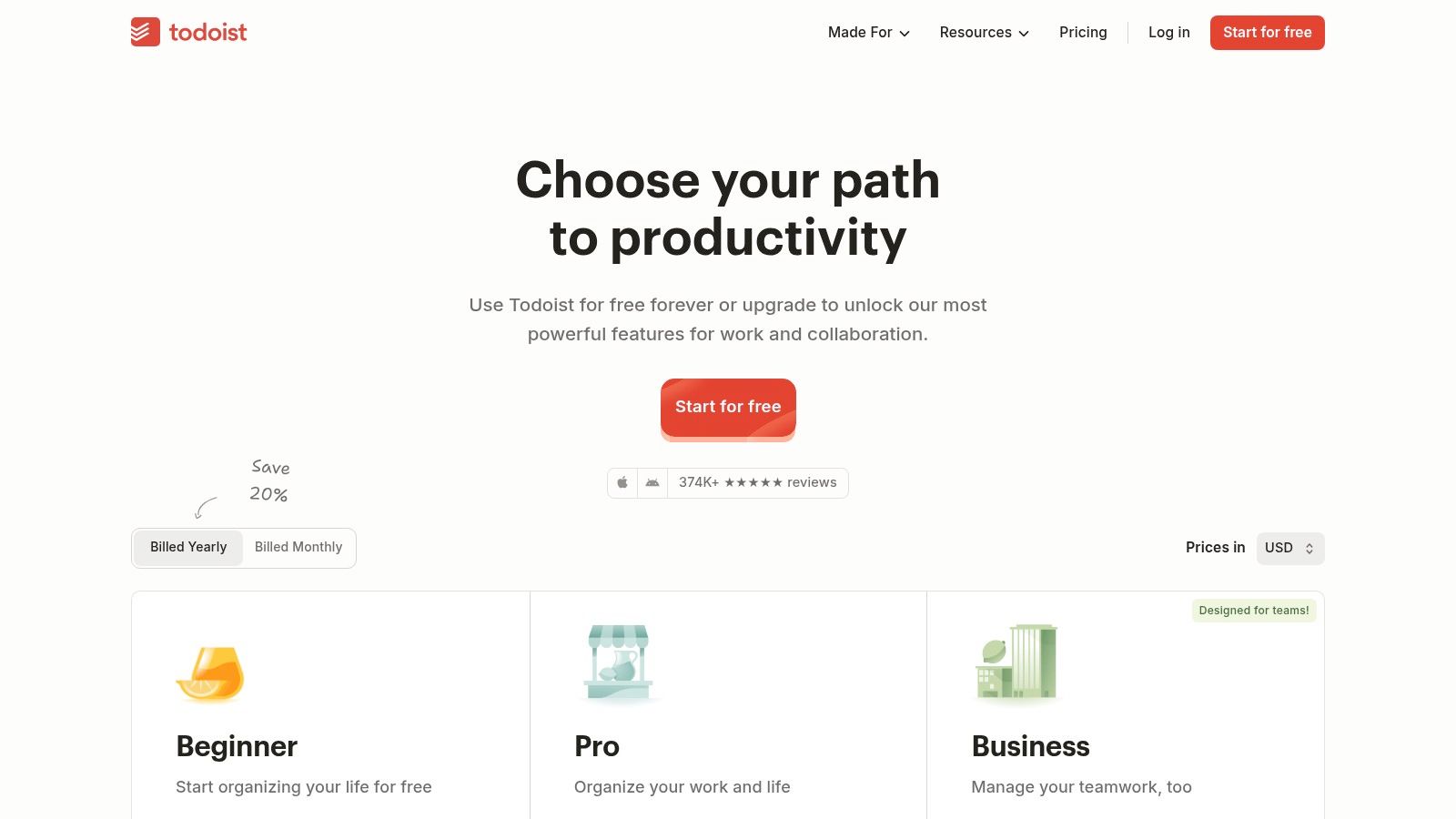
    Todoist – Official Plans (Todoist for Chrome extension)

    Browsing the pricing table presents side-by-side comparisons of the Free, Premium, and Business tiers, with clear notes on user limits. A Todoist account and Chrome installation are all you need to get started and adjust your plan at any time.

    Key Features

    • Quick-add tasks from web pages or email with a single click
    • Labels, filters, priorities, and project sections for granular organization
    • Real-time cross-platform sync with desktop, mobile, and calendar apps
    • Integration with tools like Google Calendar, Slack, and Zapier

    Pricing and Access

    • Free plan with core task creation and basic labels
    • Premium starts at $4 per user per month billed annually
    • Business plan with team administration, projects, and priority support
    • Requires registration on Todoist and Chrome browser

    Pros and Cons

    Pros

    • Polished interface optimized for both solo users and teams
    • Extensive integration ecosystem boosts productivity
      Cons
    • Key power features such as reminders require paid tiers
    • Pricing tiers and renewal terms may change without notice

    Quick Tip

    Enable keyboard shortcuts (Ctrl+Shift+A) to add tasks instantly from any tab.

    Learn more about Todoist – Official Plans on Todoist Pricing.

    11. 1Password – Official Pricing (Chrome extension included)

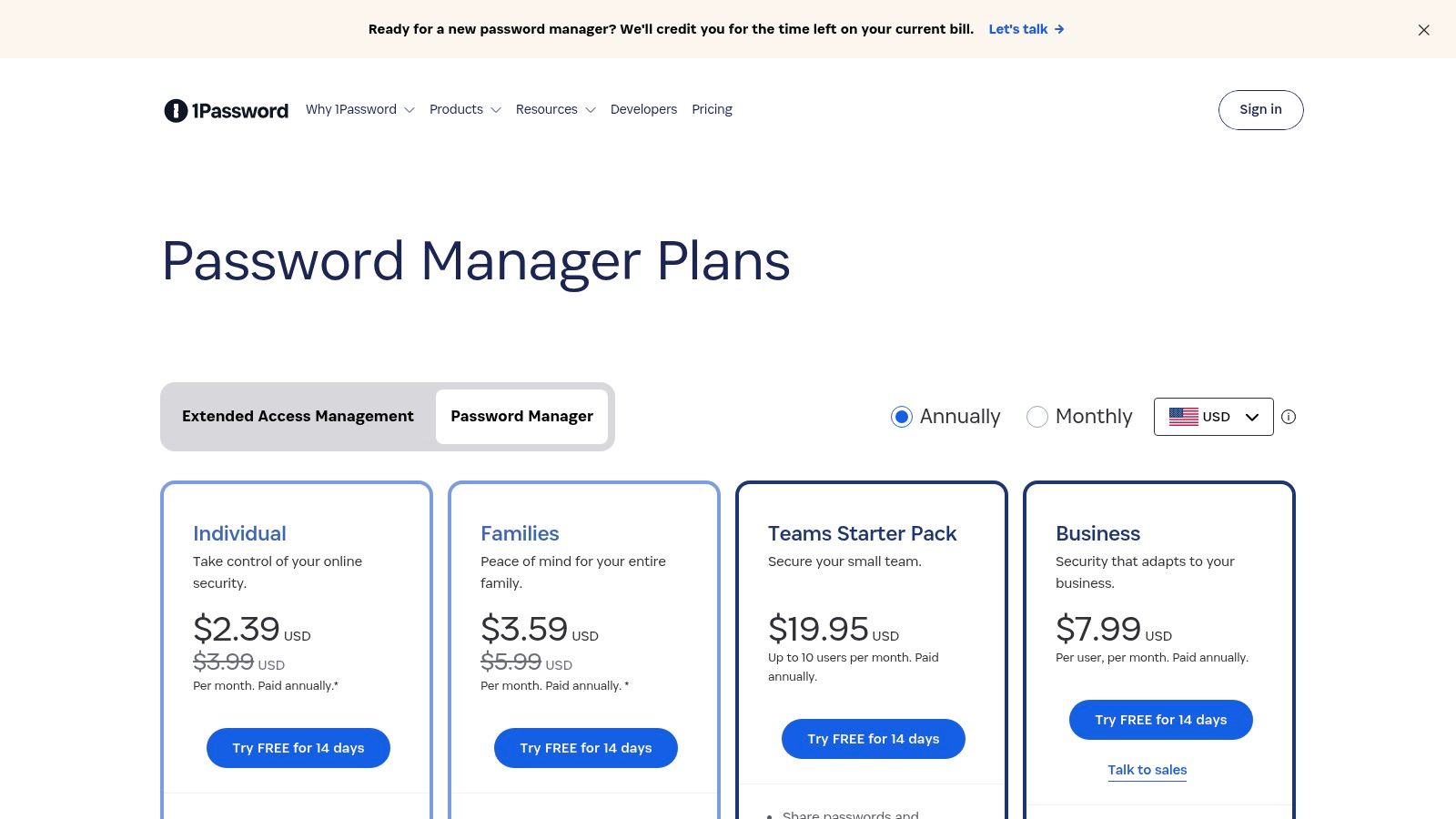
    The 1Password pricing page lays out subscription tiers and features for its award-winning password manager with a Chrome extension included. Users get autofill for passwords, passkeys, and 2FA codes alongside secure item storage and cross-device sync. This resource centralizes details to help teams and individuals boost productivity by speeding logins and credential management.
    1Password – Official Pricing (Chrome extension included)

    Browsing plans on 1Password.com is intuitive; each tier lists user seats, shared vault options, and enterprise controls. Clear comparisons help decision makers evaluate cost against features like automated security alerts, dedicated support, and custom role assignments. Its polished interface and responsive customer service set it apart from open-source alternatives.

    Key Features

    • Autofill for passwords, passkeys, and 2FA codes
    • Cross-device sync and shared vaults for teams and families
    • Security alerts (Watchtower) for weak or compromised credentials

    Pricing and Access

    • Subscription plans start at $2.99 per user per month (billed annually)
    • Team and Business tiers include activity logs and custom roles
    • Chrome extension free with any paid plan

    Pros and Cons

    Pros

    • Highly regarded security model and independent audits
    • Streamlines daily logins and account switching

    Cons

    • Subscription-based pricing, no free open-source option
    • Exact pricing varies by plan and region—confirm at checkout

    Quick Tip

    Enable Watchtower notifications in browser settings to receive real-time alerts on compromised credentials.

    Learn more about 1Password – Official Pricing on 1Password.

    12. Loom – Official Pricing (Chrome recorder for async collaboration)

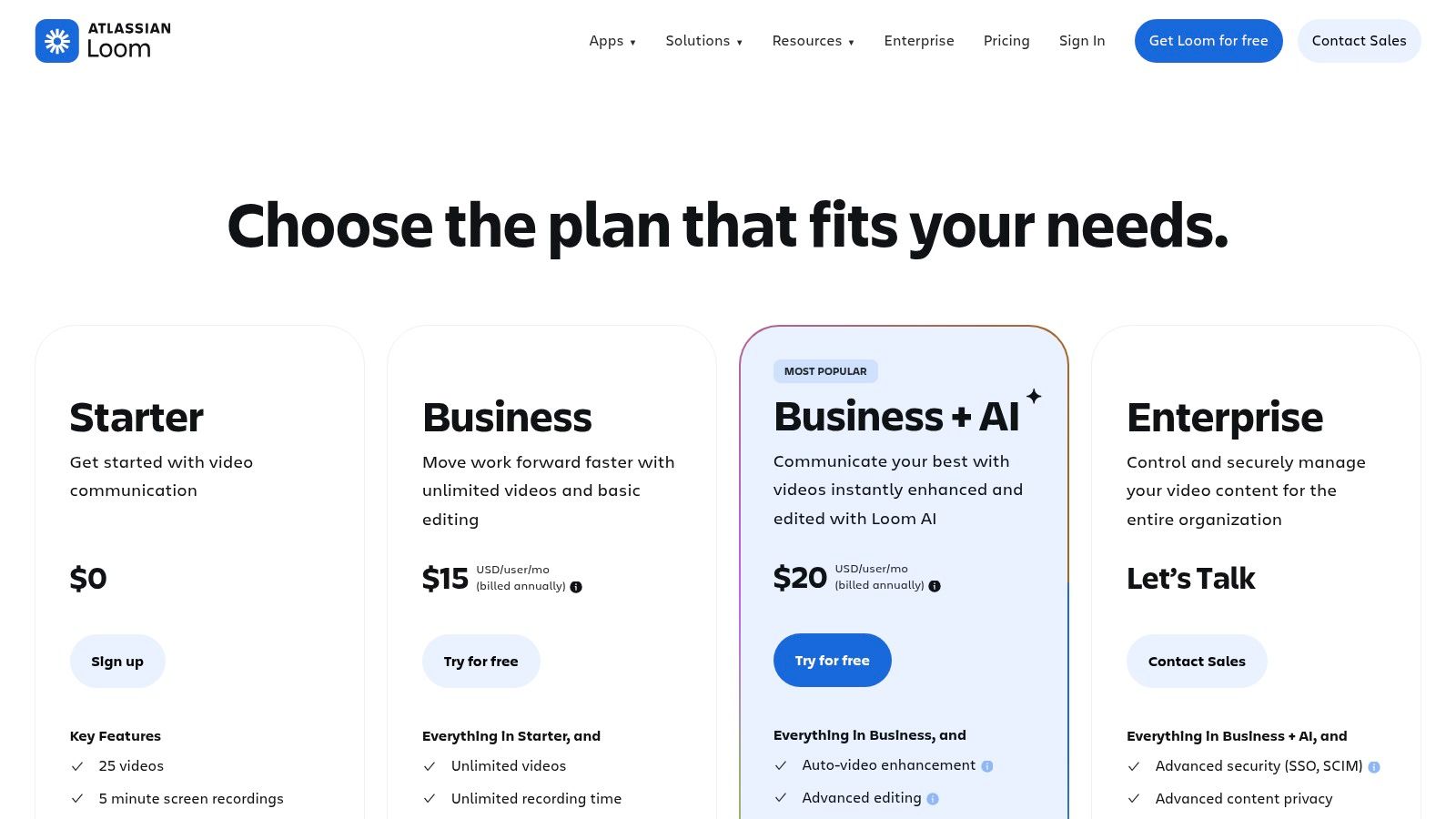
    Loom’s pricing page offers transparent subscription layers for its Chrome recorder, enabling users to assess which plan meets their async video messaging needs. From single-click screen captures to AI summarization, it breaks down feature access by tier.
    Loom – Official Pricing (Chrome recorder for async collaboration)

    Navigating loom.com/pricing, you can compare Free, Business, and Enterprise plans, review team management tools, and upgrade within the browser. The intuitive interface and clear feature matrix ensure sales and marketing teams invest in relevant capabilities.

    Key Features

    • One-click screen, camera, and audio capture directly in Chrome
    • Auto-generated titles, summaries, and chapters powered by AI
    • Shared video libraries with timestamped comments for collaboration
    • Inline embed options for emails and documentation

    Pricing and Access

    • Free tier includes 5-minute recordings with basic editing
    • Business plan unlocks unlimited recordings and AI enhancements
    • Enterprise tier adds advanced security, SSO, and dedicated support

    Pros and Cons

    Pros

    • Speeds up explanations compared to long emails or calls
    • Robust AI features enhance clarity and accessibility
    • Browser-based updates ensure newest features immediately

    Cons

    • Free tier imposes recording length limits
    • Advanced AI and team features require higher-tier plans

    Quick Tip

    Embed Loom videos in cold email campaigns to boost engagement and clarify product demos without leaving your inbox.

    Learn more about Loom – Official Pricing on loom.com/pricing.

    Top 12 Chrome Productivity Resources — Quick Comparison

    Product Core features UX & Quality Price & Value Best for Standout point
    EmailScout (recommended) One‑click email finder; AutoSave; URL Explorer; CSV/TXT export Easy Chrome install; instant results; browser‑based workflow Free unlimited find/exports; Premium from $9/mo (5K/mo) – plans to 1M; 200‑email trial Sales, marketers, founders, freelancers, biz‑dev AutoSave + bulk URL scanning for automated list building
    Chrome Web Store – Productivity Collection One‑click install; auto‑updates; ratings & reviews Trusted, secure source; granular permissions shown Free marketplace; extensions may be free or paid General users & IT admins Official storefront with enterprise controls
    Product Hunt – Chrome Extensions Category Rankings; community reviews; filters Good discovery UX for new launches Free to browse Early adopters, makers, product hunters Spot emerging tools and early traction
    G2 – Best Chrome Extensions Roundup Curated lists by use case; buyer guidance B2B review ecosystem; contextual summaries Free editorial content Teams evaluating tools for work use Review‑driven buyer guidance for workplace adoption
    Zapier Blog – “Best Productivity Extensions” “Best for” labels; pricing snapshots; links Workflow‑focused editorial; practical guidance Free editorial content Workflow/automation focused users Vendor‑neutral, task‑oriented recommendations
    Android Police – “Essential Chrome Productivity Extensions” Hands‑on picks; mobile/Chromebook notes Practical, tested reviews and tips Free editorial content Chromebook and mobile users Mobile/Chromebook perspective with real‑world tips
    SlashGear – “Best Chrome Extensions to Boost Productivity” Concise lists; quick pros & pricing Consumer‑friendly, easy scanning Free editorial content Casual users making a quick shortlist Fast shortlist creation with pricing context
    The Keyword (Google Blog) – “5 Chrome extensions…” Official Google picks; practical examples High trust; aligned with Chrome features Free editorial content General users seeking starter tools Google‑endorsed selection and examples
    Workona – Tab Manager & Workspaces Spaces/workspaces; tab suspension; search Improves focus & memory usage; team features Freemium; advanced features paid Heavy tab users, teams, project managers Workspace organization + tab suspension for performance
    Todoist – Official Plans (Chrome extension) Quick‑add tasks; labels, filters; sync Polished UX; cross‑platform sync Freemium; paid tiers for advanced features Personal productivity and small teams Deep integrations and powerful task organization
    1Password – Official Pricing (Chrome extension) Autofill, passkeys, shared vaults; alerts Secure, audited; smooth autofill UX Subscription plans; team/family tiers Security‑conscious individuals & teams Strong security model and team vaults
    Loom – Official Pricing (Chrome recorder) One‑click screen/camera recording; AI summaries Fast async communication; shareable libraries Freemium with recording limits; paid AI/team tiers Remote teams, support, product demos Rapid async video with AI enhancements

    Ready to Supercharge Your Workflow?

    You have just explored a curated list of the best chrome extensions for productivity that address every stage of your sales and marketing funnel. From email automation with EmailScout to advanced tab management with Workona, these tools are designed to streamline outreach and free you to focus on closing deals.

    Key Takeaways

    • EmailScout – Automate follow-ups, track opens, and sync with your CRM for consistent engagement
    • Chrome Web Store Productivity Collection – Discover community-rated tools for time tracking, focus modes, and more
    • G2 Roundup – Use peer insights to compare features and user satisfaction before committing
    • Zapier Blog Picks – Integrate Chrome extensions with your favorite apps for seamless automation
    • Android Police & SlashGear Guides – Find niche enhancers like quick note clipping and Pomodoro timers
    • Google Blog Recommendations – Leverage Chrome team tips on shortcuts and built-in features
    • Official Extensions (Workona, Todoist, 1Password, Loom) – Rely on vendor support, security updates, and direct integrations

    Choosing the Right Extension

    1. Define your primary goal – lead generation, task organization, or secure credential management
    2. Map features to your workflow – prioritize email templates for outreach, workspaces for client research, or video messaging for demos
    3. Align team size and budget – mix free tiers with premium plans based on usage and value
    4. Test compatibility – ensure extensions integrate smoothly with your CRM, project boards, and browser settings

    Implementing Extensions Effectively

    • Audit daily routines that can be automated or simplified
    • Pilot two or three extensions at a time to prevent overload
    • Customize permissions, shortcuts, and notification settings for faster execution
    • Monitor performance – track time saved, error reduction, and team satisfaction
    • Iterate – gather feedback, refine workflows, and swap out underperforming tools

    Next Steps

    • Schedule a 30-minute kickoff to train your team on newly adopted extensions and share productivity best practices
    • Set quarterly review sessions to analyze usage metrics and refine your Chrome extension toolkit

    Important Considerations

    • Security and Permissions – Review data access requests to protect client information
    • Browser Performance – Disable or remove extensions that cause lags or conflicts
    • Team Onboarding – Provide quick reference guides and live demos
    • Cost Management – Evaluate ROI periodically and adjust subscription levels

    By applying these insights, you can unlock the full potential of the best chrome extensions for productivity. Start small, measure impact, and scale your toolkit as your needs evolve. Every optimized click brings you closer to higher conversion rates and a more efficient workflow.


    Boost your sales productivity with EmailScout. EmailScout integrates seamlessly with your Chrome browser to automate outreach, track engagement, and enhance your existing productivity extensions. Try it today to watch your email campaigns convert at a higher rate.


  • Email Extractor for Chrome: Fast Lead Capture That Converts

    Email Extractor for Chrome: Fast Lead Capture That Converts

    Think of a Chrome email extractor as a smart magnet for professional contacts. It's a simple browser add-on that does one thing incredibly well: as you browse websites, it automatically finds and collects publicly listed email addresses. This turns what used to be hours of tedious, manual searching into a quick, automated process.

    How a Chrome Email Extractor Actually Works

    Four colorful smart contact magnets on a wooden desk with a laptop and green notebook.

    At its heart, an email extractor is just a specialized browser extension that does the heavy lifting for you.

    Imagine you're a detective looking for clues in a massive library. Instead of reading every single book yourself, you send in a highly trained assistant who knows exactly what a clue looks like. They can scan the entire library in minutes and come back with a neat list. That's exactly what these tools do.

    They don’t “see” a website the way you and I do. Instead, they read the page's source code—the underlying HTML that tells your browser what to display.

    Decoding the Digital Page

    Every time you land on a website, your browser gets a text file full of code. An email extractor is programmed to dig through this code for very specific patterns. The most common pattern it hunts for is called a regular expression (or regex), which is just a fancy term for a defined search pattern.

    For email addresses, the pattern is pretty simple: a string of characters, an "@" symbol, another string, a dot, and a final string of characters (like name@domain.com). The extension zips through the entire HTML document, looking for any text that matches this exact structure.

    Here’s how that plays out in real-time:

    • Page Scan: You head over to a website, maybe an industry directory or a company's "About Us" page.
    • Code Analysis: You click the extractor's icon in your toolbar, telling it to start scanning the page's source code.
    • Pattern Matching: The tool instantly identifies anything that looks like text@text.text.
    • Data Collection: It pulls all these matches into a clean, organized list and usually gets rid of any duplicates on its own.

    The real magic of a Chrome email extractor is its ability to turn messy, unstructured web data into a clean, actionable contact list. It accomplishes in seconds what would take a person hours to do by hand.

    From Raw Data to Actionable Leads

    This automated process is a huge piece of modern sales and marketing outreach. Before we get any deeper, understanding the fundamental lead generation concepts will put the tool's role into perspective. The extractor is your first step—it efficiently gathers the raw material (potential contacts) for your campaigns.

    But this technology isn't just about grabbing addresses from a single page. The better tools can run bulk extractions across a whole list of URLs or even crawl an entire website. For a closer look, you can read our complete guide on how an email extractor from websites works.

    This level of automation is what makes an email extractor an essential tool for sales pros, marketers, and recruiters. It helps them build targeted contact lists fast, turning the wide-open web into a manageable source of real connections.

    Key Features of a High-Performing Email Extractor

    A laptop on a wooden table displays 'Top Features' including Bulk Export, Delupe, and Veriffication.

    Choosing an email extractor for Chrome is a lot like picking a car. Some are just basic models—they get you from point A to point B. Others are high-performance machines packed with features that make the entire trip faster, smoother, and way more efficient. If you want a real lead generation asset, you have to look beyond simple extraction.

    A great tool doesn’t just find emails. It delivers clean, verified, and ready-to-use data that actually powers your outreach. Without the right features, you're just signing up for hours of manual data cleaning and risking your sender reputation on bad contacts. Let's walk through the checklist of features that really matter.

    Speed and Efficiency Boosters

    The whole point of an extractor is to save you time. Advanced features are designed to multiply that efficiency, letting you scale your efforts without getting buried in repetitive tasks. Think of these as the engine of your lead-gen machine.

    A real game-changer is the ability to do bulk extraction from multiple URLs. Instead of scraping pages one by one, you can just paste a list of websites and let the extension handle the heavy lifting. This is a massive time-saver for anyone researching conference attendee lists, business directories, or dozens of company pages at once.

    Another must-have is automatic duplicate removal. When you scrape from multiple sources, you're bound to get overlapping emails. A smart tool finds and gets rid of these duplicates on the fly, giving you a clean list right from the start. No more manual scrubbing in spreadsheets.

    A powerful email extractor should do more than just collect addresses. Its true value is in automating the entire data prep process—finding, cleaning, and verifying—so you can spend your time actually reaching out to people.

    Data Quality and Verification

    Let’s be honest: a long list of emails is completely useless if half of them bounce. High bounce rates don't just waste your time; they can get your email account flagged as spam, destroying your sender reputation. This is where data quality features become non-negotiable.

    The most critical feature here is integrated email verification. The best Chrome extensions check if an email is valid the moment it’s extracted. This real-time check confirms the address actually exists and can receive mail, keeping your deliverability rates high and making your campaigns effective from day one. Many tools even use a simple color-code system (like green for verified, red for invalid) to make it obvious.

    This proactive approach to data quality protects your domain and makes sure every email you send has the best chance of landing. It's a feature that users clearly value. For example, one of the most popular extensions on the Chrome Web Store holds 4.7 stars from over 53,500 ratings, in large part because its extraction and verification are so reliable. You can discover more about how top-rated tools integrate these advanced features.

    Seamless Workflow and Export Options

    The final piece of the puzzle is how easily the tool fits into the way you already work. A great extractor should feel like a natural part of your process, not some clunky app you have to fight with.

    • Flexible Export Formats: The ability to export your list as a CSV or TXT file is standard. This lets you easily import your new leads into any spreadsheet, CRM, or email marketing platform you use.
    • Direct CRM Integration: Even better are tools that connect directly with popular CRMs like Salesforce or HubSpot. With just a click, you can push verified contacts straight into your sales pipeline and skip the manual data entry.
    • Cloud Storage and Autosave: Some modern extractors save your lists to the cloud automatically. This is a lifesaver if you accidentally close a browser tab, and it lets you access your lead lists from anywhere.

    Comparing Basic vs Advanced Email Extractor Features

    To make it even clearer, let's break down what separates the free, basic tools from the premium, advanced ones. While a free tool can get you started, a premium one is built for serious, scalable outreach.

    Feature Basic (Free) Tools Advanced (Premium) Tools
    Email Extraction Extracts from a single active web page. Bulk extraction from multiple URLs at once.
    Duplicate Removal Usually requires manual cleaning after export. Automatic, real-time duplicate removal during extraction.
    Email Verification None. You get raw, unverified emails. Integrated real-time verification to check email validity.
    Export Options Basic formats like TXT or copy-to-clipboard. Multiple formats (CSV, TXT) and direct CRM integrations.
    Data Organization Limited or no organization features. Cloud storage, project folders, and advanced filtering.
    Speed & Volume Slower, designed for small-scale, occasional use. Fast and optimized for handling thousands of contacts daily.
    Customer Support Limited to none. Dedicated customer and technical support.

    Ultimately, choosing the right tool comes down to your goals. If you just need a handful of emails once in a while, a basic tool might be fine. But if you're building a real pipeline for sales or marketing, investing in an advanced tool with these key features will pay for itself almost immediately in time saved and results gained.

    Getting Your Hands Dirty: Installing and Using Your First Email Extractor

    A person's hand points to a Chrome web browser displaying 'Quick Set Up' on a laptop.

    Knowing the theory is one thing, but putting an email extractor for Chrome to work is where you’ll see the magic happen. This is your hands-on guide to getting started. We're moving past the concepts and into the practical skills you can use right away.

    Let's walk through the whole process, from finding a solid extension to exporting your first clean list of contacts. Think of it like a first driving lesson—we'll show you how to start the engine and take your new tool for a spin. It’s surprisingly simple, and after you do it once, it'll feel like second nature.

    For anyone involved in Modern B2B Prospecting, an email extractor is a game-changer. It automates the most tedious part of lead generation so you can spend your time crafting the perfect outreach message and building real connections.

    Step 1: Find and Install the Extension

    Your journey starts at the Chrome Web Store, the official hub for all browser extensions. Finding the right tool is easy, but it’s smart to pick one with strong user ratings and a high download count. Those numbers are a good sign of reliability and trust from other users.

    Let's use a popular choice, EmailScout, as our example to walk through the setup:

    1. Open the Chrome Web Store: Just search for it on Google or head there directly.
    2. Search for an Extractor: In the search bar, type "EmailScout" or a general term like "email extractor."
    3. Select the Extension: Find the official EmailScout extension in the results and click on it.
    4. Add to Chrome: Hit the big blue “Add to Chrome” button. A little pop-up will appear asking for permissions.
    5. Confirm Installation: Click “Add extension” on that pop-up. The install takes just a few seconds, and you’ll see a new icon pop up in your browser’s toolbar.

    Pro Tip: After installing, click the puzzle piece icon (your Extensions menu) in your toolbar. Find your new email extractor and click the pin icon next to it. This keeps the tool visible right on your toolbar for one-click access, saving you a ton of time.

    Step 2: Run Your First Extraction

    With the extension installed and pinned, you're ready to start building that contact list. The best way to learn is by doing.

    Let's say you're a sales rep for a SaaS company and you're targeting marketing managers at tech startups. Your goal is to find contacts from a handful of promising companies. Here’s how you’d do it:

    • Navigate to a Target Page: Go to a website where you’d expect to find contact info. This could be a company’s "About Us" page, a blog with author bios, or even an online directory.
    • Activate the Extension: Once the page is fully loaded, just click the email extractor’s icon in your toolbar.
    • Run the Scan: The tool instantly gets to work, scanning the page's visible content and its underlying code for anything that looks like an email address.

    The process is almost immediate. The extension’s window will open, showing you a neat list of every email address it found on that page. No more manual scanning or digging through source code.

    Step 3: Export and Organize Your Data

    Finding emails is only half the battle. How you manage them is what really sets you up for success. A messy list is a useless list. Thankfully, good extractors make this final step a breeze.

    Once the scan is done, you'll see options to manage your new contacts. The best move is to export them so you can use them in your other marketing tools.

    1. Review the List: Take a quick look at the emails. A good tool will have already filtered out any duplicates from the page.
    2. Choose an Export Format: Look for an export button. The most useful format is CSV (Comma-Separated Values) because it works with any spreadsheet software like Google Sheets or Microsoft Excel. You might also see options for a TXT file or just copying the list to your clipboard.
    3. Save Your File: Click to export as a CSV and save it to your computer. That's it—you now have a structured list ready to go.

    This exported file can be dropped right into your CRM, uploaded to an email marketing platform, or used to build a targeted cold outreach campaign. If you just need a quick, one-off extraction without installing anything, you can also try a free email extractor online.

    You’re now officially ready to build lead lists with confidence.

    Why Verified Emails Are a Game Changer for Outreach

    Pulling a long list of emails can feel like a huge win, but that's really just the starting line. The true success of any outreach campaign boils down to one critical detail: the quality of those contacts. If you skip this part, all your hard work can backfire, turning a promising campaign into a massive waste of time and money.

    This is where email verification becomes an absolute must. An unverified list is just a list full of risks. Every time you send a message to a dead or outdated address, you get a "bounce," which is a major red flag for email providers like Google and Microsoft.

    Think of it like mailing a package. You wouldn't just scribble a vague address on the box and hope for the best, right? You’d double-check everything—the street, the house number, the zip code—to make sure it gets where it's going. Email verification does the exact same thing for your digital messages, confirming an inbox is active before you ever hit "send."

    Protecting Your Most Valuable Asset: Your Sender Reputation

    Every bounced email sends a bad signal to internet service providers. While a few bounces are normal, a high bounce rate—and that's typically anything over 2%—makes you look like a spammer. This tanks your sender reputation, which is the score that decides whether your emails land in the primary inbox or get exiled to the promotions tab or, worse, the dreaded spam folder.

    Once your reputation is damaged, it’s incredibly difficult to fix. Your deliverability will plummet, and even your most important emails to real customers might never be seen. In serious cases, your entire domain can get blacklisted, effectively cutting you off from one of your most important communication channels.

    This is why top-tier email extractor for Chrome tools with built-in, real-time verification are your best line of defense. They act as a gatekeeper, automatically weeding out the bad addresses—the typos, the fakes, the old ones—before they ever contaminate your list.

    The goal isn't just to send more emails; it's to start more conversations. Verified emails are the foundation of effective outreach because they guarantee your message has a chance to be read by a real person.

    This commitment to quality pays off in every campaign metric you care about.

    • Higher Deliverability: Your emails actually make it to the inbox.
    • Improved Open Rates: More delivered emails mean more chances to get opened and read.
    • Increased ROI: You stop wasting time and money on contacts that go nowhere.
    • Stronger Sender Score: You build and maintain a healthy reputation that email providers trust.

    From Data Points to Meaningful Connections

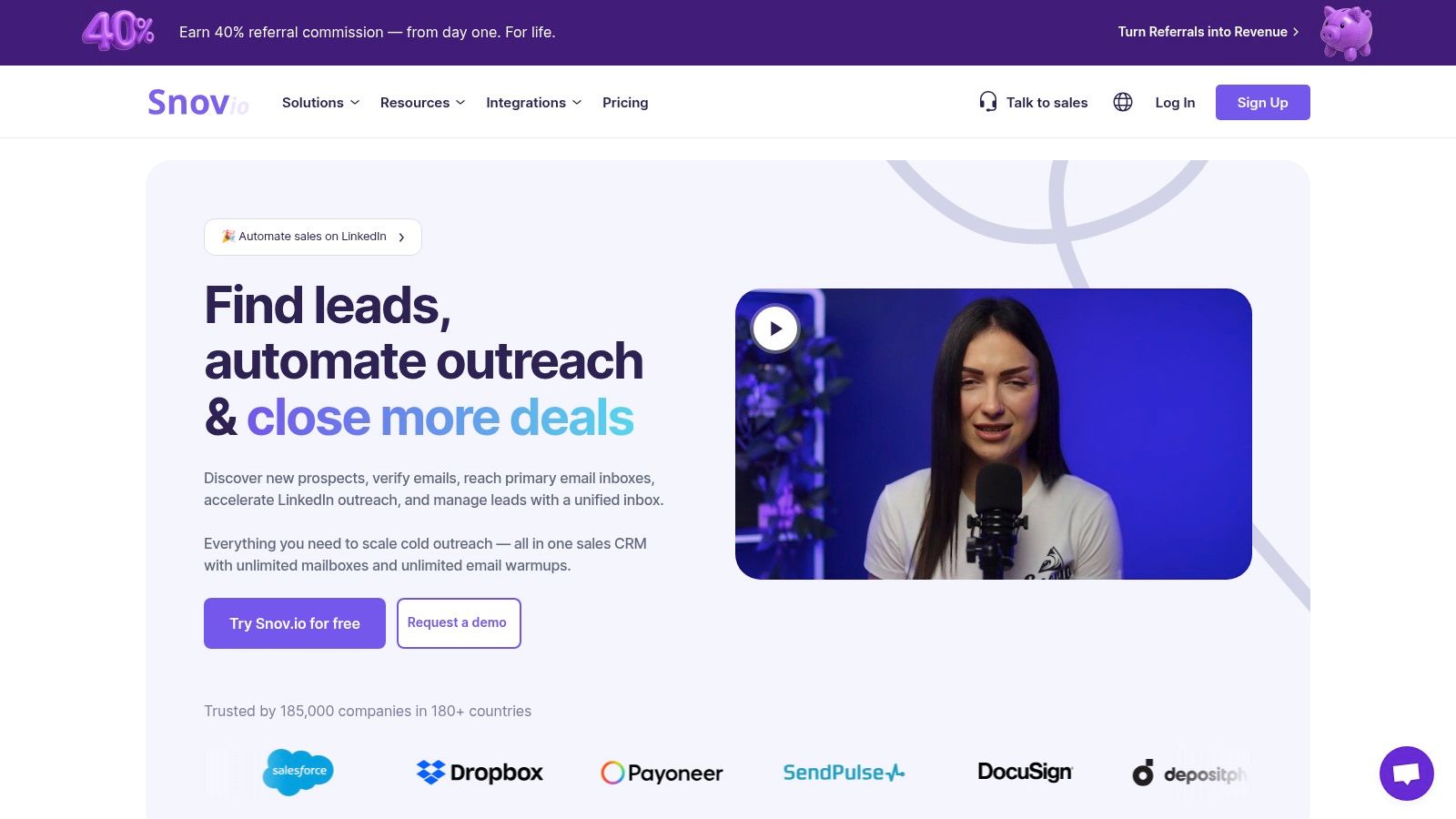
    The pressure on sales and marketing teams to deliver results is always on. This is especially true in email marketing, where campaigns are still known to generate an incredible $36 return for every dollar invested. That kind of potential is what drives the need for smart tools like Snov.io, which combines extraction with verification and plugs right into platforms like LinkedIn—all while keeping bounce rates under 1%.

    Ultimately, verification shifts your whole mindset from quantity to quality. Instead of just blasting a huge, unvetted list and hoping for the best, you’re building a smaller, more powerful list of people you know you can actually reach. It's a simple step that transforms a spreadsheet of data into a real opportunity to build genuine connections.

    For a deeper look into how it all works, check out our guide on how to validate an email address effectively. It’s the key to making sure every bit of effort you put into outreach has the highest possible chance of success.

    Ethical Guidelines for Using Extracted Emails

    Laptop screen displaying 'USE Ethically' with a handshake shield icon and a completed checklist.

    An email extractor for Chrome is an incredibly powerful tool. But like any tool, its real value comes down to how you use it. Just scraping thousands of addresses to blast with a generic message is a fast track to a trashed brand reputation and a bone-dry sales pipeline.

    The goal isn't just mass outreach. It's about building real, valuable connections.

    Think about it: every email you pull belongs to a person. Ethical outreach means respecting their inbox, offering something of genuine value, and being totally transparent. It’s the difference between being a helpful resource and getting immediately marked as spam.

    Navigating Privacy Laws and Compliance

    Jumping into email outreach without understanding data privacy laws is a huge risk. The two big ones you absolutely need to know are the CAN-SPAM Act in the U.S. and the General Data Protection Regulation (GDPR) in the European Union. They have different details, but their core message is the same.

    The essence of these laws is simple: be honest, don't use misleading information, and give recipients a clear way to say "no, thank you." Getting this wrong can lead to massive fines and do permanent damage to your brand’s credibility.

    These rules aren't just legal red tape; they're a blueprint for good business. Sticking to them forces you to be a smarter, more considerate marketer. That's why many tools operating in the US and EU have built-in verifiers to keep you compliant, with some even claiming 99%+ deliverability. You can read the full research about B2B email compliance to dig deeper into the specifics.

    Core Principles of Ethical Outreach

    To keep your campaigns both effective and respectful, you need to build these practices into your workflow from day one. This isn't just about dodging penalties—it's about building a sustainable strategy that people actually respond to.

    1. Focus on Public Business Information
    There’s a massive difference between scraping a publicly listed business email off a company website and grabbing someone’s private, personal email without their permission. Ethical use of an email extractor for Chrome is strictly about B2B outreach using professional contact info that’s already public. Never, ever target personal email addresses.

    2. Personalize Your Communication
    Don't be the person who sends a generic, one-size-fits-all template. Your first message has to show you’ve done your homework. Mention their company, their specific role, or even a recent article they published. That small bit of personalization proves you respect their time and will radically improve your chances of getting a reply.

    3. Provide Immediate and Clear Value
    Your first email needs to answer the recipient's silent question: "What's in it for me?" Forget the hard sales pitch. Instead, lead by offering a valuable resource, a useful insight, or a solution to a problem you know they have.

    4. Make Opting Out Effortless
    Every single email must have a clear, easy-to-find unsubscribe link. This is a non-negotiable requirement under both CAN-SPAM and GDPR. Hiding the opt-out link or making it a complicated process is a breach of trust and the law. Respecting someone’s choice to unsubscribe is a cornerstone of ethical marketing.

    Of course. Here is the rewritten section, crafted to sound like it was written by a human expert, following all your requirements.


    Got Questions? Let's Clear Things Up.

    Diving into a tool like a Chrome email extractor always brings up a few questions. It's smart to be curious. These extensions are incredibly useful, but knowing the ins and outs is what separates a pro from a novice. We're going to tackle the most common questions head-on so you can use these tools confidently and, more importantly, correctly.

    Think of this as your quick-start FAQ. We'll get straight to the point, cut through the jargon, and give you the clear, practical answers you need to get started without any second-guessing.

    Are Email Extractors Even Legal to Use?

    This is usually the first question on everyone's mind, and for good reason. The short answer is yes, using an email extractor is perfectly legal. But there's a huge "if" attached: it all comes down to how you use the emails you find. The tool itself is just a scraper; it's what you do next that matters.

    Legality really boils down to a few core ideas:

    • Public vs. Private Info: Stick to publicly available business contact information. Grabbing an email like hello@company.com from a corporate website is fair game. Digging a personal email out of a private social media profile without permission? That's crossing a line.
    • Respect Anti-Spam Laws: You absolutely have to play by the rules of laws like the CAN-SPAM Act (in the US) and GDPR (in the EU). That means being upfront about who you are, having a good reason to reach out, and making it dead simple for someone to opt-out.
    • "Legitimate Interest" is Key: In the B2B world, this is a big one. It just means your reason for contacting someone should actually make sense for their job. A sales tool provider emailing a VP of Sales? That’s legitimate interest. Blasting a random marketing pitch to anyone and everyone? Not so much.

    The bottom line is this: the tool isn't the problem, your process is. Use an extractor for targeted, relevant B2B outreach, and you're golden. Use it to build a giant spam list, and you're asking for trouble that can seriously damage your reputation.

    Can an Extractor Find Emails on Literally Any Website?

    While a great email extractor for Chrome can feel like a superpower, it does have its limits. No, it won't be able to find an email on every single site you visit. Its success depends on how the tool is built and, just as importantly, how the website is built.

    Some websites go out of their way to hide email addresses from automated tools to cut down on spam. They might display an email as an image or use some clever JavaScript to piece it together in a way that fools basic scrapers.

    But the best extensions are designed to get around these common tricks. They work best on sites where contact info is meant to be found, like:

    • Professional Networks: Sites like LinkedIn are a goldmine, but always be sure to use a tool that respects their terms of service.
    • Business Directories: Think online yellow pages or member lists for professional associations.
    • Corporate "Contact Us" Pages: These pages exist for the sole purpose of providing contact details.
    • Conference Speaker Lists: Industry event websites are fantastic for finding professionals in a specific field.

    Basically, if a human can see the email on the page or it’s sitting in the site's plain HTML code, a good extractor has a very strong chance of finding it.

    How Do I Avoid High Bounce Rates from My Extracted Lists?

    Finding a list of emails is only half the battle. Making sure they actually land in an inbox is what counts. A high bounce rate—and anything over 2% is considered high—is a huge red flag for email providers. It’s a fast track to getting your emails flagged as spam and wrecking your sender reputation.

    The single best way to avoid this is to use an email extractor for Chrome that comes with a built-in, real-time email verification feature.

    This feature is your quality control. As the tool pulls an email, it instantly checks with the mail server to confirm the address is real and can accept mail. It's like having a bouncer for your email list, kicking out the invalid, old, or typo-ridden addresses before they cause any problems.

    If your tool doesn't have this built-in, you have one more critical step to take. Before you even think about hitting "send," you must run your exported list through a separate bulk email verification service. It might feel like an extra chore, but it’s an non-negotiable part of any serious outreach campaign. Skipping verification is a risk that just isn't worth taking.

    What’s the Best Way to Organize the Emails I Find?

    Good organization is what turns a random list of contacts into a pipeline of opportunities. Just dumping every email you find into one massive spreadsheet is a recipe for chaos and lazy, generic outreach that nobody responds to.

    The process starts the second you hit export. Always save your list as a CSV file, since it’s the universal format that plays nice with every spreadsheet program and CRM out there. From there, it's all about segmentation.

    Break your lists down based on criteria that actually matter:

    • Source: Keep lists from different websites separate (e.g., "SaaS Conference Speakers" vs. "Local Marketing Agency Directory").
    • Industry: Group contacts by their field (e.g., FinTech, E-commerce, Real Estate).
    • Job Title: Create targeted lists for the specific roles you're after (e.g., VPs of Marketing, CTOs, Founders).

    Organizing like this lets you craft messages that speak directly to each group. A personalized email that references a person's industry and job title will always outperform a generic blast, every single time. The final step is to import these neat, segmented lists into your CRM to track conversations and manage your follow-ups like a pro.


    Ready to build high-quality, verified contact lists in seconds? EmailScout is the ultimate email extractor for Chrome, designed for sales professionals, marketers, and entrepreneurs who need reliable data without the hassle. Find unlimited emails for free and start connecting with the right people today.
    Get Started with EmailScout for Free

  • Master Your Email Extractor Chrome Extension

    Master Your Email Extractor Chrome Extension

    An email extractor chrome extension is a simple but powerful browser tool that does one thing exceptionally well: it finds and collects email addresses from websites, social media pages, and just about any other online source. It essentially automates a tedious manual process, turning hours of grunt work into a task that takes just a few clicks. For anyone in sales or marketing, it’s a total game-changer.

    Why An Email Extractor Is Your New Secret Weapon

    Workspace with a laptop displaying lead generation software, a coffee mug, and a 'Generate Leads' book.

    In sales and marketing, speed and efficiency are everything. If you're still manually digging through websites and LinkedIn profiles for contact info, you're falling behind. That kind of work is a massive time drain, pulling you away from the activities that actually move the needle—building relationships and closing deals.

    This is exactly where an email extractor extension comes in. Think of it less as another browser add-on and more as a strategic asset. It automates the most frustrating part of lead generation, letting you build hyper-targeted prospect lists with incredible speed.

    A Few Real-World Examples

    Let's get practical. Imagine you're prepping for a big industry conference. Instead of spending the week before hunting down contacts, you could just visit the event's exhibitor page and pull hundreds of relevant emails in a matter of minutes. This gives you a massive head start, allowing you to kick off your outreach before the event even starts.

    Here are a few other ways you can get a strategic edge:

    • Laser-Focused Prospecting: Scrape emails from niche forums, industry blogs, or LinkedIn groups to find people actively talking about problems your product solves.
    • Smarter Competitor Analysis: See where your competitors are active online. You can often identify potential customers they might be overlooking in those same communities.
    • Quick Networking: Need to gather contacts fast? Use it on online portfolios, speaker bios from virtual events, or professional directories to build a list in no time.

    The scale these tools operate at is what makes them so powerful. The best extensions are trusted by millions of professionals and have processed billions of email searches. By 2025, tools like these have become standard issue, with some maintaining databases of over 200 million regularly refreshed B2B profiles. That data integration means you're not just getting emails; you're often getting verified contacts, which is a huge deal for keeping bounce rates low. You can read more about how B2B data collection is scaling to see just how critical this has become.

    To put it simply, a good email extractor tool brings several key advantages to your daily grind.

    Core Benefits of Using an Email Extractor Extension

    Here’s a quick breakdown of how these tools can immediately improve your workflow.

    Benefit Impact on Your Workflow
    Time Savings Cuts down hours of manual research into minutes, freeing you up for high-value tasks like outreach and follow-ups.
    Increased Accuracy Reduces human error from copy-pasting, leading to cleaner data and lower email bounce rates.
    Scalable Lead Generation Allows you to build large, targeted prospect lists quickly, something that's simply not feasible to do by hand.
    Targeted Outreach Enables you to gather contacts from specific sources (like niche communities or competitor sites) for hyper-relevant campaigns.

    These benefits aren't just about convenience; they directly contribute to a more effective and profitable sales or marketing operation.

    Key Takeaway: Using an email extractor isn't just about getting emails faster. It’s about building smarter, more relevant lists that let you execute personalized outreach at a scale that was impossible before.

    This shift from manual labor to automated intelligence is the foundation of any modern, data-driven workflow. By removing the data entry bottleneck, you free up your most valuable resource—time—to focus on crafting great messages, nurturing leads, and driving revenue. The job becomes less about finding people and more about effectively engaging them.

    Setting Up Your Email Extractor for First Use

    Getting a new tool up and running should be the easiest part of the job. We designed EmailScout to be a simple email extractor chrome extension that takes you from zero to finding emails in just a couple of clicks, all right from the Chrome Web Store.

    First things first, you need to find the extension. Just pop "EmailScout" into the Chrome Web Store search bar, and it'll be the top result. You'll see a big blue button that says “Add to Chrome.” Go ahead and click it—that’s literally the only step. Chrome takes care of the rest, downloading and setting it up for you.

    Understanding Permissions

    Once you click that button, Chrome will show you a pop-up asking for certain permissions. This is a totally standard security check for any extension, but it’s good to know what you’re actually saying "yes" to. It will ask for permission to “read and change your data on the websites you visit.”

    That might sound a little intense, but it's essential for the tool to do its job. Here's the simple breakdown of what that means:

    • Reading Data: The extension needs to scan the code and text on a webpage to spot anything that looks like an email address (like contact@company.com).
    • Changing Data: This permission is usually just so the extension can display its icon on the page, often with a little badge showing how many emails it found.

    Good extensions only use these permissions for what they say they will. EmailScout isn't reading your personal emails or grabbing your passwords; it’s just scanning the public content on websites for you.

    Key Insight: Granting these permissions is what brings the extension to life. It’s what allows the tool to actively scan the sites you're on and pull out contact information, turning a simple webpage into a lead-generating resource.

    Activating and Pinning the Extension

    After it's installed, you’ll find the EmailScout icon tucked away under the puzzle piece icon in your browser's toolbar. To save yourself a click every time, I recommend pinning it.

    Just click the puzzle piece, find EmailScout in the list, and click the little pin icon next to it. This will lock the icon to your toolbar so it's always visible and ready to go.

    And that's it! You're all set to start finding emails. If you’re just getting started and want to learn more about the different ways to approach this, check out our guide on using a free email scraping tool.

    Putting Core Features into Action

    Now that you're all set up, let's get down to business. A powerful email extractor Chrome extension is more than just a button you click; it’s a tool you weave into your daily workflow to hit specific goals. I’ll walk you through how to use EmailScout’s core functions in real-world situations to get immediate results.

    The whole point of a tool like this is to make your life easier. Getting started is designed to be quick and painless.

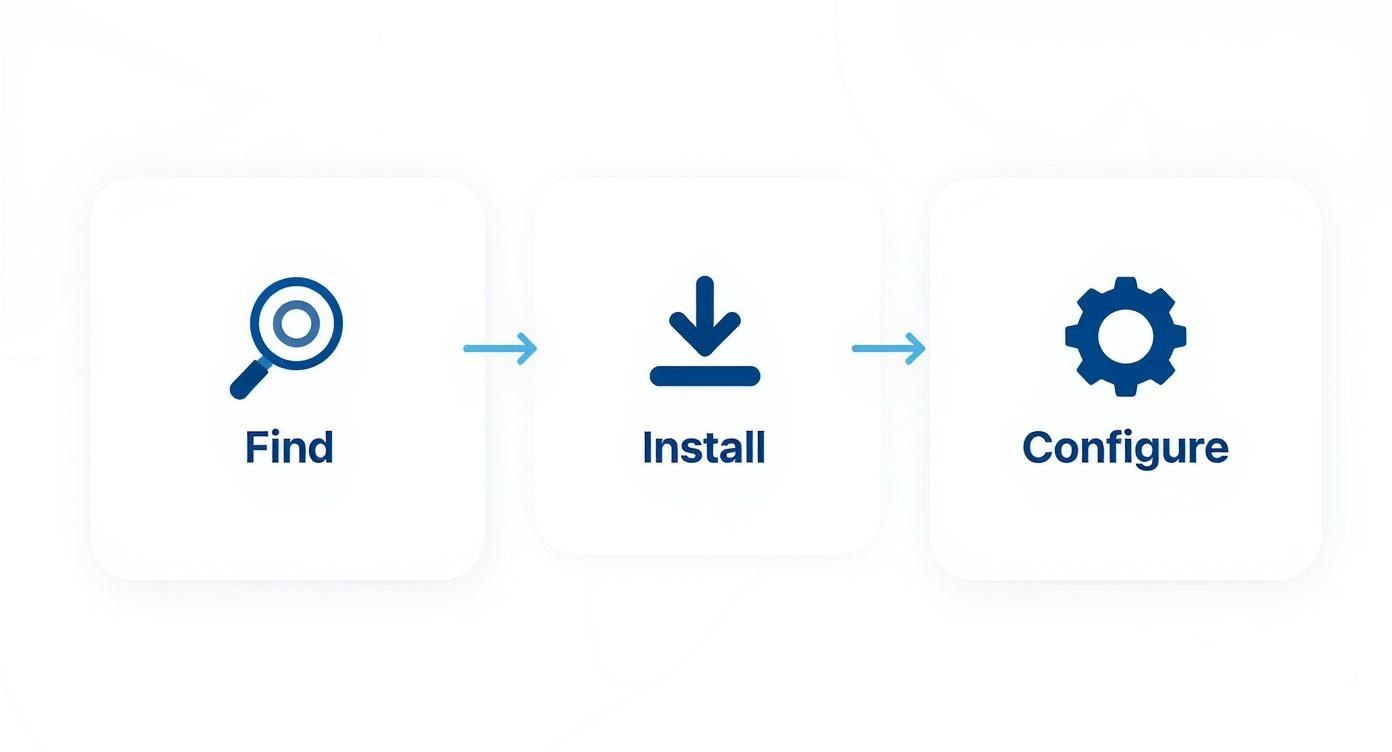
    A three-step process diagram showing Find, Install, and Configure with magnifying glass, download, and gear icons.

    This simple flow—Find, Install, and Configure—is all it takes to get EmailScout ready for action. So, what’s next?

    Extracting from a Single Webpage

    The most common way to use an extractor is for pulling emails from a single, high-value source. This is your go-to move for targeted, on-the-spot needs.

    Let's say you're a SaaS sales rep who just stumbled upon a blog post: "Top 50 Marketing Agencies in Texas." That page is pure gold. All you have to do is navigate to that URL, click the EmailScout icon in your toolbar, and watch it work. In seconds, it scans the entire page and gives you a clean list of every email address it found. Just like that, you have a hot prospect list ready to go.

    This on-demand method is perfect for situations like:

    • Conference Exhibitor Lists: Instantly grab contacts from event pages.
    • Industry Directories: Scrape member lists from professional associations.
    • "About Us" Pages: Pinpoint key decision-makers at your target companies.

    This is the bread and butter of any solid email scraper. If you want a deeper dive, check out our guide on how to extract emails from any website.

    Leveraging Automation with AutoSave and URL Explorer

    One-off extractions are great, but automation is where the real magic happens. This is where features like AutoSave and URL Explorer step in to save you a massive amount of time.

    These features are what truly scale your efforts. For example, EmailScout’s AutoSave and AutoVisit features can automatically crawl and scan up to 1,000 URLs at a time, pulling emails even from websites that are tricky to scrape manually. It builds and maintains cloud-based lists you can even share with your team.

    Better still, these systems have built-in filters to remove duplicates and block spammy addresses, keeping your list quality high. For sales development reps, this means you get verified, up-to-date contact lists that can hit deliverability rates over 97% when you pair them with a verification tool. That’s how you maximize campaign efficiency.

    Pro Tip: When you're using the URL Explorer for a bulk job, remember that a highly targeted list is everything. A tight list of 50 relevant URLs will always beat a generic list of 500. Quality over quantity wins every time in outreach.

    Understanding these advanced features is what separates a basic tool from one that can genuinely scale your lead generation. To see what’s possible, it’s worth exploring some specific lead scraping capabilities out there. This is how you build a robust pipeline while you focus on the work that really matters.

    Advanced Strategies for Building Better Lists

    Businesswoman creating targeted lists using a computer and a pen to organize data.

    Having a powerful tool is just the first step. The real magic happens when you use it strategically—that's what separates the pros from the beginners. Just grabbing every single email you come across is a surefire way to get low open rates and burn through your leads.

    The true power of an email extractor chrome extension isn't just about collection; it's about building high-quality, targeted lists that are actually ready to convert.

    This requires a shift in mindset. Move away from broad, generic scrapes and start thinking with precision. Instead of just pulling contacts from a homepage, dig deeper. Where do your ideal prospects hang out online? Maybe they’re leaving thoughtful comments on niche industry blogs or are listed as speakers for a specialized webinar. Those are the goldmines you want to tap into.

    Refining and Segmenting Your Data

    Once you have your raw data, the real work begins. A clean, organized list is your most valuable asset. The first thing you should always do is scrub for duplicates and get rid of those generic, role-based emails like info@ or contact@. They rarely get you a real conversation and can do a number on your sender reputation.

    Next up is segmentation. This is where you can get really smart with your outreach. Group your contacts based on where you found them or what their job title is.

    For example, you could:

    • Segment by Source: Keep contacts from a marketing blog in one list and those from a tech forum in another.
    • Segment by Job Title: Create separate lists for decision-makers (like CEOs or VPs) and operational staff.

    This simple act of organizing your data lets you create hyper-personalized emails. A message crafted specifically for a marketing manager will always outperform a generic blast sent to everyone. Clean data is everything in successful campaigns, and using an email address verification service is a non-negotiable step to keep your lists healthy.

    Key Takeaway: A small, super-targeted list of 100 engaged prospects will crush a generic, messy list of 1,000 every single time. It's all about quality, not quantity.

    Turning Raw Data into Conversations

    With a clean, segmented list in hand, you’re ready to start writing outreach that actually gets a response. A cold email doesn't have to feel cold.

    By simply mentioning the context of where you found their email—"I saw your insightful comment on the XYZ blog"—you instantly break the ice, establish relevance, and start building rapport. It shows you did your homework.

    Of course, once you’ve built your lists, you need to make sure your messages actually land in the inbox. For a masterclass on that, check out this fantastic email deliverability guide from the experts.

    Sample Outreach Templates

    To help you hit the ground running, here are a couple of versatile templates for different outreach scenarios using your newly extracted email lists.

    Template Type Subject Line Idea Body Snippet
    Cold Sales Quick question about [Company Name] Hi [First Name], I found your email on [Source, e.g., the speaker list for the Tech Growth summit] and was impressed by your work in [their field]. At [Your Company], we help businesses like yours solve [problem]. I had a specific idea for how we could help you achieve [goal].
    Networking Loved your post on [Topic] Hi [First Name], I came across your profile while browsing [Platform/Website] and was really impressed with your article on [Article Topic]. Your point about [specific insight] was particularly sharp. I'm also working in the [Your Industry] space and would love to connect.

    Remember, these are just a jumping-off point. The real power comes from customizing them with genuine, specific details you've gathered. This strategic approach is how you turn a simple list of emails into a pipeline of real opportunities.

    Navigating Pricing and the Competitive Landscape

    Picking the right email extractor Chrome extension almost always boils down to one thing: value. What are you getting for your money? The market is crowded, and every tool seems to have a different pricing structure. It’s not about finding the cheapest option—it’s about finding the one that actually fits your goals, whether you're a freelancer building your first list or a sales team scaling up your outreach.

    Most tools you'll find run on a tiered model. You’ll almost always see a free plan, which is perfect for just testing the waters. These plans give you a small number of credits or basic features, enough to see if the tool works for you before pulling out your credit card. Once you're ready, paid plans unlock the good stuff and raise the usage limits.

    Decoding Common Pricing Models

    The pricing for these extensions usually falls into a few buckets, each designed for a different kind of user. It’s crucial to look past the monthly fee and understand what you’re actually paying for.

    • Credit-Based Plans: A lot of tools sell "credits," where one credit gets you one email find or verification. This model is great if your prospecting needs are unpredictable—you just pay for what you use, when you use it.
    • Subscription Tiers: This is the classic monthly or annual plan. You typically get a set number of credits per month, and higher tiers throw in more credits and advanced features like bulk finding or CRM integrations.
    • Unlimited Plans: For the real power users, some premium tools offer plans with unlimited email credits. If you're running high-volume campaigns day in and day out, this is your best bet. You never have to worry about hitting a cap.

    The email extractor space is incredibly competitive, and the pricing reflects that. You can find premium tools offering unlimited credits and bulk prospecting for around $59 per month. On the other end, some offer free basic versions with affordable upgrades like cloud storage for about $9.99 per month. The best tools integrate right into company websites, letting marketing teams pull entire lead lists seamlessly. This variety just goes to show that there are solid options whether you're searching for a few thousand emails or over 50,000 each month. You can discover more about the competitive market on swordfish.ai.

    What Separates the Good from the Great

    When you're weighing your options, price is only one piece of the puzzle. A truly great tool gives you features that make your entire workflow faster and more effective.

    Key Takeaway: The best value isn't always the lowest price. It's the tool that offers the right combination of features, accuracy, and support to match your specific outreach strategy and scale.

    Look for tools that integrate smoothly with the CRM you already use. Built-in email verification is another non-negotiable—it keeps your bounce rate low and your sender reputation high. And don't forget about customer support. These are the things that save you time, get you better results, and ultimately deliver a much higher return on your investment. A smart decision here will pay off big time in your future campaigns.

    Got Questions About Email Extractors?

    Jumping into the world of automated email collection always brings up a few important questions. Using an email extractor Chrome extension is a seriously powerful technique, but you absolutely have to approach it the right way. Let's tackle the most common concerns so you can use these tools with confidence.

    Probably the biggest question we hear is about the legality and ethics of it all. It's a valid concern. The short answer is that using an extractor is generally legal, but it really comes down to how you use the data you find. The key is to stick to publicly available business information for legitimate B2B outreach, not scraping private data.

    Crucial Insight: Compliance with rules like GDPR and the CAN-SPAM Act isn't about the tool you use—it's about your entire process. You must always give people a clear and easy way to opt out of your messages. This isn't just a legal hoop to jump through; it's ethical, respectful, and frankly, just good business.

    Responsible use means treating the contact info you gather as the first step toward a real connection, not just another number in a database.

    How Do I Know the Emails I Find Are Accurate?

    Data quality is everything. A list full of bad emails will absolutely tank your deliverability, hurt your sender reputation, and waste your time. So, how can you trust the data you're pulling?

    First off, pick an extension with a solid reputation for accuracy. Many modern tools, including EmailScout, have verification features baked right in, checking an email's validity the moment it's found. Think of this as your first line of defense against bounces.

    Beyond that, you should always practice good list hygiene. This isn't a one-and-done thing; it's an ongoing process.

    • Deduplication: Make sure your tool automatically removes duplicate entries. This keeps your list clean and prevents you from annoying the same person with multiple messages.
    • Filter Generic Emails: You'll want to avoid collecting role-based addresses like contact@, info@, or support@. They rarely get you to a decision-maker and almost always have terrible engagement rates.
    • Verify Periodically: If you're building a big list over several months, it’s a smart move to run it through a dedicated email verification service every so often. This helps you weed out any emails that have gone inactive.

    What if the Extension Can't Find Any Emails?

    It’s going to happen. You land on what looks like the perfect prospect's website, run your extractor, and… nothing. Don't panic. This is usually an easy fix.

    Before you assume there are no emails to be found, run through a quick troubleshooting checklist. Sometimes, a simple page refresh is all it takes. Seriously. If that doesn't do the trick, try clearing your browser's cache, since old data can occasionally mess with how extensions work.

    It's also good to remember that many modern websites use dynamic content. This means information—including email addresses—might not even load until you scroll down or click on something. Try interacting with the page a bit. And of course, some sites just don't list public emails. In those cases, the tool is actually working perfectly by not finding anything.


    Ready to build better, cleaner prospect lists with confidence? EmailScout gives you the tools you need to find accurate contacts quickly and responsibly. Start extracting unlimited emails for free today.

  • 12 Best Free Email Finder Tool Options for 2025

    12 Best Free Email Finder Tool Options for 2025

    In today's competitive environment, connecting with the right people is the backbone of successful sales, marketing, and networking. The primary challenge is often the first step: finding a verified email address. This process can be a significant drain on time and resources, directly impacting your outreach potential and slowing down your growth pipeline. This is precisely the problem a dedicated email finder tool solves, automating prospecting and ensuring your message reaches the intended inbox.

    The great news is that you don't need a significant budget to access this powerful technology. A high-quality, best free email finder tool can be a game-changer, helping you build targeted lists, verify contact data, and dramatically improve your outreach efficiency without any initial investment. However, the market is saturated with options, and navigating the limitations of free plans can be confusing. Each tool offers a different number of free credits, data accuracy levels, and feature sets, making it difficult to determine which one truly fits your specific workflow.

    This comprehensive guide is designed to eliminate that guesswork. We provide a detailed, hands-on analysis of the 12 best free email finders available today. For each tool, we'll dive into its real-world performance, practical use cases, and the genuine capabilities of its free tier. You'll find direct links and screenshots to guide you. Whether you're a freelancer building a client base, a startup founder seeking investors, or a sales professional aiming to crush your quota, this resource will equip you to select the perfect tool to fuel your outreach strategy.

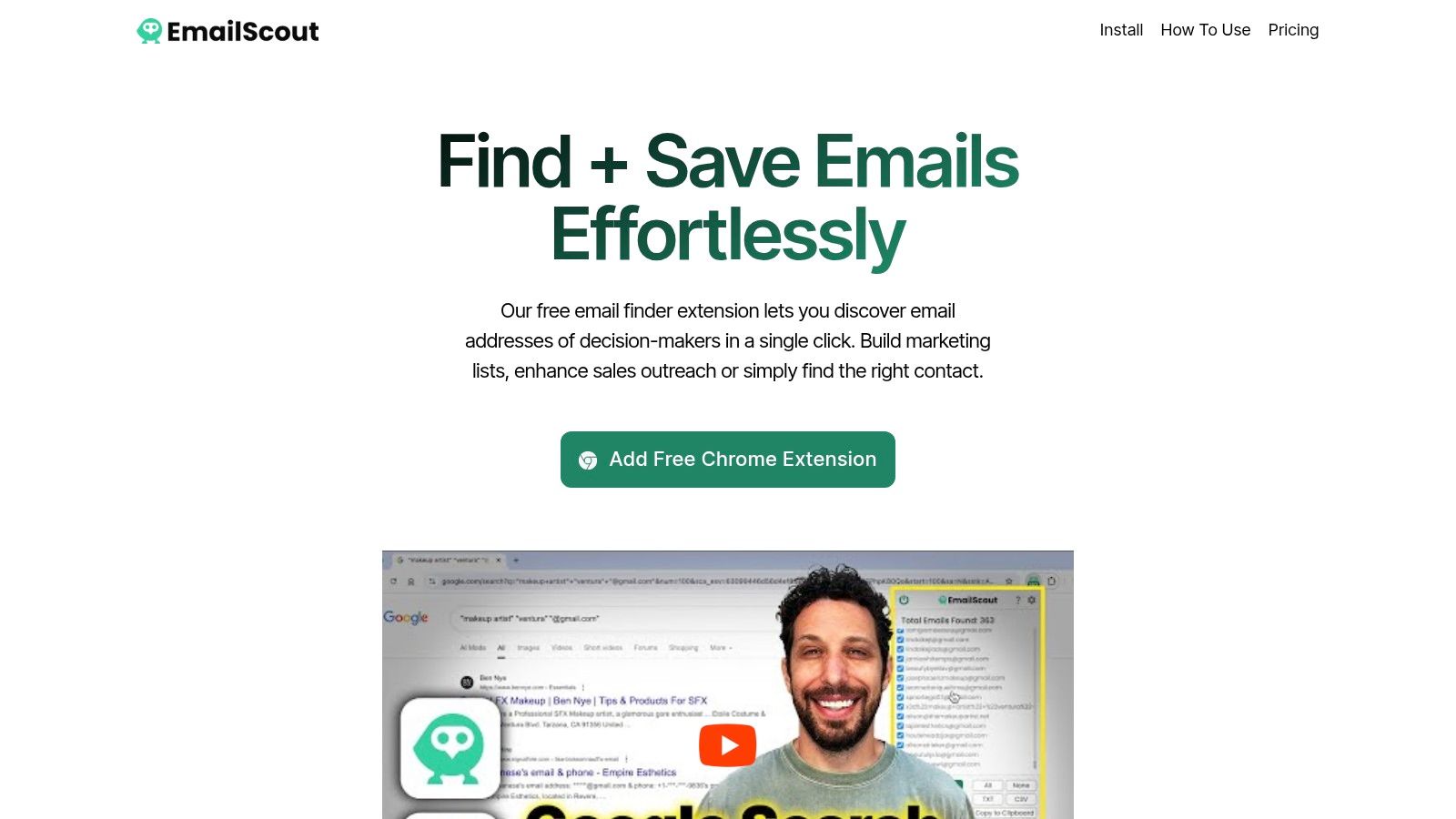
    1. EmailScout

    EmailScout distinguishes itself as the best free email finder tool by offering a rare and highly valuable feature: unlimited email searches and exports at no cost. This single attribute makes it a powerful ally for sales professionals, marketers, and entrepreneurs who need to build substantial contact lists without an initial investment. Its streamlined Chrome extension integrates directly into your browser, allowing for one-click email extraction from any webpage you visit, making it incredibly efficient for on-the-fly lead generation.

    EmailScout

    While the free version is robust, EmailScout’s premium features are where it truly excels in scalability. For users needing to build massive lists, the URL Explorer is a game-changer, capable of scanning up to 1,500 URLs in a single operation. Another standout is the AutoSave feature, which passively collects emails in the background as you browse, creating a hands-free lead generation workflow.

    Key Features & Use Cases

    • Unlimited Free Searches: Build extensive email lists without ever hitting a monthly credit limit. This is ideal for startups and freelancers operating on a tight budget.
    • One-Click Extraction: Instantly pull all available email addresses from a webpage directly from the Chrome toolbar, saving significant manual effort.
    • URL Explorer (Premium): A perfect tool for large-scale campaigns. Simply paste a list of company websites, blog posts, or directory pages to extract thousands of potential leads in minutes.
    • AutoSave (Premium): Activate this feature during research sessions. As you browse competitor sites or industry forums, EmailScout automatically populates your lead list without any extra clicks.

    Why It Stands Out

    EmailScout’s core advantage is its frictionless entry point. The unlimited free plan provides immediate, tangible value, which is a significant differentiator in a market often limited by restrictive credit systems. The user interface is clean and intuitive, requiring virtually no learning curve. Upgrading is also straightforward, with plans starting at an accessible $9/month, ensuring the tool can grow with your outreach needs.

    Pros:

    • Completely free unlimited email searches and exports
    • AutoSave feature for hands-free, passive lead generation
    • URL Explorer can process up to 1,500 URLs at once
    • Affordable and flexible pricing plans for scaling up

    Cons:

    • Advanced automation features like AutoSave and URL Explorer are behind a paywall
    • Only scrapes emails from visited pages, so it may miss contacts hidden behind forms or in databases

    Website: https://emailscout.io

    2. Hunter.io

    Hunter is a giant in the B2B email prospecting world, widely recognized for its comprehensive domain search feature. It excels at finding all publicly available email addresses associated with a specific company domain, making it an ideal starting point for broad outreach campaigns or mapping out an organization's structure. Its straightforward interface and reliable data have cemented its place as a go-to tool for sales and marketing professionals.

    The platform's free plan is designed for light use and evaluation, offering a solid entry point for freelancers or small teams just beginning their prospecting efforts. While the tool is powerful, understanding its credit system is key to maximizing its free offering.

    Hunter.io

    Key Features & Use Cases

    Hunter's strength lies in its simplicity and direct approach to lead generation. It's not just a finder; it's a complete outreach toolkit.

    • Domain Search: The most popular feature, allowing you to input a company website (e.g., company.com) and retrieve a list of associated email addresses. This is perfect for identifying key contacts within a target account.
    • Email Finder: If you have a person's name and company, Hunter can find their specific email address. This is highly effective for targeted outreach to specific decision-makers.
    • Built-in Verification: Each email search also acts as a verification, helping to maintain a clean email list and protect your sender's reputation.
    • Browser Extension: Its Chrome extension allows you to find email addresses associated with the website you are currently visiting, streamlining your prospecting workflow.

    Pricing & Limitations

    Hunter's free plan provides 25 monthly searches and 50 monthly verifications. A "search" is counted for each domain search or individual email lookup. While generous for testing, these credits can be consumed quickly if you're building a large list. Advanced features like bulk tasks and advanced data exports are reserved for paid tiers, which start at $49/month.

    Practical Tip

    Use the Domain Search feature to get a general feel for a company's email pattern (e.g., firstname.lastname@company.com). You can then use this pattern to guess an email and use your free verifications to confirm it, saving your valuable search credits. For more strategies on finding email addresses, you can find a comprehensive guide on how to find someone's email address on EmailScout.io.

    Feature Best For Free Plan Limit
    Domain Search Broad company-level prospecting 25 searches/mo
    Email Finder Targeting specific individuals (Counts toward search limit)
    Email Verifier List cleaning and validation 50 verifications/mo
    Integrations CRM and workflow automation Available on free plan

    Website: https://hunter.io

    3. Snov.io

    Snov.io positions itself as an all-in-one cold outreach automation platform, and its email-finding capabilities are a core component of that suite. It's more than just a simple lookup tool; it's designed to support the entire prospecting workflow, from finding leads to verifying their emails and launching automated drip campaigns. This integrated approach makes it a strong contender for users looking to manage multiple aspects of their outreach from a single dashboard.

    The free plan is generous enough to give users a real feel for the platform's power, offering credits that can be used flexibly across its different tools. This makes it a great entry point for those wanting to test a more holistic prospecting solution without immediate financial commitment.

    Snov.io

    Key Features & Use Cases

    Snov.io's feature set is built for sales and marketing teams who need a cohesive, scalable system for lead generation and engagement.

    • Email Finder: Search for emails by individual name, company domain, or even in bulk by uploading a list of names and companies. This is ideal for building targeted prospect lists quickly.
    • LI Prospect Finder: A powerful Chrome extension feature that allows you to find and save leads directly from LinkedIn profiles and search results, complete with email addresses and other data.
    • Email Drip Campaigns: A standout feature that lets you build and automate email outreach sequences directly within the platform, a function often reserved for separate, dedicated tools.
    • Email Verifier: Clean your lists by verifying email addresses in bulk or one by one to reduce bounce rates and protect your sender reputation.

    Pricing & Limitations

    Snov.io's free "Trial" plan provides 50 monthly credits and allows you to add up to 100 recipients to an email campaign. Credits are consumed for different actions: 1 credit per single email found, and 0.5 credits per single verification. This flexible system lets you choose how to spend your allowance, but the credit accounting can feel complex at first. Paid plans with more credits and features start at $39/month.

    Practical Tip

    Leverage the LI Prospect Finder extension on LinkedIn Sales Navigator searches. You can build highly targeted lead lists and then use your free Snov.io credits to find their email addresses directly from the search results page, saving significant time compared to manual lookups.

    Feature Best For Free Plan Limit
    Email Finder Building lists by name or domain 50 credits/mo
    LI Prospect Finder Sourcing leads from LinkedIn (Counts toward credit limit)
    Email Verifier Validating email addresses (Counts toward credit limit)
    Email Drip Campaigns Small-scale automated outreach 100 recipients/mo

    Website: https://snov.io

    4. Apollo.io

    Apollo.io positions itself as more than just an email finder; it's an end-to-end sales intelligence platform. It boasts a massive B2B database, making it a powerful tool for users who need not only contact information but also deep prospecting and engagement features. Its strength lies in integrating the entire top-of-funnel sales process, from finding leads to enriching data and executing outreach sequences.

    The platform's generous "free forever" plan is a major draw, offering a taste of its enterprise-grade capabilities. While it operates on a credit system for revealing contact details, its comprehensive nature makes it one of the best free email finder tool options for those looking to build a full sales workflow.

    Key Features & Use Cases

    Apollo.io excels by combining a vast contact database with powerful sales engagement tools, all within a single interface.

    • Vast Prospecting Database: Access a huge B2B database with advanced filters (job title, company size, location, etc.) to build highly targeted lead lists directly within the platform.
    • Email & Phone Reveal: Use credits to unlock verified email addresses and direct-dial phone numbers for prospects, a key feature for multi-channel outreach.
    • Enrichment & Sequences: Automatically enrich your existing CRM contacts with fresh data or enroll prospects into automated email sequences to nurture leads at scale.
    • CRM Integrations: Seamlessly sync data with popular CRMs like Salesforce and HubSpot, ensuring your sales data remains consistent across your tech stack.

    Pricing & Limitations

    Apollo's free plan is quite robust, offering 60 email credits per year (5 per month) and 10 export credits per month. The monthly email credits are limited, which encourages strategic use for high-value prospects. The free plan also includes access to the Chrome Extension and basic sequencing. Paid plans unlock higher credit limits and advanced features, starting at $49/month.

    Practical Tip

    Use Apollo's advanced prospecting filters to build highly specific lists of your ideal customers first. Before spending your limited monthly email credits, save these lists. Then, strategically use your credits only on the highest-priority contacts in your saved lists to maximize the value of the free plan.

    Feature Best For Free Plan Limit
    Prospecting Database Building targeted lead lists Unlimited browsing, credit-based reveal
    Email & Phone Reveal Obtaining direct contact info 60 email credits/year (5/month)
    Data Enrichment Updating and completing CRM data (Uses export credits)
    Chrome Extension Finding contacts on LinkedIn/websites Included in free plan

    Website: https://www.apollo.io

    5. Skrapp

    Skrapp is a powerful B2B prospecting tool with a strong emphasis on LinkedIn integration, making it a favorite for sales professionals who live on the platform. It excels at extracting email addresses directly from LinkedIn profiles, Sales Navigator, and company websites through its versatile Chrome extension. Its focus on social prospecting workflows makes it a highly efficient tool for building targeted lead lists.

    The platform's free plan is designed for consistent, low-volume use, offering a recurring monthly credit allowance. This makes Skrapp an excellent choice for users who need a reliable, albeit limited, email finder to supplement their ongoing sales activities without a financial commitment.

    Skrapp

    Key Features & Use Cases

    Skrapp is built to streamline the process of finding verified B2B emails, integrating seamlessly into existing sales workflows.

    • LinkedIn & Sales Navigator Integration: The Chrome extension allows you to find emails from individual profiles or search result pages directly within LinkedIn, which is ideal for sales development representatives.
    • Company Email Finder: Use the extension on a company website to uncover email addresses associated with that domain, helping you map out potential contacts.
    • Bulk Email Finder: Upload a CSV file with names and company information to find corresponding email addresses in bulk, saving significant manual effort.
    • Built-in Verification: Each email found is cross-referenced against Skrapp's database to ensure a high level of accuracy and reduce bounce rates.

    Pricing & Limitations

    Skrapp’s free plan offers 20 credits per month. A single credit is used for one email lookup. While the monthly credit count is lower than some competitors, the simplicity of its one-credit-per-email system is a plus. Paid plans, which offer more credits and features like bulk exports, start at $49/month.

    Practical Tip

    Leverage the LinkedIn Sales Navigator extension to its fullest. Build highly targeted lead lists within Sales Navigator and then use Skrapp to enrich those lists with contact information in one go. This targeted approach ensures you use your limited free credits on the most promising prospects. To understand more about company-level searches, see this guide on how to find company email addresses on EmailScout.io.

    Feature Best For Free Plan Limit
    LinkedIn Extension Sales prospecting on LinkedIn 20 credits/mo
    Company Finder Website-based email discovery (Counts toward credit limit)
    Bulk Finder Enriching existing lead lists (Counts toward credit limit)
    Email Verification Data accuracy and validation Included with each search

    Website: https://skrapp.io

    6. Lusha

    Lusha has carved out a strong reputation as a premium sales intelligence platform, excelling at providing not just email addresses but also direct-dial phone numbers for B2B contacts. Its polished interface and seamless integration with platforms like LinkedIn make it a favorite among sales teams who need accurate, multi-channel contact information to close deals. The tool is designed for speed and accuracy, helping users bypass gatekeepers and connect directly with decision-makers.

    The free plan offers a taste of its powerful capabilities, providing a small number of credits each month. This makes it a great supplementary tool for high-value targets or for professionals who only need to find a few key contacts periodically.

    Lusha

    Key Features & Use Cases

    Lusha's primary strength is providing both email and phone contact details, offering a more holistic approach to prospecting than many competitors.

    • Email & Phone Number Reveal: With a single click on a contact's LinkedIn profile or in the web app, Lusha reveals verified email addresses and direct phone numbers.
    • Browser Extension: The Chrome extension is the core of the Lusha experience, allowing you to find contact details directly on LinkedIn, Salesforce, and company websites.
    • CRM Integrations: Seamlessly save and enrich contacts in your CRM (like Salesforce, HubSpot, etc.), reducing manual data entry and keeping your records up-to-date.
    • Team Management: Paid plans offer features for teams to share credits and manage user access, making it a scalable solution for growing sales organizations.

    Pricing & Limitations

    Lusha's free plan provides 5 credits per month. A credit is used to reveal one contact's full details (email and phone number). These credits are quickly consumed, making the free plan suitable for only highly targeted prospecting. Phone number reveals can sometimes cost more credits than emails on certain paid plans. Paid tiers start at $29/month per user (billed annually) for more credits and features.

    Practical Tip

    Reserve your limited free Lusha credits for your highest-value prospects where a direct phone call could make a significant difference. For general email finding, use another tool with more generous free credits and save Lusha for the critical contacts that warrant a multi-channel outreach approach.

    Feature Best For Free Plan Limit
    Email & Phone Reveal Multi-channel sales outreach 5 credits/mo
    Browser Extension Finding contacts on LinkedIn (Uses monthly credits)
    CRM Integrations Automating lead data entry Available on free plan
    Team Features Collaborative prospecting Paid plans only

    Website: https://www.lusha.com

    7. ContactOut

    ContactOut is a powerful email and phone number finder, heavily favored by recruiters and sales professionals for its direct integration with LinkedIn. It operates primarily through a Chrome extension, allowing users to uncover contact details from personal profiles with a single click. Its reputation is built on providing both professional and personal email addresses, offering multiple avenues for outreach.

    The platform's free plan is notable for providing a recurring daily allowance of credits, making it a sustainable option for consistent, low-volume prospecting. This model allows users to continuously test data quality and integrate the tool into their daily workflow without needing an immediate subscription, making it a strong contender for the title of best free email finder tool for LinkedIn-centric users.

    ContactOut

    Key Features & Use Cases

    ContactOut excels at enriching profiles directly where most prospecting happens: on LinkedIn. Its features are designed to quickly turn a social profile into an actionable lead.

    • LinkedIn Profile Enrichment: The core feature, its Chrome extension, adds a sidebar to LinkedIn profiles, revealing work emails, personal emails, and sometimes phone numbers.
    • Email & Phone Finder: Beyond LinkedIn, you can use its web app to search for contacts, although the extension-based workflow is its primary strength.
    • Data Accuracy: The tool claims a high accuracy rate by cross-referencing multiple data sources, which is particularly useful for recruiters trying to reach passive candidates.
    • Search Portal: Users can search for candidates within ContactOut’s own database of professional profiles, filtering by job title, skills, and location.

    Pricing & Limitations

    ContactOut's free plan offers 40 contacts per month, which is a solid starting point for individual users. The main limitation is that its full potential is realized only through its Chrome extension on LinkedIn. Full pricing details for paid plans are not publicly listed and often require a sales consultation. Advanced features like team management and API access are reserved for higher-tier paid plans.

    Practical Tip

    Since the free credits are limited, be strategic. Before using a credit on a LinkedIn profile, quickly assess if the person is the right decision-maker for your outreach. Prioritize high-value prospects to ensure every credit counts towards a meaningful connection.

    Feature Best For Free Plan Limit
    LinkedIn Extension Recruiters & sales reps on LinkedIn 40 contacts/mo
    Email Finder Sourcing both work & personal emails (Counts toward contact limit)
    Phone Number Search Multi-channel outreach (Included in contact limit)
    Search Portal Sourcing outside of LinkedIn Available on free plan

    Website: https://contactout.com

    8. GetProspect

    GetProspect is a highly regarded email finder that strikes a compelling balance between a generous free plan and powerful B2B prospecting features. It is particularly well-suited for users who need a reliable stream of verified contacts without an immediate financial commitment. The platform is designed for efficiency, focusing on providing valid email addresses and essential data points to fuel sales and marketing pipelines.

    The free plan is one of the most generous available, offering a substantial number of credits for both finding and verifying emails each month. This makes GetProspect an excellent choice for startups, freelancers, or sales teams looking to build their initial contact lists without incurring costs.

    GetProspect

    Key Features & Use Cases

    GetProspect combines a powerful LinkedIn extension with a robust web app to create a seamless prospecting workflow.

    • LinkedIn Prospecting: Its Chrome extension is a standout feature, allowing users to find email addresses and other contact data directly from LinkedIn profiles and search results.
    • Bulk & Single Finder: You can search for individual contacts by name and company or upload a CSV file with names and companies to enrich the list with emails in bulk.
    • Built-in Verification: The platform prioritizes data quality by including a verifier, ensuring the emails you find are valid and reducing bounce rates.
    • Basic Cold Emailing: GetProspect includes a simple sequence builder, allowing you to send basic cold email campaigns directly from the platform, which is a useful addition for small-scale outreach.

    Pricing & Limitations

    The GetProspect free plan provides 50 valid email credits and 100 verifications per month. A "valid email" credit is only consumed when a verified, valid email is found. This is a key distinction that makes its free offering particularly valuable. While the UI is clean and functional, it lacks the polish of some larger sales suites. Paid plans start at $49/month for 1,000 valid emails.

    Practical Tip

    Leverage the LinkedIn extension for targeted list-building. Identify key decision-makers on LinkedIn, and use your free credits to pull their verified contact information. This targeted approach ensures you use your monthly credits on the highest-value prospects.

    Feature Best For Free Plan Limit
    LinkedIn Extension Finding emails from LinkedIn profiles 50 valid emails/mo
    Email Finder Individual or bulk contact lookups (Counts toward email limit)
    Email Verifier Validating existing email lists 100 verifications/mo
    Data Export Saving prospects to CSV/XLSX Available on free plan

    Website: https://getprospect.com

    9. Voila Norbert

    Voila Norbert has built a strong reputation over the years for its simplicity and accuracy in finding corporate email addresses. It operates on a straightforward principle: you provide a name and a company domain, and Norbert finds the corresponding email. Its clean interface and "pay-for-what-you-find" philosophy make it an attractive option for users who need a reliable, no-frills email finder without a complex subscription.

    The platform offers a one-time trial for new users to test its capabilities. While not a recurring free plan, this initial credit pack is a great way to evaluate its accuracy and see if its pay-as-you-go model fits your workflow, making it a valuable contender for anyone testing the best free email finder tool options.

    Voila Norbert

    Key Features & Use Cases

    Voila Norbert focuses on doing one thing exceptionally well: finding emails. Its features are built around this core function to ensure high deliverability and user confidence.

    • Single & Bulk Email Finding: Ideal for both targeted searches for specific decision-makers and enriching larger prospect lists by uploading a CSV file.
    • High-Confidence Results: Norbert provides a confidence score for each email it finds, helping you prioritize the most likely valid addresses and reduce bounce rates.
    • Verification & Enrichment: Beyond just finding, it offers services to verify existing email lists and enrich contacts with additional data points like job titles and social profiles as add-ons.
    • Chrome Extension: The browser extension allows for quick prospecting directly from company websites and LinkedIn profiles, integrating smoothly into your research process.

    Pricing & Limitations

    Voila Norbert’s free offering consists of 50 free credits as a one-time trial for new sign-ups. Unlike other tools with recurring monthly limits, these credits do not renew. The key advantage is that you are only charged a credit for a successful find. After the trial, paid plans start at $49/month for 1,000 credits, with pay-as-you-go options also available.

    Practical Tip

    Use your 50 free trial credits strategically on high-value prospects where you are confident about the name and company domain. Since credits are only deducted for successful finds, you don't have to worry about wasting them on unsuccessful searches, allowing you to maximize the value of your trial.

    Feature Best For Free Plan Limit
    Email Finding High-accuracy individual lookups 50 credits (one-time)
    Confidence Score Ensuring list quality (Included with searches)
    Integrations Connecting with other sales tools Available on trial
    API Access Custom tool development Available on paid plans

    Website: https://www.voilanorbert.com

    10. Anymail Finder

    Anymail Finder distinguishes itself with an accuracy-first approach, built around a unique credit system that prioritizes deliverability. The platform charges users only for verified, high-confidence email addresses, making it an excellent choice for teams who cannot afford high bounce rates and need predictable costs for their outreach campaigns.

    While it doesn't offer a perpetual free plan, its trial provides a risk-free way to test its performance. This model is best suited for professionals ready to invest in a reliable tool after validating its effectiveness, ensuring every credit spent translates directly into a usable contact.

    Anymail Finder

    Key Features & Use Cases

    Anymail Finder’s core value is its promise of quality over quantity, with features designed to maximize the ROI of your prospecting efforts.

    • Pay-for-Verified Model: Its most significant feature is that credits are only consumed for emails with a 97%+ deliverability rating. Guessed or unverified emails are free, protecting your budget.
    • Bulk Finder & Verifier: Upload a list of names and companies to find or verify email addresses in bulk, saving significant manual effort.
    • Rollover Credits: Unused credits roll over each month, providing flexibility for fluctuating campaign needs without wasting your subscription value.
    • Duplicate Prevention: The system automatically detects and provides duplicates free of charge within a 30-day window.

    Pricing & Limitations

    Anymail Finder offers a free trial with 20 verified emails. After the trial, you must upgrade to a paid plan, which starts at $49/month for 1,000 verified emails. The primary limitation is the absence of a recurring free monthly plan, making it a "try-before-you-buy" tool rather than a long-term free email finder tool.

    Practical Tip

    Use the free trial to test the tool on your most difficult-to-find prospects. This will give you a clear indication of its data quality and accuracy before you commit to a paid subscription, ensuring it aligns with your specific industry or niche needs.

    Feature Best For Free Plan Limit
    Verified Email Search Ensuring high deliverability rates 20 verified emails (Trial)
    Bulk Finder Processing large prospect lists (Counts toward trial limit)
    Rollover Credits Flexible monthly usage Paid plans only
    Duplicate Prevention Cost-effective list building Included in all plans

    Website: https://anymailfinder.com

    11. AeroLeads

    AeroLeads is a versatile prospect and lead generation tool that excels at finding business emails and phone numbers, particularly from professional networks like LinkedIn. It operates primarily through a Chrome extension, integrating directly into your browsing workflow to capture contact information from profiles on platforms such as LinkedIn, Crunchbase, and AngelList. This makes it a strong contender for sales teams and recruiters who spend significant time on these sites.

    The platform offers a free trial that acts as its entry-level free plan, allowing users to test its capabilities without a credit card commitment. While many advanced features are gated, the trial provides a good sense of its core functionality, positioning it as an accessible, free email finder tool for initial prospecting needs.

    Key Features & Use Cases

    AeroLeads is built to streamline the data-gathering process from professional networking sites into a manageable, actionable list.

    • LinkedIn Prospecting: Its Chrome extension is the star feature, allowing you to find email addresses and other data from LinkedIn profiles with a single click. This is ideal for sales development representatives building targeted lists.
    • Data Enrichment: The tool finds not only emails but also company names, phone numbers, job titles, and locations, providing a more complete profile for each prospect.
    • CRM Integration: AeroLeads supports exporting data to popular CRMs like Salesforce, HubSpot, and Zoho, making it easy to transfer your newly found leads into your sales pipeline.
    • Data Export: You can export your collected data as a .csv file, which is useful for bulk uploads or further analysis in spreadsheets.

    Pricing & Limitations

    AeroLeads offers a free trial with 10 credits to find prospects. These credits are used each time you add a prospect to your list. While this is a small number, it's sufficient for evaluating the tool's accuracy and workflow. The free plan has significant limitations; for instance, exporting data requires a paid subscription. Paid plans offer more credits and features, starting at $49/month.

    Practical Tip

    Use your 10 free credits very strategically on high-value prospects you find on LinkedIn. Since the data is captured in real-time, prioritize decision-makers at your top target accounts. You can find more tips on how to validate an email address on EmailScout.io to ensure your limited credits are used on high-quality contacts.

    Feature Best For Free Plan Limit
    LinkedIn Prospecting Sales and recruitment on LinkedIn 10 credits (total)
    Data Enrichment Building complete prospect profiles (Counts toward credit limit)
    Data Export Transferring leads to other systems Paid feature
    Integrations Pushing leads to CRMs Paid feature

    Website: https://aeroleads.com

    12. FindThatLead

    FindThatLead positions itself as more than just an email finder, offering a suite of prospecting and outreach tools aimed at streamlining the entire sales process. It’s built for users who want to not only discover contacts but also engage with them directly from the same platform. The tool is particularly useful for building targeted lists based on specific criteria like industry and location.

    Its permanent free plan offers a sustainable option for individuals or small teams with very light, ongoing prospecting needs. While the limits are modest, it provides a genuine opportunity to integrate the tool into a workflow and evaluate its full potential before considering an upgrade.

    FindThatLead

    Key Features & Use Cases

    FindThatLead combines data discovery with simple campaign management, making it a balanced tool for sales and marketing startups.

    • Prospector Tool: Search and build targeted lists using filters for company, industry, job title, and location. This is ideal for defining a specific market segment and finding relevant leads within it.
    • Email Finder: Find individual email addresses by inputting a person's name and company domain, perfect for direct outreach to key decision-makers.
    • Built-in Outreach: Send simple email sequences directly from the platform, allowing you to quickly act on the leads you've just discovered.
    • Chrome Extension: Scrape contact information from LinkedIn profiles and company websites, adding a layer of convenience to your daily prospecting routine.

    Pricing & Limitations

    The free-forever plan provides 20 monthly credits, which are only consumed when a valid email is found. This makes it a great entry-level option. However, this credit limit is restrictive for any significant list-building efforts. Paid plans offer more credits and unlock advanced features like bulk processing, starting at different price points that can vary by region.

    Practical Tip

    Use the Prospector tool to build a highly targeted, small list of ideal contacts. Since credits are only used on successful finds, you can focus on quality over quantity without wasting your limited free allowance. This makes it a great free email finder tool for hyper-specific campaigns.

    Feature Best For Free Plan Limit
    Prospector Building targeted lead lists 20 successful finds/mo
    Email Finder Locating specific contacts (Counts toward credit limit)
    Outreach Basic email campaigns Available on free plan
    Chrome Extension LinkedIn and website prospecting Available on free plan

    Website: https://findthatlead.com

    Top 12 Free Email Finder Tools Comparison

    Product Core Features User Experience & Quality Value Proposition Target Audience Pricing & Plans
    EmailScout Unlimited email searches/exports; AutoSave; URL Explorer (up to 1,500 URLs) Easy Chrome toolbar integration; highly accurate; time-saving Free unlimited email searches; premium automation; flexible plans Marketers, sales pros, entrepreneurs, freelancers Free unlimited; Premium from $9/month (5,000 emails)
    Hunter.io Domain and person email finder; verifier; team sharing Robust integrations; browser & Sheets extensions Generous free plan; straightforward credit system B2B sales and marketing teams Free limited credits; paid tiers for bulk & advanced
    Snov.io Email finder/verification; LinkedIn sourcing; outreach No credit card signup; flexible credits All-in-one prospecting; free testing tier Small teams, sales & marketing Free tier; paid add-ons for automation
    Apollo.io Email/phone reveal; prospecting filters; CRM sync Large contact database; broad sales tools Free tier to test; integrated sales workflows Sales professionals and teams Free forever core features; paid plans for scale
    Skrapp LinkedIn & website email finder; verification; bulk exports Simple pricing; credit rollover Rolling free plan; good LinkedIn tools Recruiters & sales pros Limited free; paid plans with credit rollover
    Lusha Email & phone reveals; CRM integration; team features Polished UX; easy onboarding Flexible team options; scalable credits Sales teams and recruiters Free limited credits; paid scalable plans
    ContactOut Email & phone finder; LinkedIn-centric workflow Strong recruiting reputation; free daily credits Recurring free credits; Chrome required Recruiters, sales professionals Free daily credits; premium team/API options
    GetProspect Email finder by name/company; verifier; CSV enrichment Clear pricing; utilitarian UI Free email & verification credits; add-ons Small teams, startups Free 50 emails + 100 verifications; paid plans
    Voila Norbert Email finder & verification; pay-as-you-go pricing Transparent per-email pricing Only pay for successful finds; one-time free credits Sales & marketing individuals Pay-as-you-go; free trial credits
    Anymail Finder Person, domain, LinkedIn search; 97%+ delivery verifier Focus on accuracy; credits roll over Pay for valid emails only; risk-free trial Teams focused on deliverability Paid plans only after trial; credits rollover
    AeroLeads LinkedIn & other sources email/phone finder; CRM integration Competitive pricing; free trial Low-cost trial; CRM export Small teams, solo users Free trial; paid credit-based plans
    FindThatLead Email finder with filters; outreach sequences; Chrome extension Balanced toolset; free forever plan Ongoing free plan for light users Small teams, startups Free forever (20 emails/month); paid plans

    Start Building Your Connections Today

    Navigating the crowded landscape of outreach tools can feel overwhelming, but finding the right instrument to build your network doesn't have to be a costly endeavor. Throughout this comprehensive guide, we've explored a dozen of the top contenders, each offering a unique approach to uncovering the contact information essential for growth. The journey from a cold prospect to a warm lead begins with a single, accurate email address, and the tools we've detailed provide a powerful starting point for any sales, marketing, or business development professional.

    The primary takeaway is that there is no single, one-size-fits-all solution. The best free email finder tool is ultimately the one that seamlessly integrates into your specific workflow, respects your budgetary constraints, and consistently delivers the accurate data you need to make meaningful connections. Your ideal choice depends entirely on your strategy and operational needs.

    How to Choose the Right Tool for Your Needs

    To make the best decision, you must first define your primary use case. Are you a freelancer focused on targeted outreach for a handful of high-value clients each month, or are you a startup aiming to build a massive top-of-funnel list?

    Consider these key scenarios when making your selection:

    • For High-Volume Prospecting: If your strategy involves building large lists from various online sources without worrying about monthly credit limits, a tool with generous free search capabilities is paramount. EmailScout's unlimited free searches make it an exceptional choice for this purpose, allowing for extensive research without financial friction.
    • For Deep LinkedIn Integration: Sales professionals and recruiters who live on LinkedIn will benefit most from a tool with a robust and reliable Chrome extension. Solutions like Apollo.io, Snov.io, and ContactOut excel in this environment, offering rich profile data and seamless integration directly within the LinkedIn interface.
    • For All-in-One Sales Engagement: If you need more than just an email finder and are looking for a platform that includes sequencing, CRM integration, and analytics, a comprehensive tool is your best bet. Apollo.io stands out here, providing an entire sales intelligence platform, though its free tier is more limited for pure email finding compared to specialized tools.
    • For Domain-Level Searches: Marketers and business development teams often need to find key contacts within a specific company. Hunter.io has long been the gold standard for its powerful domain search feature, making it incredibly efficient for account-based marketing strategies.

    Final Considerations Before You Begin

    Before committing to a tool and integrating it into your daily operations, remember to consider a few critical factors. Data accuracy should always be a top priority; a large list of unverified emails is far less valuable than a smaller, highly accurate one. Test the verification features of any tool you consider.

    Furthermore, think about your long-term needs. While a free plan is an excellent starting point, evaluate the paid tiers to ensure the tool can scale with your success. Look at the cost per valid email and the additional features unlocked at each level. Finally, always respect data privacy regulations like GDPR and CCPA. Use these tools responsibly to build genuine professional relationships, not to spam.

    The power to connect with almost anyone is now more accessible than ever. By experimenting with the free plans of the tools listed in this article, you can identify the perfect fit for your outreach goals. The right technology will not only save you time but will also open doors to opportunities that can fundamentally transform your business. Start experimenting, find your ideal tool, and begin building the valuable connections that will drive your success forward.


    Ready to stop worrying about monthly credits and start building your prospect lists without limits? EmailScout offers unlimited free email searches, making it the most generous and truly free email finder tool available. Discover the freedom of limitless prospecting with EmailScout today!