
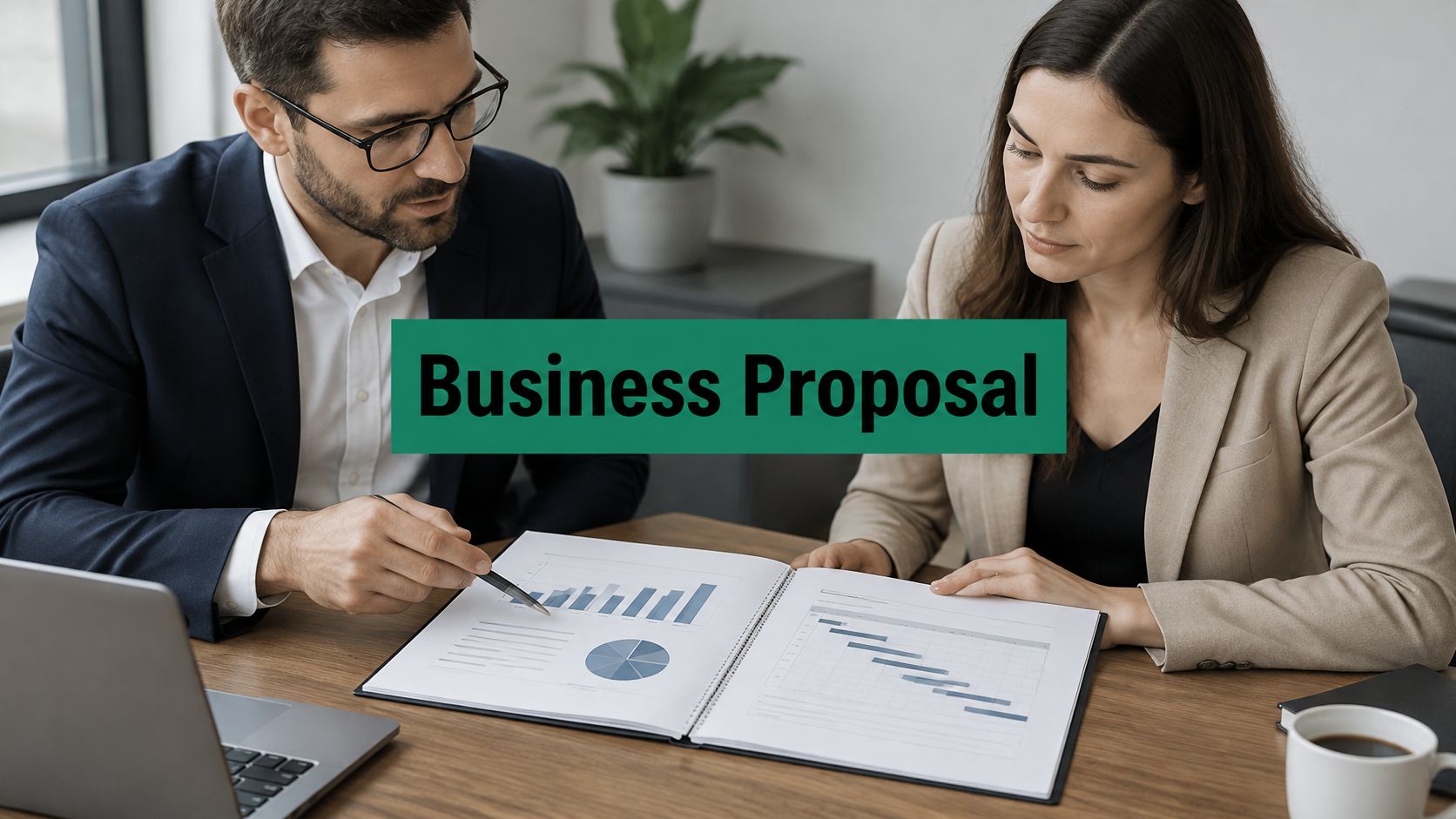
A business proposal is a formal written offer that presents a defined solution to another organization's stated need and asks for a decision.
A prospect has asked you to send something over, and you're staring at a blank document. Should you explain your company, attach a price list, or write a detailed project plan? The answer starts with what the recipient needs to approve, not what you want to say about yourself.
What a Business Proposal Means
Think of a shop counter. A sales pitch is the conversation about what you sell; a proposal is the written price, scope, and terms the buyer can compare with other offers. It gives the recipient something concrete to evaluate, discuss internally, and negotiate.
The practical business proposal meaning comes down to these elements:
- A need: The buyer has a problem, requirement, or opportunity worth addressing.
- A solution: You offer a defined product, service, or project that addresses it.
- A request for approval: You identify the decision you want the recipient to make.
A company profile might describe your bookkeeping services. A proposal explains which bookkeeping tasks you'll perform for this buyer, what they'll receive, what it costs, and how to proceed.
The procurement meaning
In public procurement, the requirements are more explicit. As the government contract proposal overview explains, suppliers typically respond to a Request for Proposals, or RFP, that sets out the public buyer's written requirements. Suppliers then explain their approach, qualifications, deliverables, timetable, pricing, and terms.
A proposal isn't automatically the same as a contract. It generally offers terms for consideration; the final agreement establishes enforceable obligations. If you intend the document to support discussion rather than acceptance, make that intention clear and review any signature language carefully.
Before choosing a template, identify the decision involved. Hiring a supplier, awarding a public contract, approving a partnership, and funding a project call for different documents.
Business Proposal Types and When Each Applies
An unsolicited sales proposal begins with a supplier identifying an opportunity. An RFP response begins with a buyer defining what suppliers must submit.
That difference affects more than tone. It determines your structure, supporting evidence, attachments, and freedom to choose what to include.
Business proposal types, who starts them and what they ask for
| Proposal type | Who starts it | What the buyer is asking for | Typical length |
|---|---|---|---|
| Unsolicited sales proposal | Supplier | A tailored offer to a prospect who hasn't asked for one | Keep to the scope, evidence, price, and next action |
| Solicited proposal (RFP response) | Buyer issues the RFP | Answers to written requirements plus required forms and certifications | Set by the RFP page limit |
| Renewal or upsell proposal | Existing client or supplier | A scope change or updated price on an existing account | Cover the changes and their commercial implications |
| Partnership proposal | Either party | Shared goals, roles, revenue split, and responsibilities | Include enough detail to evaluate obligations and governance |
| Grant or funding proposal | Funder's call for applications | Project need, budget, expected outcomes, and long-term sustainability | Follow the application's word and page limits |
| Government bid | Public entity | A compliance-focused offer with certifications and administrative information | Set by the solicitation |
These categories overlap. A government bid may be a solicited RFP response, while a renewal proposal may follow an informal request rather than a published competition.
The Commerce Acquisition Regulation proposal-preparation provision illustrates why terminology matters: its business-proposal volume is the actual offer to enter a contract and includes certifications and administrative information. A persuasive narrative alone won't satisfy that purpose.
Choose by the decision, not the template
Use this decision path before drafting:
- Who requested it? If nobody did, establish relevance and willingness to discuss the problem before preparing an extensive offer.
- What decision is sought? Hiring, renewing, sharing customers, and awarding funding each require different evidence.
- Do compliance rules apply? Follow prescribed headings, forms, submission instructions, and limits before adding optional material.
Say a freelance designer approaches a retailer about improving its online catalog. The designer can organize that offer around customer navigation, design deliverables, and price. When answering a city's RFP for similar design work, the designer must instead follow the city's evaluation structure and submission requirements.
For teams managing formal submissions, Bidwell's tools for drafting tender responses are a resource to consider alongside a requirement-by-requirement review.
A mismatch creates avoidable problems. A sales-style response can omit mandatory forms, while a grant request built around promotional claims can leave reviewers without the evidence their scoring criteria require.
How a Proposal Differs From Look-Alike Documents
People often request a proposal when they mean a quote, or send a business plan when the buyer needs a priced scope of work.
The simplest way to distinguish these documents is to ask what job each performs.
Documents often confused with a business proposal
| Document | Main job | Typical reader | Key difference from a proposal |
|---|---|---|---|
| Business plan | Explain a whole venture and its longer-term strategy | Investors, lenders, internal leaders | Describes the company's strategy, not a specific offer for approval |
| Pitch deck | Persuade quickly in a meeting or presentation | Investors, prospects, partners | Usually summarizes the opportunity without complete scope or terms |
| Quote | State a price for defined items or hours | Buyer approving a purchase | Usually lacks a narrative explaining approach, value, or proof |
| Sales email or letter | Start a conversation and earn a response | Prospect | Usually asks for a next step rather than presenting a complete offer |
| Contract | Establish binding obligations | Both parties agreeing to the work | Records the obligations and terms governing the relationship |
Match the document to the question
If the reader is asking whether to approve a specific offer, a proposal is usually appropriate. If the reader needs to understand how a venture will operate and grow, a business plan or investor presentation is more suitable.
These distinctions describe purpose, not file format. A PDF isn't automatically a proposal, and a slide deck can support a detailed commercial offer if it contains the necessary information.
Practical rule: Name the decision at the top of your draft. If you can't identify what the reader is approving, clarify the request before adding more content.
Getting the document wrong creates different costs. A long business plan makes a procurement manager hunt for the work, price, and delivery terms. A bare quote gives a buyer little help explaining why your approach deserves approval rather than a cheaper alternative.
A proposal can include a quote as a pricing attachment. That arrangement lets the buyer inspect the charges without losing the explanation of what those charges cover.
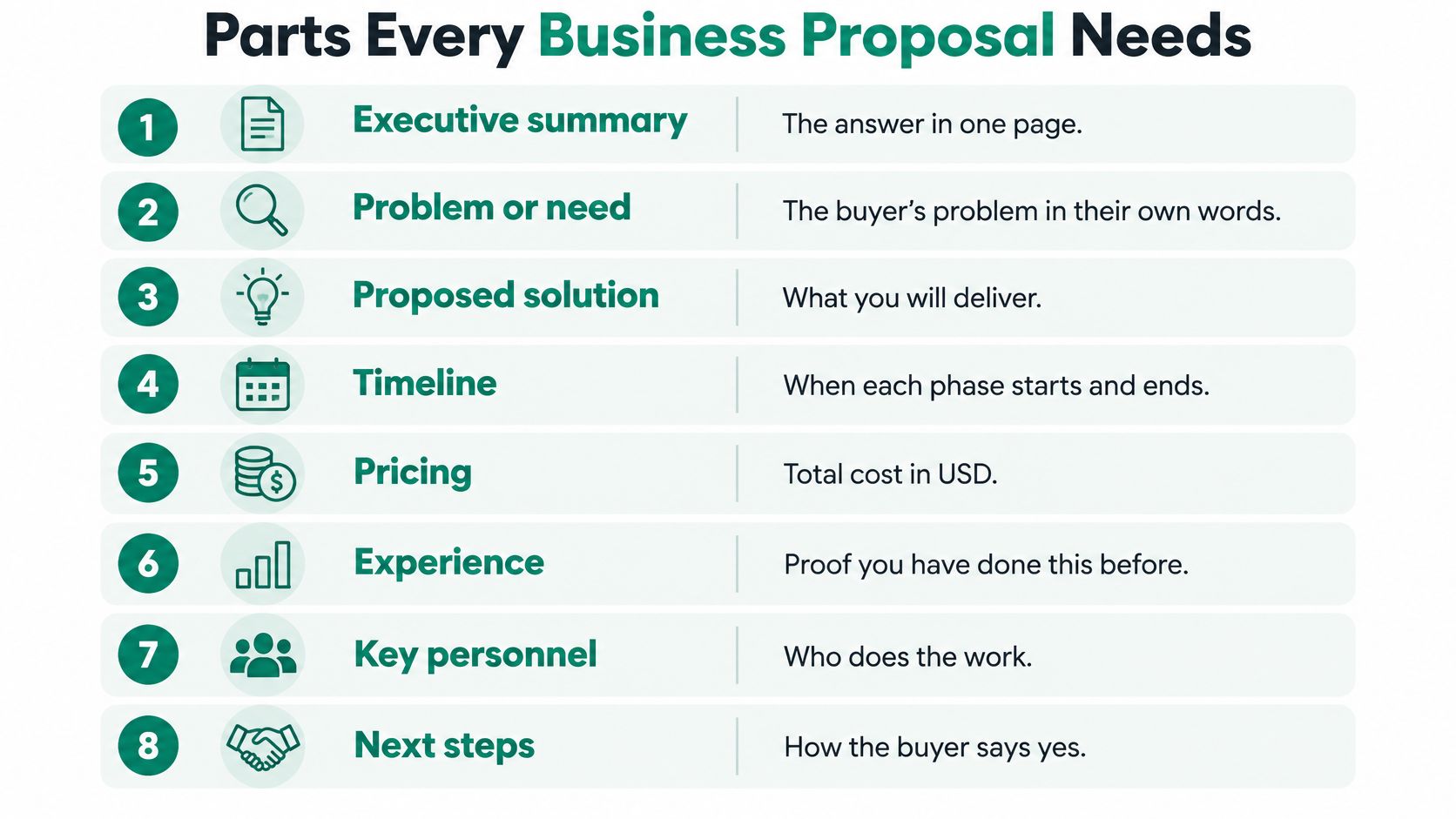
Parts Every Business Proposal Needs
Organize the document around the buyer's questions. The headings can change, especially when an RFP prescribes them, but the underlying answers should remain easy to find.
Use this visual checklist to orient your draft.
Build the buyer's checklist
- Executive summary. What are you asking us to approve? Lead with the outcome, recommended approach, commercial commitment, and requested action. Write it after the detailed sections so it reflects the actual offer.
- Problem or need. Have you understood our situation? Use the buyer's terminology and explain the operational consequence. Separate confirmed facts from your interpretation.
- Proposed solution and approach. How will the work happen? Describe the method and explain why it fits. A list of services isn't a delivery plan.
- Deliverables and acceptance criteria. What will we receive? Name the outputs and the checks used to accept them. Include exclusions where a buyer might reasonably assume extra work is included.
- Timeline and milestones. When can we expect progress? Connect delivery stages to reviews and approvals. Show where delayed client input would affect completion.
- Pricing and payment terms. What will we pay, and when? Distinguish setup charges, recurring services, optional work, and payment triggers.
- Qualifications and proof. Why should we trust your team? Select relevant past work, case studies, and named personnel. Explain each person's role rather than adding unrelated biographies.
- Assumptions, dependencies, and next steps. What must happen to proceed? Identify required access, client responsibilities, unresolved decisions, and the approval action.
Formal evaluators don't reward attractive writing alone. The Federal Acquisition Regulation's proposal-evaluation provision requires evaluation against the factors and subfactors specified in the solicitation, including assessment of the supplier's ability to perform.
Make the scope auditable
For an outbound lead-generation project, replace a general promise to find leads with outputs the buyer can inspect:
| Requirement | Deliverable and acceptance check | Owner |
|---|---|---|
| Define suitable accounts | Approved target-account criteria, including exclusions | Client approves; supplier documents |
| Identify decision-makers | Contact records with role and relevance evidence | Supplier |
| Check email quality | Documented validation workflow and status fields | Supplier |
| Prepare campaign handoff | Deduplicated list in the agreed delivery format | Supplier; client confirms import |
| Report progress | Reporting cadence covering delivery, exceptions, and corrections | Named project lead |
Separate mandatory requirements from optional differentiators. A useful extra doesn't compensate for a missing required deliverable.
For structured public-sector submissions, SamSearch's government proposal software is an option to assess when organizing proposal work. Keep a human review of requirements, evidence, and commitments regardless of the drafting tool.
Confirm CRM access, geographic coverage, data-refresh frequency, and approved outreach policies before finalizing the scope. Those dependencies determine whether the proposed workflow is practical.
How Buyers Decide Between Proposals
Buyers compare expected value with execution risk. They need confidence that the supplier understands the work, can perform it, and has priced it realistically.
A review discussion may involve people with different responsibilities and concerns.

The Commerce acquisition evaluation provision identifies technical approach, experience, key personnel, past performance, and realistic, complete, reasonable cost as evaluation dimensions. It also allows a higher-priced or lower-scoring offer to be selected when the integrated assessment indicates better overall value.
That doesn't mean price is unimportant. It means the buyer needs to understand what the price buys and which risks remain.
Show the mechanism behind the estimate
Say a sales-services supplier proposes a recurring qualified-contact delivery service for a fixed fee. The proposal should explain how the supplier will move from a candidate account list to accepted contact records.
- Starting pool: Identify the available account universe and the exclusions that reduce it.
- Quality controls: Explain role checks, email validation, duplicate removal, and replacement rules.
- Conversion assumptions: Distinguish accepted contacts from replies, meetings, opportunities, and sales.
- Economic effect: Show how the service could reduce internal list-building work or support outreach capacity.
- Full cost: Include implementation, ongoing operation, client review time, and optional work.
- Downside risks: Address limited coverage, stale records, and missing client inputs.
An illustrative forecast isn't a guarantee. Label assumptions, show how they affect the estimate, and avoid promising sales outcomes that depend on the buyer's messaging, offer, and follow-through.
Understanding a buyer behaviour model can also help you distinguish the operating team's needs from the concerns of finance, procurement, and the final approver.
Use the accompanying video as a discussion prompt while reviewing the offer.
Before submission, apply an internal-consistency test: every promised result needs a method, a resource requirement, a measurement rule, and a cost implication. A low fee built on unsupported volumes or omitted quality checks doesn't give the buyer a dependable comparison.
Proposal Examples for Sales, Partnerships and Funding
A design agency's owner keeps postponing financial reviews because the books aren't ready. A bookkeeping firm notices the agency is seeking operational support and sends a focused unsolicited proposal rather than a general brochure.
The offer needs to acknowledge what the supplier still doesn't know. An unsolicited proposal shouldn't present an assumed problem as a confirmed discovery finding.
Sales proposal for bookkeeping services
Problem to confirm: Financial reporting may be arriving too late to support project-margin decisions. Ask the agency owner to confirm the issue in their own words.
Offer: Reconcile accounts, organize transaction records, and deliver an agreed management-reporting pack. Identify whether payroll, tax work, and historical cleanup are excluded.
Proof: Attach a relevant, permission-cleared work sample or case study demonstrating comparable reporting work.
Price: Insert the approved setup charge, recurring fee, and payment terms.
Start: Enter an available start date, subject to access and agreement.
Next step: Ask the owner to approve a scope-confirmation call.
This works because the request is proportionate to the relationship. The supplier presents a credible offer while leaving room to validate the need before either party commits.
A proposal review should check the commercial details as carefully as the prose.

Partnership proposal for referral activity
Say a payroll app and an accounting tool want to refer suitable customers to each other. Their decision isn't just whether referrals sound attractive; it's whether the responsibilities and economics are acceptable.
Shared customer: Businesses that need connected payroll and accounting workflows.
Each party's role: Define who identifies suitable customers, obtains permission for introductions, handles demonstrations, and provides support.
Referral compensation: Insert the negotiated fee, eligible revenue basis, payment trigger, and treatment of cancellations.
Joint review: Set a review date and agree which referral and customer-experience measures to examine.
Exit clause: Explain how either party can stop participating and how outstanding referrals will be handled.
Approval sought: Authorize a limited referral arrangement under documented terms.
The useful detail is the division of responsibility. Each party can assess the commitment without assuming that the other will handle qualification, customer consent, or support.
Funding proposal for a literacy program
A community literacy nonprofit needs support for an adult-learning program. The proposal must connect a documented local need to an achievable program and a defensible budget.
Need: Insert current local literacy evidence, its source, and the service gap.
Request: State the funding amount, program period, and learner target supported by the operating plan.
Budget: Provide staffing, materials, and other eligible costs using the funder's required format.
Budget line Basis to document Staffing Tutor time, preparation, supervision, and administration Materials Learning resources and accessibility requirements Total request Reconciled total matching the funding application Measurement: Define enrollment, attendance, assessment, and reporting methods.
Continuation: Explain how partnerships, future funding, or recurring income could support delivery after the grant.
Decision sought: Approve the documented program and budget.
The funding ask works when reviewers can connect need, activities, spending, and measurement. Founders seeking investment face a different decision process; finding startup investors requires matching the venture with suitable capital rather than treating every funding request as a grant application.
Qualify the Prospect Before You Send a Proposal
Not every interested prospect deserves a custom proposal. Drafting too early can turn an unanswered discovery question into unpaid planning work.
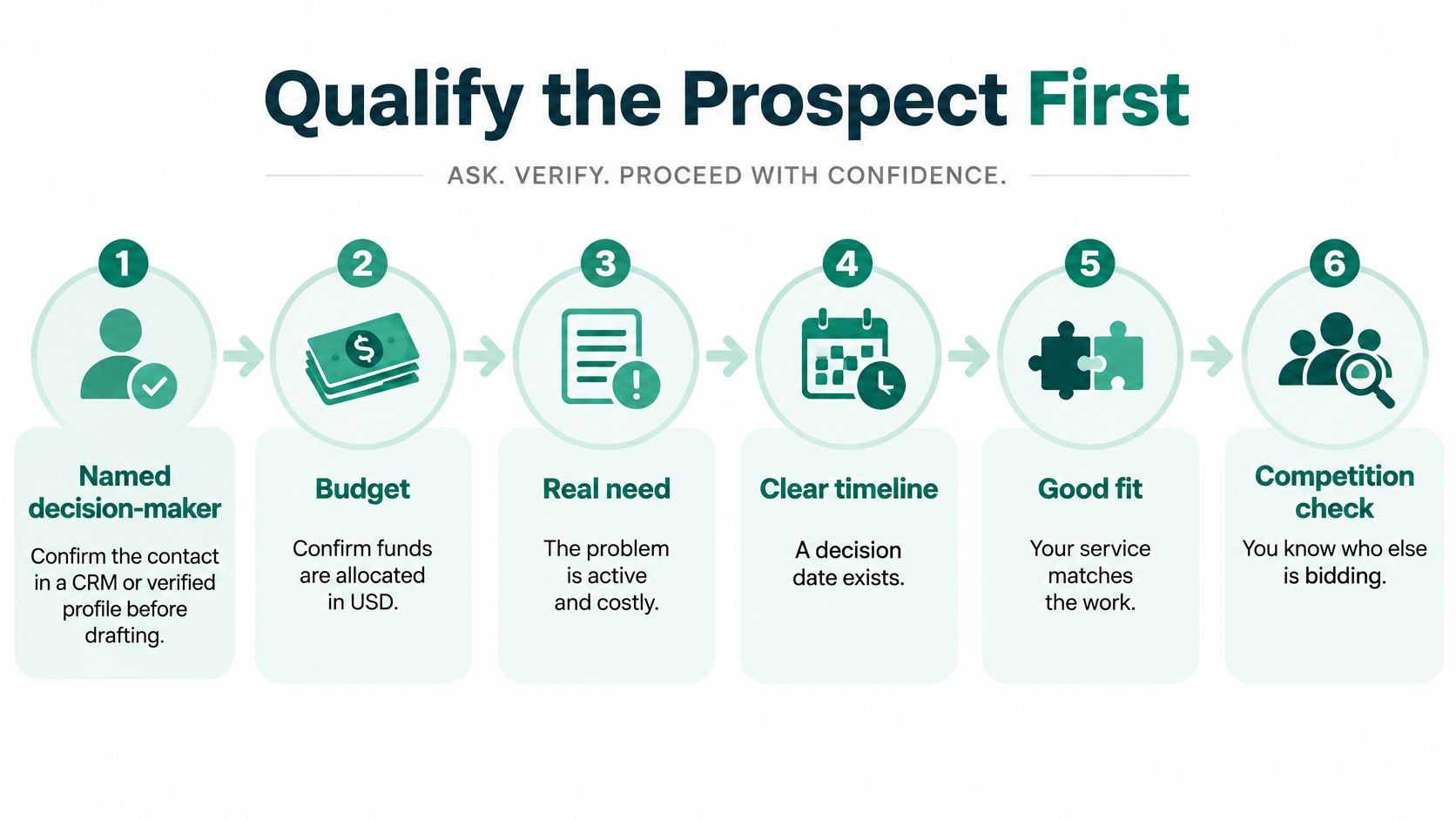
Use the qualification checklist before committing substantial writing time.
Check whether a decision is possible
- Confirm the decision-maker. Verify the contact's role through a company website, professional profile, or CRM. An email address doesn't establish purchasing authority.
- Name the problem. Ask the buyer to explain what needs to change and why it matters.
- Confirm the buying route. Establish whether funds are available, procurement approval is needed, or a formal competition applies.
- Check the timeline. Identify submission, evaluation, and decision milestones, including dependencies.
- Assess your position. Consider relationship knowledge, relevant proof, delivery capacity, and competing suppliers. The Thomson Reuters/QorusDocs benchmark reported an average existing-client proposal win rate of 62%, compared with a new-business median of approximately 40%.
- Choose the next action. Proceed when the important checks are clear. Otherwise, send a focused discovery question instead.
For help identifying timely reasons to engage, CapyScout's a signal-based guide to outbound prospecting offers a useful starting point. Combine those signals with direct qualification rather than treating activity as proof of buying intent.
Don't confuse opportunity with fit
Deltek's small-business federal contracting overview reports a record $195 billion in small-business federal contracting in 2025, while small-business participation had fallen 49% since FY 2010. Opportunity volume alone doesn't justify the cost of a bid.
Use a consistent process to qualify sales leads before drafting. After submission, follow the buyer's evaluation timeline rather than an arbitrary reminder schedule; a missed decision date is a reason to ask what changed, not assume rejection.
EmailScout offers an email finder Chrome extension to help you discover decision-maker email addresses and build outreach lists. Visit EmailScout to find relevant contacts, then confirm their role and buying needs before investing time in a proposal written specifically for them.