

What if the free plan you choose determines your workflow more than the verifier itself? A one-time trial, a monthly credit drop, and a daily drip all get described as free, but they suit completely different list sizes. Pick the wrong shape and you'll spend more time splitting CSVs, waiting for resets, and reconciling exports than you saved by avoiding a paid plan.
That's the decision this comparison is built around. For each free bulk email verifier below, check what the allowance covers, whether it renews, how it handles catch-all and unknown results, and where it connects to the rest of your outreach stack. A founder cleaning a short investor list has different needs from an SDR team adding prospects every week, even something like email outreach for first-time founders fails fast if a small list is full of stale addresses.
Read the results carefully, too. Deliverable doesn't mean engaged, consented, or guaranteed to land in the inbox. It means the address passed the checks the tool ran. Catch-all and unknown verdicts need a separate segment and a slower sending plan, not blind inclusion.
Practical rule: Choose by renewal pattern first, accuracy claims second. A modest allowance that refills every month beats a large trial you can only use once if you clean lists continuously.
1. Bounceless
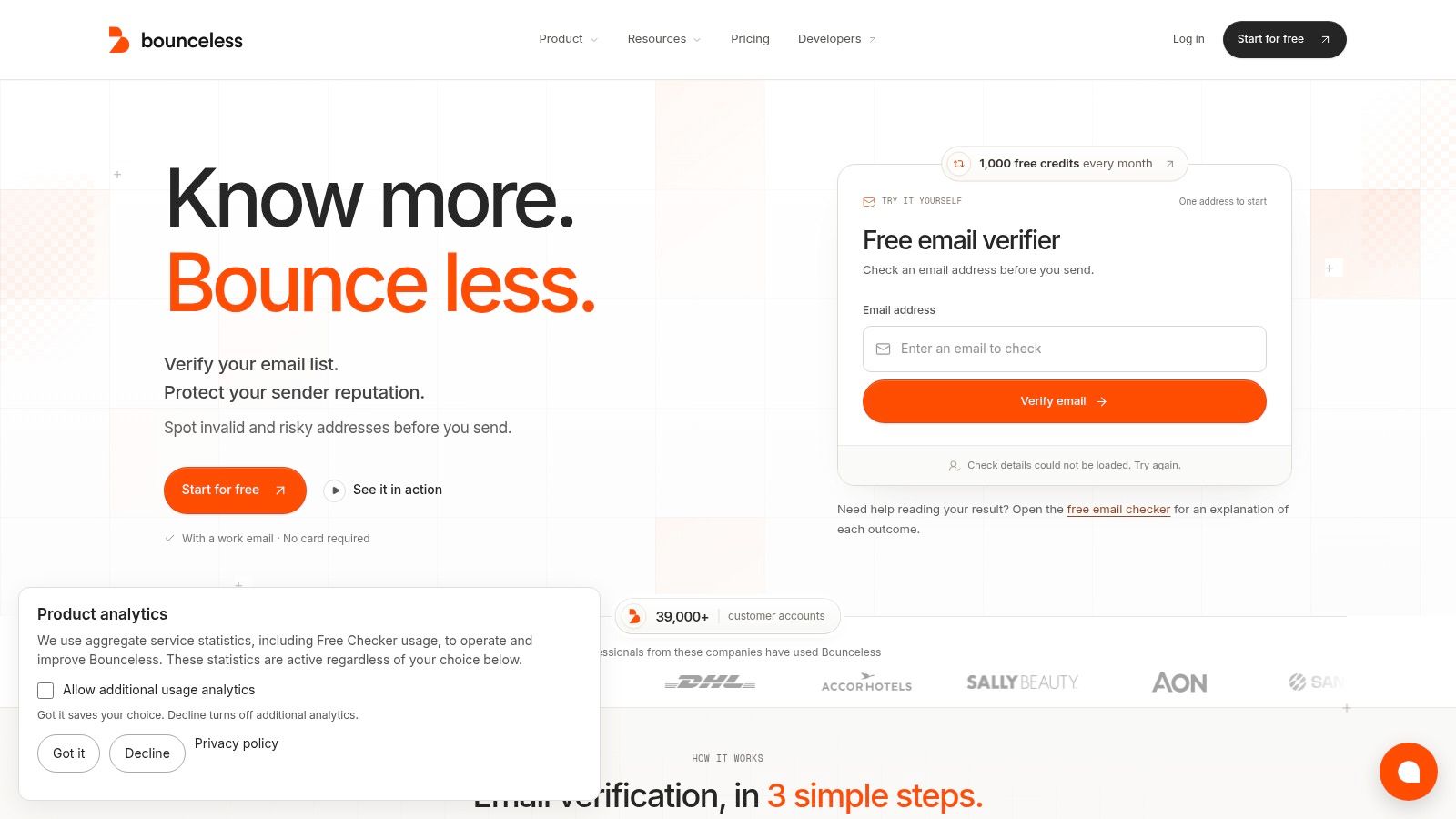
Bounceless is the strongest recurring free offer here if you qualify for it. Eligible work-email accounts receive 1,000 free credits per month, with no credit card required to start. That's enough for ongoing hygiene on a small sales list instead of a single test. Public email addresses don't qualify, so Gmail signups won't access the allowance.
The workflow covers bulk CSV verification with duplicate and invalid-format review, single-address checks, and an estimate of credit usage before you run a job. Results split into deliverable, undeliverable, catch-all, and unknown, which matters because those middle categories shouldn't be merged into your main send. Understanding what email bounce rate means for sender reputation helps you decide how aggressively to treat them.
Where It Fits Best
- Free allowance: 1,000 credits monthly for eligible work-email accounts
- Billing edge: Unknown results aren't billed, and pay-as-you-go credits don't expire
- API access: Included on the free plan, unlike many trial-only tools
The trade-offs are real. Additional catch-all resolution may cost extra credits, and an unknown result doesn't mean an address is safe. I recommend Bounceless for teams with steady monthly volume under that cap who want a repeatable process, not a one-off cleanup they'll have to rebuild elsewhere.
2. ZeroBounce
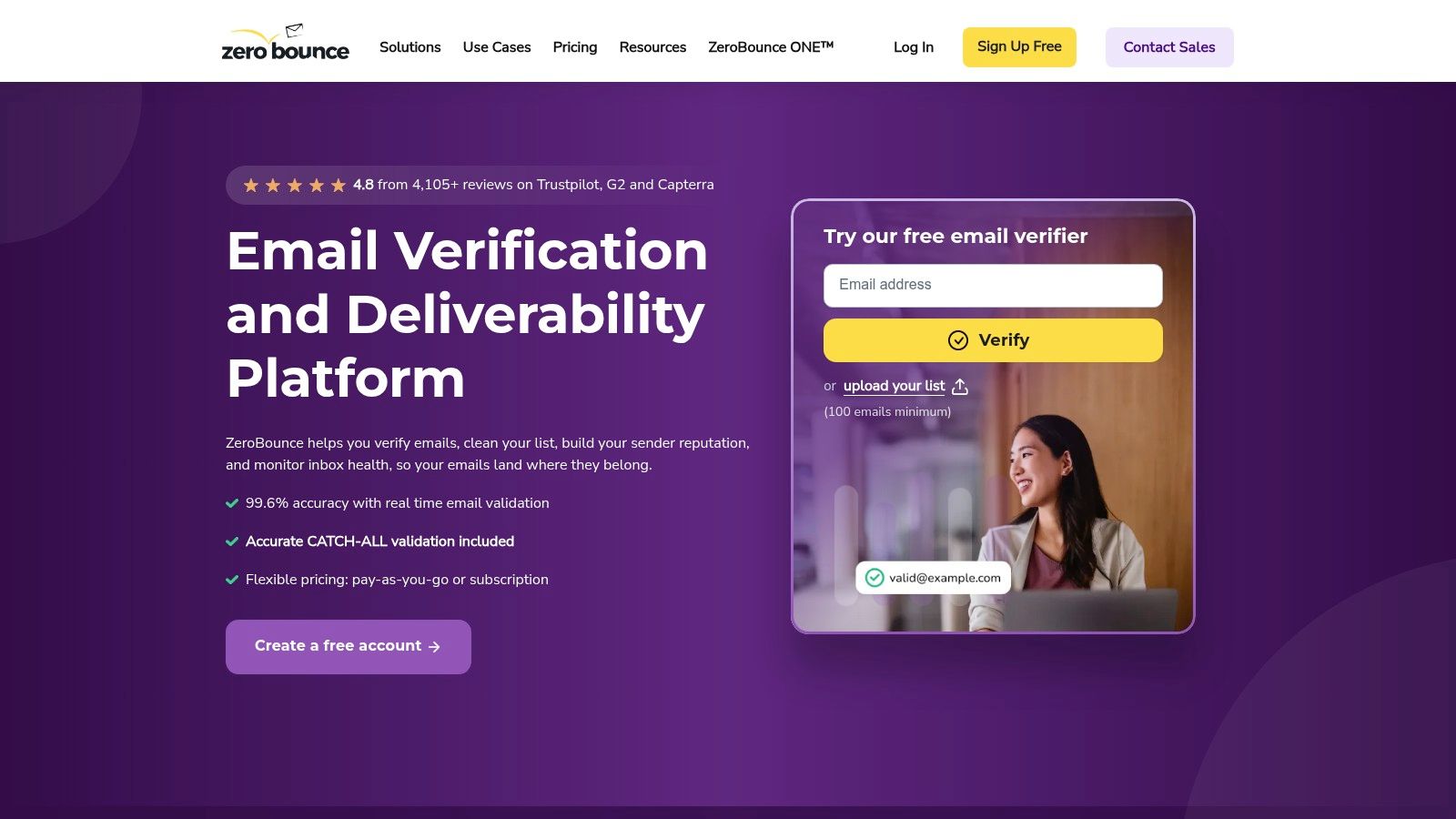
ZeroBounce pairs bulk verification with a wider deliverability toolkit. You can upload lists or verify through the API, and its free list evaluator gives a broad assessment before you spend credits checking every address. That evaluator is useful for triage. It doesn't replace address-level verification on the list you're about to send.
The free plan gives 100 verification credits per month. Purchased credits don't expire, and duplicates and unknown results aren't charged as standard verifications. That's a fair billing policy, but 100 credits won't clean a substantial prospect list. Treat it as a monthly sample budget.
Why the Extra Tools Matter
ZeroBounce also offers inbox placement and mail-server testing, which most pure verifiers skip. That broader view matters because Validity's global deliverability benchmark found permission-based programs averaged approximately 1.5% combined hard and soft bounces, while roughly one in six legitimate marketing emails failed to reach the inbox. A clean address can still miss the inbox for reputation reasons.
Paid verification starts with a minimum purchase, so run the numbers before your credits run out mid-list. ZeroBounce suits senders who want diagnostics beyond valid or invalid and don't mind paying once volume grows past the small monthly allowance.
3. Emailable

If your list already lives in a CRM, Emailable earns its place on integrations. It connects with HubSpot, Salesforce, Mailchimp, and Zapier, so verified results can flow back into the system your team sends from instead of sitting in a downloaded CSV. It also supports bulk uploads, individual checks, and API access.
You get 250 free credits with no credit card required. That's enough to run a real list upload and judge result quality on your own data, not a demo file. Duplicates and unknown results are credited back, and pay-as-you-go credits don't expire. No long-term contract is required, which suits sporadic senders.
The jump after the trial is the catch. The minimum paid purchase is 5,000 credits, so a team verifying a few hundred addresses a quarter may overbuy. And 250 free checks won't cover a large prospect list without sampling.
- Best use: Test a representative slice of your CRM export first
- Watch out for: The gap between 250 free credits and the 5,000-credit minimum purchase
- Remember: Verification doesn't guarantee inbox placement or engagement
I'd pick Emailable when integration eliminates manual file handling. If you're uploading spreadsheets by hand anyway, that advantage shrinks.
4. DeBounce
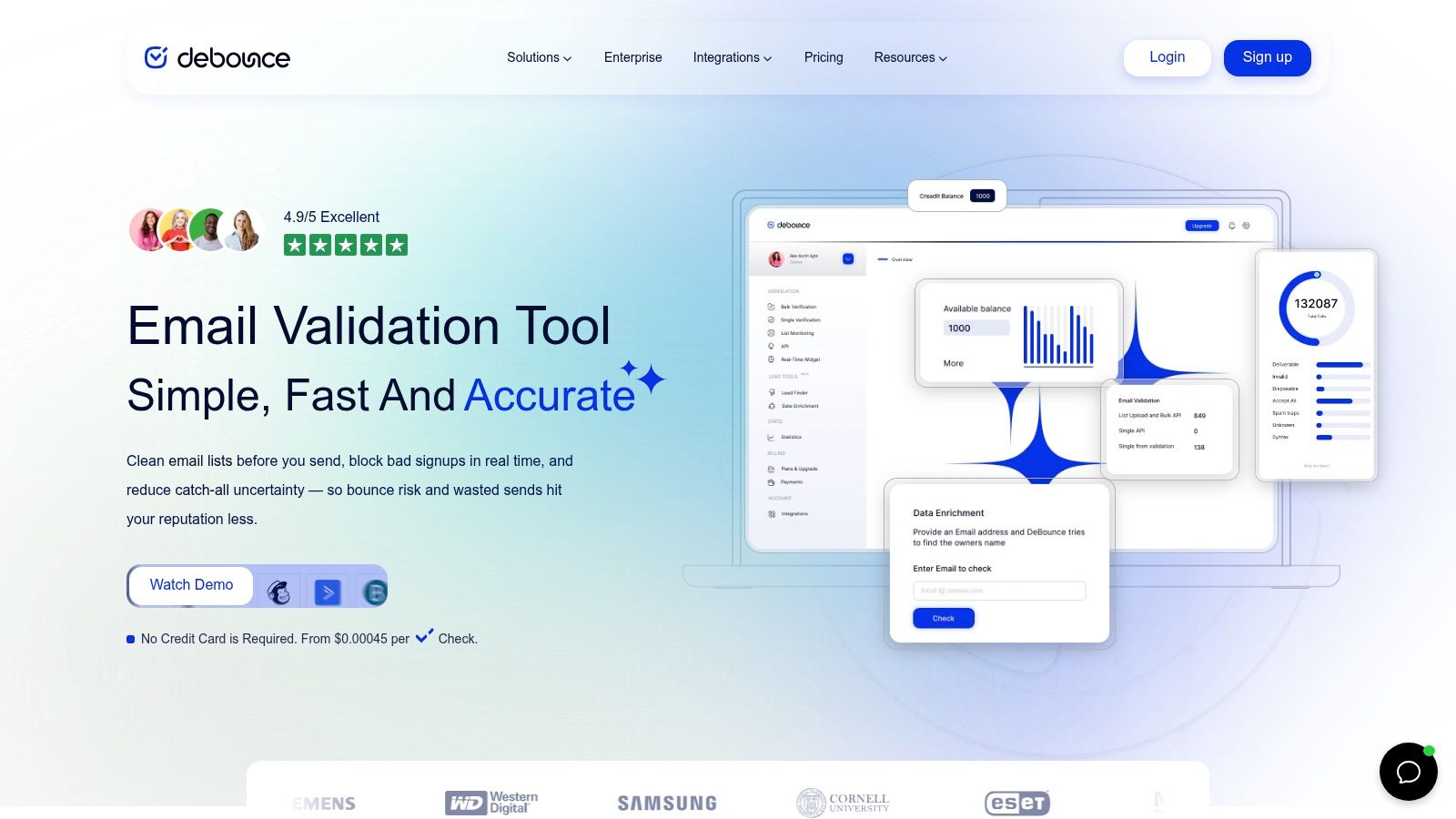
DeBounce is simple to classify. Its 100 free trial credits are one-time, not monthly. That makes it a sampling tool, not an ongoing free workflow. Use the credits on your messiest segment, where the result distribution tells you the most about list quality, rather than burning them on your cleanest contacts.
The feature set covers bulk list validation, API access, and list monitoring options. It checks for invalid, disposable, and spam-trap addresses, which goes beyond syntax and domain checks. Unknown results aren't charged, according to its help documentation. Purchased credits don't expire, and you can choose one-time purchases or subscriptions.
A one-time grant answers one question well. Is this list source worth paying to clean in full? Spend it on a representative sample and you'll know.
Anything larger than a small test list requires a purchase, so don't plan a recurring process around the free tier. Also treat advertised accuracy or deliverability claims carefully. They're not guarantees for your specific list, especially scraped or old CRM data where decay varies by source.
DeBounce works best as a low-commitment trial before a paid cleanup. If you need credits that refill, look at the monthly or daily options instead.
5. Hunter
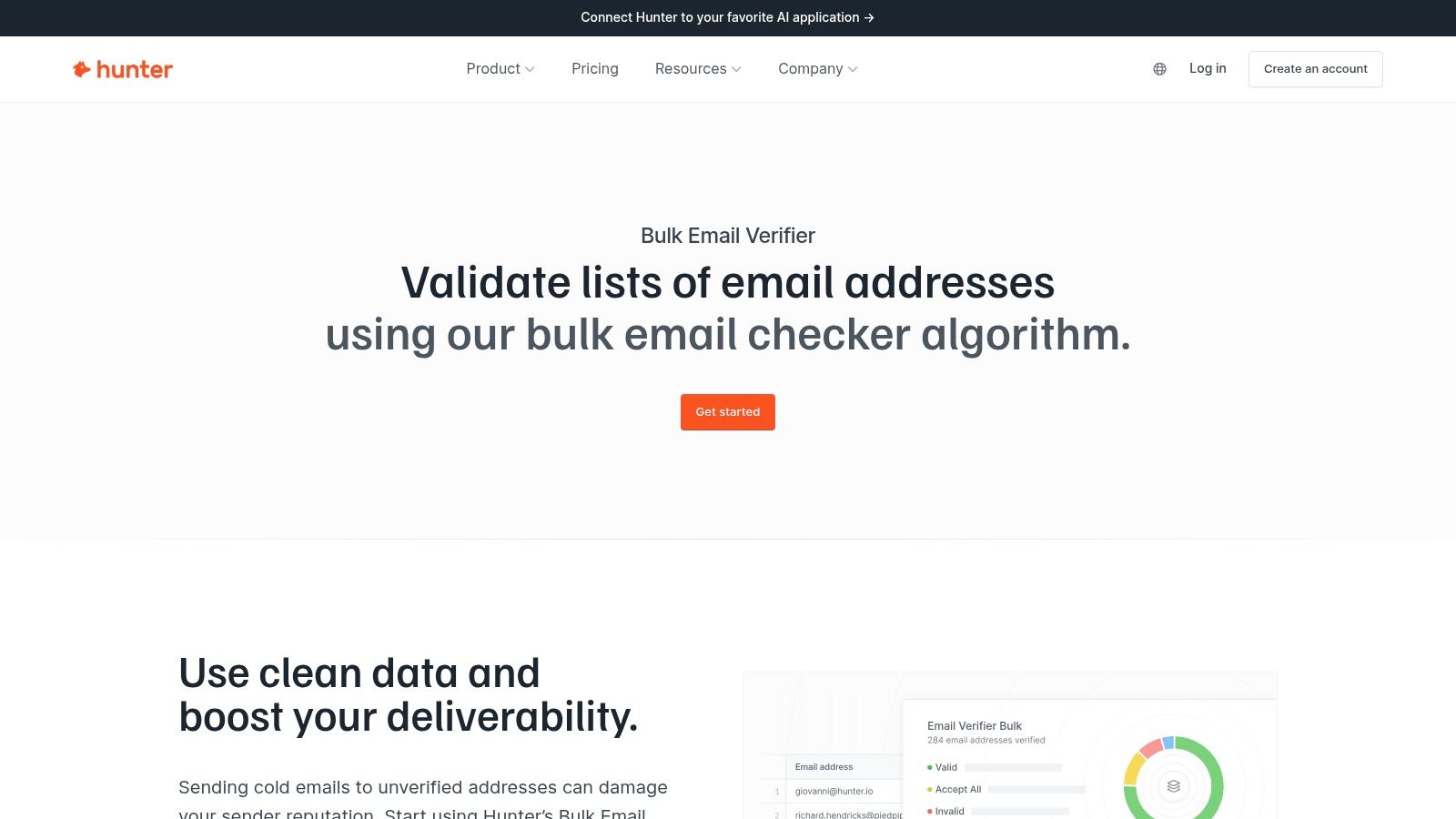
Hunter's Bulk Email Verifier makes the most sense if you already find prospects in Hunter. Verification sits alongside its email-finding and lead-management tools, so you can move from discovery to checking without exporting between platforms. Bulk tasks accept CSV or TXT uploads with downloadable results and can handle large jobs subject to available credits.
The checks cover format, disposable-email status, MX records, and server connection. The free plan includes 50 credits per month, and unknown results don't consume credits. That sounds workable until you notice the constraint. The allowance is shared across Hunter tools, not reserved for verification. Credits spent finding emails aren't available to verify them.
The Shared Credit Trade-Off
- Advantage: Prospecting and verification in one account
- Constraint: One credit pool serves every Hunter tool you use
- Uncertainty: Accept-all addresses still require your own judgment
For a solo rep building small, targeted lists inside Hunter, the combined workflow saves friction. For anyone cleaning lists sourced elsewhere, 50 shared credits cover only a small part of a large list. I recommend Hunter as a verifier only when it's already your prospecting home. Otherwise you're paying for a bundle to use one feature.
6. Verifalia
Verifalia runs on a daily drip. You get 25 free credits every day, usable through the dashboard or the API. Unused credits expire and don't roll over, so the allowance rewards consistent small batches and punishes anyone saving up for a big cleanup. A large list verified entirely for free would take a long time at 25 checks a day.
Where Verifalia stands out is control. It offers standard, high, and extreme validation levels, so you can match check depth to how risky a segment looks. Bulk uploads support CSV, TSV, and Excel, and deduplication options help you avoid paying to verify the same address twice. Both the web app and API are available.
Higher validation levels use more credits than standard validation, which shrinks your daily 25 fast. Use the deeper levels on high-value or questionable addresses, and standard checks on routine ones.
Say you're testing an API integration or verifying a handful of form signups daily. Verifalia fits that rhythm well. Say you have a 2,000-address campaign list due Friday. It doesn't. The daily model is the whole decision here, so judge it against your sending schedule before anything else.
7. Bouncer
Bouncer keeps its offer straightforward. You get 100 free credits to start, no credit card required. That's a starter allowance for testing list cleaning on real data, and it's modest. Plan on paying quickly if your list runs into the hundreds.
Pricing is listed by volume on its official page, with pay-as-you-go credits and monthly subscriptions. Purchased credits don't expire, which suits teams that clean lists in bursts rather than every month. The stated minimum purchase is 1,000 credits. Duplicates and unknown results aren't billed, so you don't pay for rows the tool couldn't resolve.
Bouncer also offers deliverability-related add-ons, but keep the boundary clear. Those tools are separate from basic list verification, and buying verification doesn't automatically give you the full diagnostic picture.
- Free tier: 100 credits, no card required
- Paid entry: Minimum purchase of 1,000 credits, volume-based pricing
- Billing policy: Duplicates and unknowns not billed, credits do not expire
I see Bouncer as a clean test-then-pay path for occasional senders. The non-expiring credits remove the pressure to use a purchase before a deadline. Teams needing a recurring free allowance should look elsewhere.
8. Clearout
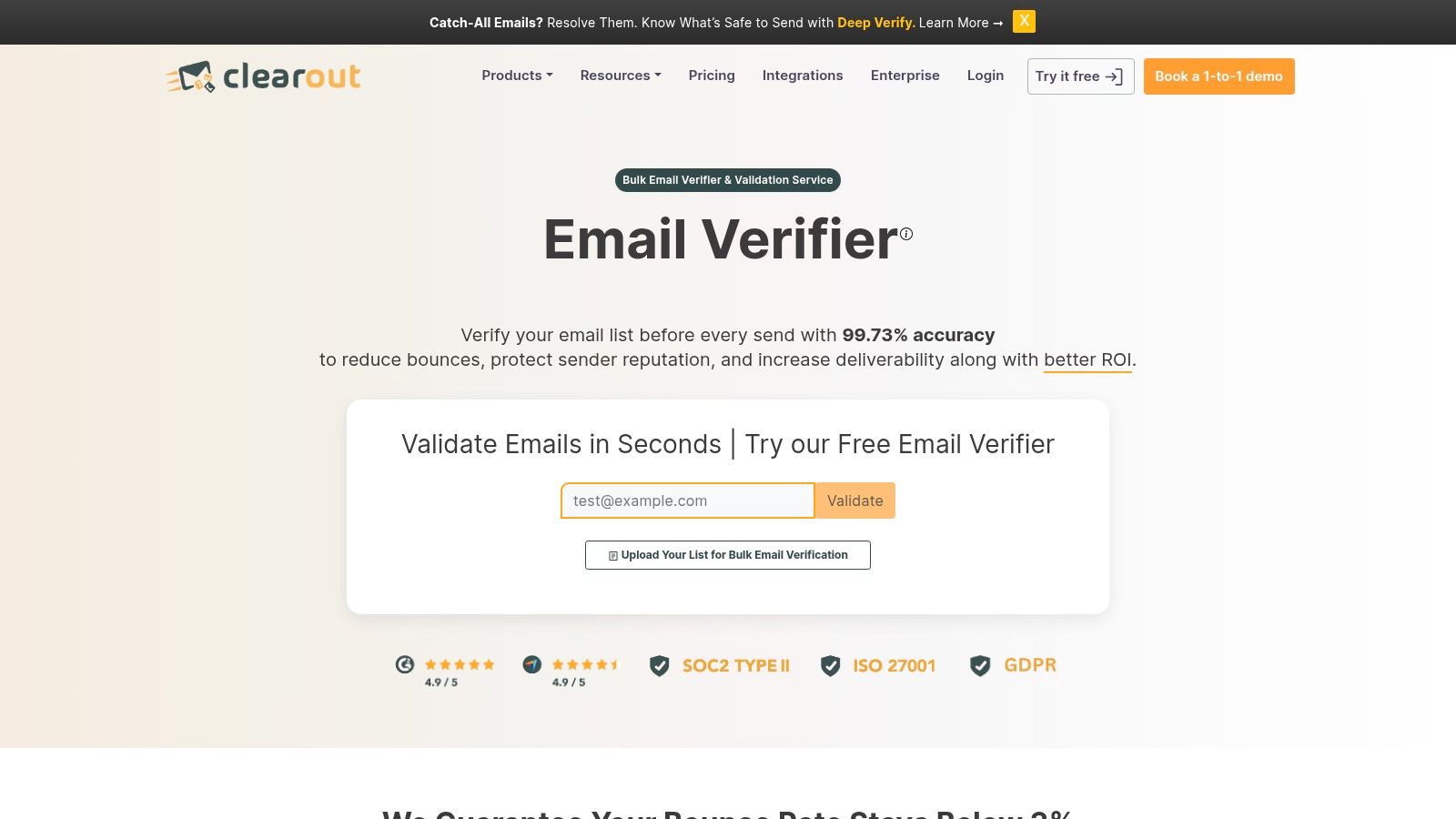
Most tools here verify lists you upload. Clearout also checks addresses as they arrive. Alongside bulk CSV and XLSX verification, it offers real-time checks through an API, a JavaScript widget, and a WordPress plugin. That makes it relevant for form signups, not just campaign cleanup. Catching a bad address at entry beats scrubbing it later, and a good email scrubbing service workflow still needs clean input to work well.
It detects duplicates and catch-all addresses and supports large-upload workflows with multiple processing modes. You get 100 free signup credits, which don't expire according to its pricing information. Duplicates and unknown results aren't charged.
Limits to Plan Around
Free-tier users may be limited to one active list at a time, which slows down anyone cleaning several client or campaign lists in parallel. The 100 credits also run out quickly on large lists. Catch-all and mailbox results can remain uncertain, so segment those verdicts instead of treating them as deliverable.
Clearout suits teams that want one tool for both batch cleaning and point-of-capture checks. Test it on a small sample that includes form-sourced addresses, since that's where its real-time options prove their value against upload-only competitors.
9. MillionVerifier
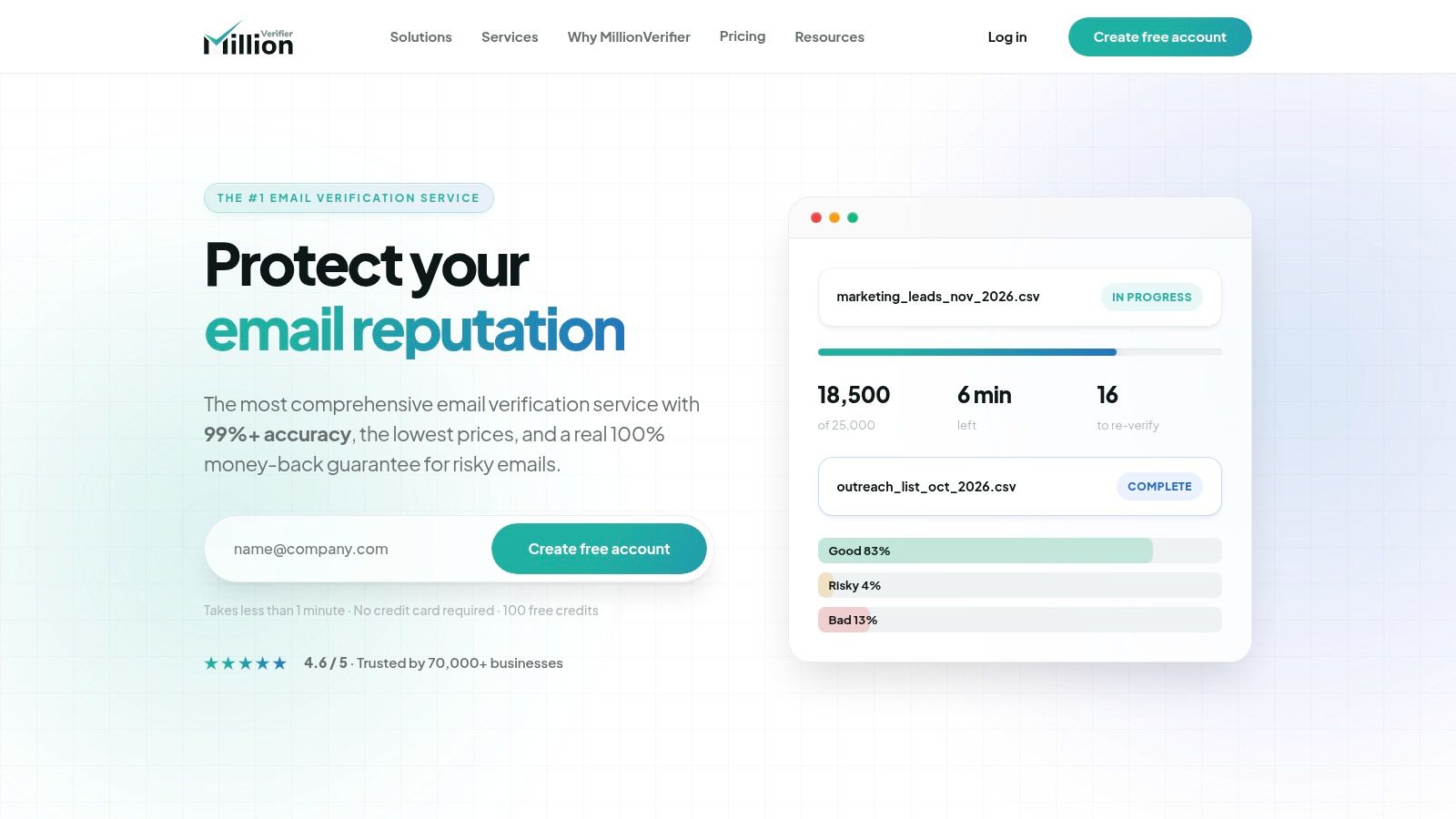
MillionVerifier offers the largest potential trial on this list, with conditions attached. Business-email signups can receive 500 trial credits. Connecting an eligible email-marketing integration may provide up to 10,000 trial credits, subject to its cap and a calculation based on your connected contacts. Read that carefully. The headline number isn't guaranteed.
This is a trial, not a recurring monthly allowance. Once the credits are spent, continued use means a paid credit plan. A one-time trial purchase option is also listed for 2,000 checks, which gives you a cheap way to extend testing before committing further. If you're comparing trial structures across tools, our roundup of the best free email verification tools covers how these allowances differ.
- Standard trial: 500 credits for business-email signups
- Integration trial: Up to 10,000 credits, capped and calculated from connected contacts
- Catch: No monthly refill after trial credits end
MillionVerifier makes sense for a single large cleanup if you already use a supported email platform and qualify for the bigger grant. Verify your actual credit balance after connecting before you promise anyone a cleaned list by a deadline.
10. NeverBounce
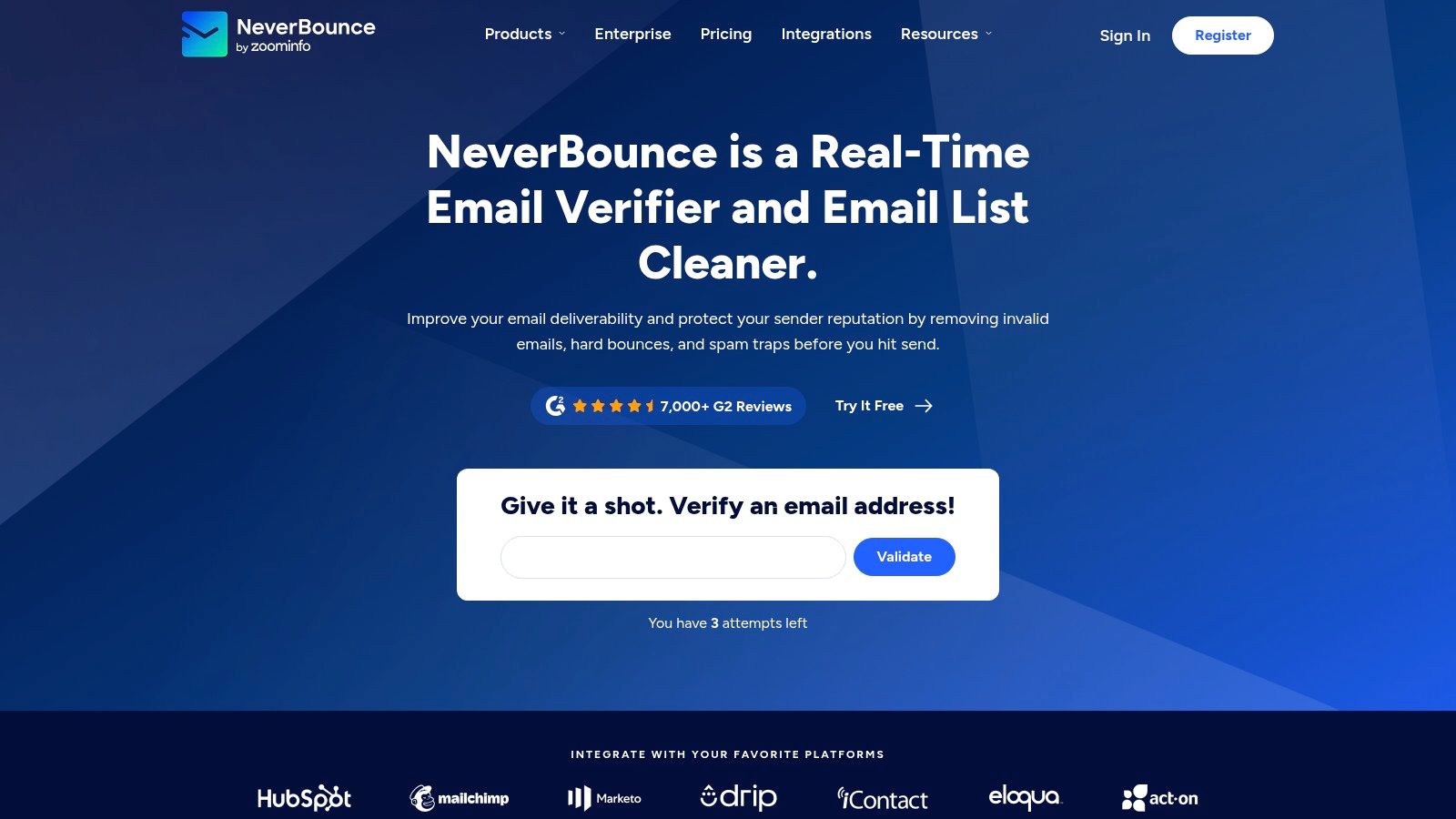
What does NeverBounce give you for free? A bulk verification sample to inspect output quality. That is the full extent of the no-cost allowance. Full-list cleaning runs on paid credits.
That distinction matters for planning. Plenty of roundups file it under free verification, then outreach teams discover the sample will not cover a campaign list. Treat it as a vendor test drive. Upload a mixed batch, check formatting, turnaround time, and how it labels invalids and catch-alls.
The trade-off is clear. You get a useful quality check with zero commitment, but no monthly refill and no path to clean 5,000 addresses without paying. For list owners choosing a paid verifier, that sample reduces risk before purchase.
Evaluation tip: Run the same 100-address sample, including known invalids and catch-alls, through every tool you're considering. Identical input is the only fair way to compare verdicts.
Choose NeverBounce when you are ready to buy and want proof of accuracy first. Skip it if you need usable free volume this month.
Free bulk email verifier tools at a glance
| Free Allowance | Allowance Type | Bulk Upload Formats | Integrations/API | Best For |
|---|---|---|---|---|
| 1,000 credits per month for eligible work-email accounts | Recurring monthly; public email accounts are ineligible | CSV | API included; integrations not specified | Bounceless: recurring free checks and bulk CSV verification |
| 100 credits per month | Recurring monthly | Bulk list uploads; format not specified | API verification; integrations not specified | ZeroBounce: small monthly checks plus deliverability tools |
| 250 credits | Free starter credits; no recurring schedule specified | Bulk list uploads; format not specified | API; HubSpot, Salesforce, Mailchimp, and Zapier | Emailable: trying list uploads and common platform integrations |
| 100 credits | One-time trial | Bulk list uploads; format not specified | API; integrations not specified | DeBounce: sampling lists with API access and monitoring options |
| 50 credits per month, shared across Hunter tools | Recurring monthly | CSV, TXT | Verification works alongside Hunter's prospecting and lead-management tools | Hunter: sales prospecting and email verification in one account |
| 25 credits per day | Daily; unused credits expire | CSV, TSV, Excel | Web app and API | Verifalia: small daily batches and testing validation levels |
| 100 credits | Free starter credits; no recurring schedule specified | Bulk list uploads; format not specified | Integrations/API not specified | Bouncer: testing list cleaning before buying more credits |
| 100 credits | Free signup credits; stated not to expire | CSV, XLSX | API, JavaScript widget, WordPress plugin; other integrations not specified | Clearout: bulk cleaning and real-time verification |
| 500 trial credits for business-email signups; potentially up to 10,000 through an eligible integration | One-time trial; integration credits are conditional and capped | Bulk list uploads; format not specified | Eligible email-marketing integration may add trial credits; API not specified | MillionVerifier: trial use, especially with an eligible integration |
| Free bulk-verification sample; size not specified | Sample only; full verification is paid | Bulk sample; file format not specified | Integrations/API not specified | NeverBounce: testing the service before purchasing credits |
Matching the Tool to Your List Size and Knowing When to Pay
Sort your shortlist by renewal pattern before you compare features. Recurring monthly credits from Bounceless and ZeroBounce suit ongoing list hygiene, because the allowance refills whether you cleaned 200 addresses or 2,000 this month. Bounceless gives eligible accounts far more room, while ZeroBounce pairs a small quota with broader deliverability testing. Either way, you can build a monthly routine around them.
One-time trials from DeBounce and MillionVerifier suit sampling before purchase. Spend those credits on a representative slice of your worst list source, measure the invalid and catch-all rates, and use that result to decide whether the full list is worth paying to clean. MillionVerifier can stretch further if you connect an eligible integration, but it still ends.
Daily drips like Verifalia suit small, patient batches. If addresses trickle in through forms or daily prospecting, a daily allowance matches the flow. If a campaign list lands all at once, it doesn't.
Whichever pattern you pick, verification is only half the workflow. Authenticate your sending domain before scaling, because Unspam's deliverability benchmark reports 93% SPF and 90% DKIM adoption among tested domains but only 49% DMARC adoption. A verified list sent from an unauthenticated domain still gets filtered. Keep total bounces controlled, suppress hard bounces permanently, and send catch-all and unknown segments separately at low volume while you watch complaints.
Don't confuse deliverable with permitted, either. The FTC CAN-SPAM compliance guide notes each separate violating email may carry a civil penalty of up to $53,088. Verification never establishes consent. Document where each address came from, screen against unsubscribe and suppression lists, upload only the fields the verifier needs, and delete or re-verify on a schedule. That discipline is what separates list hygiene from list gambling, and it sits comfortably alongside Olivetree Marketing's approach to email strategy of treating email as a long-term channel rather than a volume game.
Pay when the workarounds cost more than the credits. If you're splitting lists across three free accounts, waiting days for daily resets, or pausing campaigns mid-month, you've already crossed that line. Non-expiring pay-as-you-go credits suit bursty senders. Subscriptions suit teams cleaning lists every week.
Clean addresses still need to come from somewhere. EmailScout is a free Chrome extension for finding decision-maker emails in one click, and it pairs naturally with any verifier here. Find the contacts, export them, verify before sending, and your list starts clean instead of being rescued. Its Premium plan adds bulk export and large-scale URL extraction for heavier prospecting workflows, which matters once manual, page-by-page collection becomes the bottleneck.
Stop guessing which addresses on a page are worth contacting. EmailScout finds decision-maker emails in a single click while you browse, so you can build a targeted list, export it, and run it through the verifier you picked above before your first send. Start free with unlimited email finding and export, and upgrade only when bulk export and large-scale URL extraction will save you real hours.