

Ask ten different sales reps about the best time to send a cold email, and you'll probably get ten different answers. But what if there was a data-backed starting point?
Turns out, there is. The consensus points to early Monday morning, specifically between 5 AM and 8 AM in your prospect's local time. Sending in this window consistently gets your email to the top of the inbox right before the workweek chaos officially kicks in, leading to a noticeable bump in reply rates.
While a good old midweek morning is still a solid bet, that early Monday slot often lets you sneak in before the competition really wakes up.
The Surprising Truth About Cold Email Timing
Figuring out the "perfect" time to send a cold email can feel like a guessing game. Hit send too early, and your message is buried under a pile of weekend notifications. Send it too late, and it's lost in the shuffle of a busy workday.
The good news? It's not about luck. Decades of email data have revealed clear patterns in how professionals work, giving us a huge strategic advantage. It's less about guessing and more about aligning your outreach with your prospect's daily rhythm.
Think of it like this: your prospect's inbox is a crowded train station. Your goal is to show up when the platform is clear, and your target is actually paying attention. A Friday afternoon email is like arriving during the 5 PM rush hour—pure chaos. But a Monday morning email? That's like catching the very first train of the day. You get seen before the station fills up.
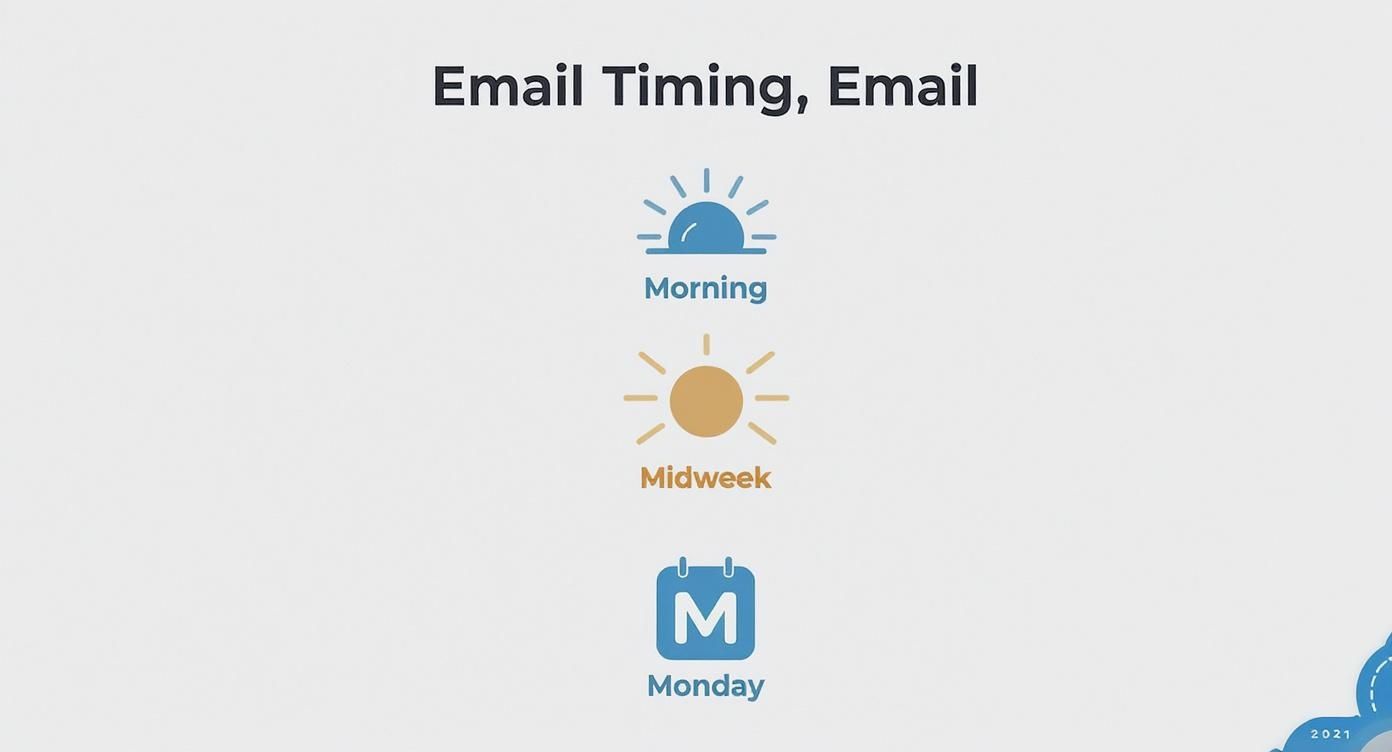
As the visual shows, early mornings and midweek days are your prime opportunities. It's all about catching someone when they're focused and ready to tackle what's in front of them.
Finding Your Foundational Send Window
While every industry and role has its own quirks, broad data gives us a powerful place to start. One of the most consistent findings is that the early morning hours just work better.
For instance, one analysis found that emails sent between 5 AM and 8 AM on a Monday hit an average reply rate of 2.3%. That might not sound like a lot, but it’s significantly higher than emails sent later in the day.
This early window is effective for a simple reason: your email is one of the first things a professional sees. They’re often clearing out their inbox with a fresh mind before the day's meetings and urgent tasks take over. By landing at the very top of their list, you dramatically increase the odds of getting an open and maybe even a thoughtful reply.
Improving your cold email response rate starts right here, with getting your timing right.
Here's a quick summary of the data-backed sweet spots for sending cold emails.
Quick Guide to High-Performing Cold Email Send Times
This table breaks down the most effective days and times, based on aggregated industry data. Use this as your starting point, but always remember to test what works for your specific audience.
| Day of the Week | Optimal Send Window (Local Time) | Why It Works |
|---|---|---|
| Monday | 5 AM – 8 AM | Catches prospects at the start of the week before their schedule fills up. Low competition. |
| Tuesday | 8 AM – 10 AM | The week is in full swing. Prospects are settled in and actively working through their inbox. |
| Wednesday/Thursday | 9 AM – 11 AM | Peak productivity days for most professionals. Emails are often addressed promptly. |
| Friday | Before 12 PM | Morning is okay, but engagement drops sharply in the afternoon as people wind down. |
While these times are backed by strong data, think of them as your baseline. The real magic happens when you start testing and tailoring this to your own campaigns.
Why Midweek Sends Consistently Win
Sending a cold email on a Monday morning might feel like you're getting a jump on the week, but the real magic happens in the middle. The heart of the professional week—Tuesday through Thursday—is the undisputed sweet spot for getting your emails opened and read. This isn't just a gut feeling; it’s a pattern tied directly to the rhythm of a typical workweek.
Think of the workweek like a short story. It has a beginning, a middle, and an end, and each part has a totally different energy. Your goal is to make sure your email lands in the right chapter.
Deconstructing the Workweek Flow
Mondays are for planning and putting out fires. Professionals are digging out from a weekend's worth of emails, jumping into kickoff meetings, and just trying to get their bearings. An unsolicited email from a stranger during this phase often feels like one more thing to deal with, not an opportunity.
On the flip side, Fridays are for winding down. By Friday afternoon, everyone's focus has shifted to tying up loose ends before the weekend. Inboxes get ignored, and the mental energy required to consider something new is pretty much gone.
The core idea is simple: You want to send your emails when people are deep in their work, not when they’re just starting their week or already mentally checking out.
The Midweek Advantage in Action
Tuesday, Wednesday, and Thursday are peak productivity. The Monday chaos has settled, but the weekend is still a distant thought. This is when people are in execution mode, and that creates the perfect window for your outreach.
This isn't just a theory; it's backed by data. Countless studies show that Tuesday, Wednesday, and Thursday consistently deliver the highest open and response rates for cold emails. If you want to dig deeper into the numbers, you can explore some great AI-powered insights on why midweek sends perform so well on AnyBiz.io.
Here’s how it breaks down:
- Tuesday: Prospects are settled in. They’re actively clearing their inbox and are receptive to messages that can help them hit their weekly targets.
- Wednesday & Thursday: These are often the most productive days of the week. People are tackling their biggest projects and are looking for solutions to immediate problems.
By timing your outreach for this midweek window, you’re aligning your message with your prospect’s mindset. Your email shows up not as a distraction, but as a potential solution right when they need it most. That strategic timing is often what turns a cold lead into a warm conversation.
Pinpointing the Golden Hours for Maximum Opens
While sending mid-week is a solid starting point, the exact hour your cold email lands is what can really move the needle. Think of it like this: you want to show up right when your prospect is most likely to be checking their inbox, not when they're swamped with other things. It’s the difference between having a real conversation and leaving a voicemail that gets forgotten.
Through tons of data and real-world testing, two specific windows have consistently proven to be the "Golden Hours" for outreach. These are the moments in a typical workday when professionals are most tuned into their email, giving your message its best shot at getting noticed.
The Early Morning Advantage
The first—and arguably most powerful—window is early in the morning, usually between 6 AM and 9 AM in your prospect’s local time. Why? Because you’re getting in at the very top of their inbox before the day's chaos really kicks off.
Most professionals start their day by scanning their email to triage tasks and set priorities. Their minds are fresh, and they're actively looking to clear out clutter. An email that arrives during this time has a much higher chance of being read and considered before back-to-back meetings and urgent projects dominate their attention.
Sending an email at 8 AM is like being the first person to speak in a meeting—you get undivided attention before the conversation gets crowded.
The data backs this up. One huge analysis of over 10 billion emails pinpointed the absolute best time for open rates as being between 8 AM and 9 AM. If you're looking for more on this, you can explore the research on high-performing send times on EmailChaser.com. Hitting this window is your single best bet for catching a prospect when they’re most receptive.
The Afternoon Wind-Down Window
If you miss the morning slot, don't worry. The second key window opens up in the mid-afternoon, from around 3 PM to 5 PM. This timing is strategic because it catches people as they start to wind down their day. They've likely tackled their biggest tasks and are often doing a final sweep of their inbox before logging off.
This creates another prime opportunity for your email to get seen. The mid-day rush is over, where your message might get quickly archived or lost in the noise. An afternoon email can feel like a welcome distraction, arriving when your prospect isn't deep in focus mode and might actually have a few minutes to consider something new.
Of course, timing is just one piece of the puzzle. Nailing the send time is crucial, but even a perfectly timed email needs a killer subject line to actually get opened. Make sure you combine a great send time with our email subject line best practices to give your outreach the best possible chance of success.
How to Adapt Send Times for Different Industries
Treating email timing with a "one-size-fits-all" approach is a fast track to a miserable reply rate. The generic advice—send midweek in the morning—is a decent starting point, but it completely falls apart when you consider the unique rhythms of different industries.
Think about it. If you email a restaurant owner at 10 AM, you’re hitting their inbox right as they’re prepping for the lunch rush. Your message is dead on arrival. Same goes for a teacher at 1 PM; that email is landing mid-lesson and getting buried.
The key is to stop hunting for a single "best time" and start thinking about your specific prospect's day. When you adapt your send time to their schedule, it shows you’ve done your homework and, more importantly, that you respect their time.

Researching Your Prospect’s Day
To really nail your timing, you need to create a "day in the life" profile for your ideal customer. This isn’t about being a private investigator; it’s about making educated guesses based on their role and industry. The goal is to map out their schedule and pinpoint those quiet moments when they might actually check their inbox with some focus.
Here are a few industry-specific examples to get you started:
- Tech Startups: Founders and developers are notorious for keeping weird hours. Early mornings (7-8 AM) can be great, but don't discount late evenings (8-10 PM) when the office has cleared out and they finally have time to think.
- Restaurants & Hospitality: Your best bet is to aim for the lulls between service. The mid-afternoon slot from 2-4 PM is often a sweet spot, right after the lunch chaos and before dinner prep kicks into high gear.
- Corporate Finance: These folks are often at their desks before the sun comes up. Sending an email before the market opens (6-8 AM) can get you in front of them before their day explodes.
- Real Estate Agents: Agents are always on the go. Try mid-mornings (10-11 AM), when they might be back at their desk catching up on admin between property viewings.
Thinking like your prospect is the most powerful optimization you can make. Ask yourself: When would they have a moment of quiet to thoughtfully consider a new email?
Building a Targeted Outreach Strategy
Once you have a solid hypothesis, the next step is building segmented lists that match these different timing strategies. This level of precision is what separates amateurs from pros. Smartly adapting send times goes hand-in-hand with smart lead generation. A modern outbound lead generation playbook will always emphasize defining your ICP and building hyper-specific lists first.
This all circles back to truly understanding who you're trying to reach. Before you even think about timing, you need to be obsessed with their pain points, goals, and daily workflow. Learning how to identify your target audience isn't just a preliminary step; it's the foundation of any campaign that actually gets replies.
When you combine deep audience knowledge with strategic timing, your cold outreach is no longer a shot in the dark. It becomes a calculated, data-informed strategy that gets results.
Testing to Find Your Perfect Send Time
Industry benchmarks are a fantastic starting point, but they're not the final word. The real truth about the best time to send cold emails is hiding in your own data.
Your audience, your product, and your unique outreach style create a situation that generic advice just can't cover. This is where A/B testing becomes your most powerful tool.
Think of it like a science experiment for your sales process. You start with a hypothesis—for example, "Sending at 7 AM will get more replies than sending at 10 AM"—and then run a controlled test to see if you're right. It takes the guesswork out and replaces it with cold, hard data.
Setting Up Your A/B Test
The golden rule of A/B testing is to change only one variable at a time. In this case, that variable is the send time. Everything else—the subject line, the email copy, the CTA, and the target audience—has to stay exactly the same for both test groups.
Ready to get started? Just follow these simple steps:
- Segment Your List: Grab a large, uniform chunk of your prospect list. Let's say, 500 VPs of Sales in the software industry. Split this list randomly and evenly into Group A and Group B.
- Schedule Campaign A: Set up your email campaign for Group A to go out on Tuesday at 7:30 AM local time.
- Schedule Campaign B: Duplicate that exact same campaign for Group B, but this time, schedule it for Tuesday at 4:00 PM local time.
- Measure and Wait: Let the campaigns run for at least a week. You need to give prospects enough time to open and reply, so don't jump to conclusions after just one day.
Tools like the EmailScout extension shown above are a lifesaver here. They help you quickly build the clean, segmented lists you need for an accurate test. A well-defined audience is the bedrock of any good A/B test.
Interpreting Your Results
Once your test is over, it’s time to compare the numbers. While open rate is a nice vanity metric, the number that really matters in cold outreach is the reply rate. A high open rate with zero replies doesn't start any conversations.
Look for a statistically significant difference. This just means the difference in your results is big enough that it's probably not due to random chance. If Group A gets a 4% reply rate and Group B gets 3.8%, the difference is likely meaningless. But if Group A hits 6% and Group B is stuck at 3%, you've found a clear winner.
Rinse and repeat this process with different days and times to keep sharpening your approach.
For a deeper dive into optimizing your outreach, exploring AI-powered lead generation strategies can show you how modern tech can enhance your entire process, including dialing in the perfect send times.
Common Questions About Cold Email Timing
Even with a solid strategy in place, a few nagging questions always seem to pop up right before you hit "send." Let's clear the air and tackle some of the most common ones so you can fine-tune your approach with confidence.

Think of your send time as the key that gets you in the door. It's crucial, but what you say once you're inside is what actually closes the deal.
Does Send Time Matter More Than the Subject Line?
This is a classic "chicken or the egg" debate in cold email. The reality? Send time, subject line, and the email copy itself are like three legs of a stool. If one is weak, the whole thing topples over.
A perfectly timed email can't save a boring subject line, and a killer subject line won't matter if it's sent at 2 AM on a Saturday. They all have to work together.
A great send time gets your email to the top of the inbox. A compelling subject line earns the open. Persuasive copy drives the reply. You need all three.
So, timing isn't more important—it's equally important. You have to nail every element, from the moment of send to the final call-to-action.
How Do I Handle Sending Emails to Different Timezones?
This is one of the biggest, yet most easily avoidable, blunders in cold outreach. Never, ever send a mass email blast based on your own timezone.
An email sent at 9 AM from your desk in New York lands at 6 AM in Los Angeles (which is good!), but it also hits London at 2 PM (not great) and Dubai at 6 PM (terrible). The solution is simple: always send based on the recipient's local time.
Modern outreach tools make this a breeze. When you set up a campaign, just look for the setting that lets you schedule sends for a specific time—say, 8:30 AM—in your prospect's timezone. This simple click ensures your "golden hour" email actually arrives during their golden hour, not yours.
What Is the Best Cadence for Follow-Up Emails?
Persistence pays, but being annoying just gets you marked as spam. A smart follow-up cadence keeps you top-of-mind without overstaying your welcome. While you should always test what works for your specific audience, a fantastic starting point is the "2-4-7" rule.
Here’s the breakdown:
- First Follow-up: Send 2 days after your initial email.
- Second Follow-up: Send 4 days after that first follow-up.
- Third Follow-up: Send 7 days after the second follow-up.
This spacing gives your prospect room to breathe but keeps the momentum going. And remember, every follow-up needs to add new value. Ditch the "just checking in" line and instead share a relevant case study, ask a different thought-provoking question, or reference another pain point.
Should I Avoid Sending Cold Emails on Weekends?
For nearly all B2B outreach, the answer is a hard yes. Steer clear of weekends and major public holidays. Professionals are checked out, and by the time Monday morning rolls around, your email will be buried under a mountain of other messages.
Sure, there are a few rare exceptions, like targeting industries that operate seven days a week. But for over 95% of campaigns, sticking to midweek business hours is your safest and most effective bet. Send your emails when people are actually in a work mindset.
Ready to find the perfect contacts for your next timed campaign? With EmailScout, you can build hyper-targeted prospect lists in minutes. Find verified email addresses for decision-makers and segment them for precise A/B testing, ensuring your perfectly timed emails reach the right people every time. Try it for free and start building your ideal outreach list today at https://emailscout.io.